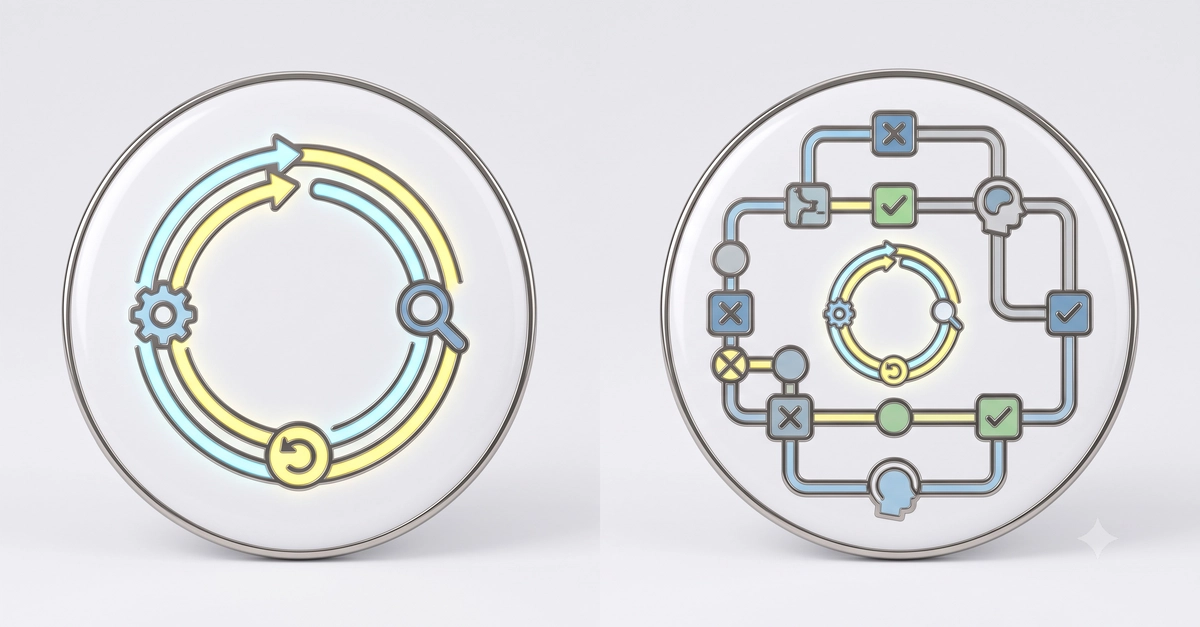
The Rise of Loop Engineering
In June 2026, the AI development landscape shifted dramatically. "Loop engineering" exploded from obscurity into the dominant conversation. Prominent figures in AI, like the creator of Claude Code and the head of OpenClaw, publicly endorsed this approach. They advised developers to move beyond simple prompts and focus on designing the loops that orchestrate AI agents. Addy Osmani, a name synonymous with pattern recognition in development, formalized the term, leading to rapid adoption and official documentation from major AI labs within days.
This sudden ubiquity wasn't without its critics. A strong counter-argument emerged, positing that loop engineering is merely a new label for existing concepts, specifically the Software Development Lifecycle (SDLC). The argument suggests that agents planning, building, testing, reviewing, and shipping code is simply the SDLC re-enacted by AI actors, not a novel paradigm.
Distinguishing Loops from Lifecycles
The core of the debate lies in understanding the fundamental difference between a 'loop' and a 'lifecycle' in the context of AI development. A loop, in this emerging terminology, refers to a self-contained, iterative process where an AI agent or a series of agents repeatedly execute a set of actions to achieve a specific goal. Think of it as a highly specialized, automated assembly line for a single task. For instance, an AI could be tasked with finding bugs in a codebase. It might execute a loop: analyze code, identify potential issues, suggest fixes, re-analyze, and repeat until no new issues are found or a predefined threshold is met.
This is incredibly powerful for rapid iteration and exploration. It allows developers to quickly test hypotheses, generate variations of solutions, or perform repetitive tasks with high throughput. The appeal is clear: faster development cycles, reduced manual effort, and the potential to uncover novel solutions through sheer volume of execution. It's the kind of pattern that shines in a sandbox, perfect for exploring a problem space or generating initial drafts.
However, the term 'lifecycle' implies a broader, more comprehensive, and often more regulated process. The traditional SDLC, for example, encompasses not just the development and testing phases but also requirements gathering, design, deployment, maintenance, and eventual decommissioning. It’s a structured journey from conception to retirement, involving distinct stages, gates, version control, rollback strategies, and human oversight at critical junctures. It’s built for reliability, maintainability, and predictability in complex, long-term systems.
When Loops Fall Short
The limitations of pure loop engineering become apparent when moving from prototype to production. Loops excel at focused, repetitive tasks. They are excellent for generating code snippets, refactoring existing code based on clear rules, or performing continuous integration-style checks. The creator of Claude Code, for example, noted that his job evolved to writing loops for specific tasks like finding and fixing bugs.
But what happens when the AI needs to make a strategic decision, integrate with external systems that have their own complex lifecycles, or adhere to strict compliance and security standards? A simple loop might get stuck in an infinite recursion if an error condition isn't perfectly defined, or it might fail to account for emergent properties of a larger system. It lacks the inherent structure for managing dependencies, handling unforeseen edge cases gracefully, or incorporating human judgment at the right moments.
Consider the process of launching a new feature. This involves more than just writing code. It requires market analysis, user feedback integration, A/B testing, phased rollouts, monitoring performance in production, and preparing for potential rollback. A loop could write the code for the feature, but it cannot, by itself, manage the entire launch process, which is inherently a lifecycle event.
The Necessity of Lifecycle Management for AI
This is where the concept of lifecycle management becomes critical for AI development, mirroring its importance in traditional software engineering. For AI systems intended for production, simply designing a loop is insufficient. We need to engineer the entire lifecycle of the AI artifact, whether it's a model, an agent, or a system built using AI components.
This lifecycle includes:
- Data Management: Sourcing, cleaning, labeling, and versioning datasets.
- Model Development & Training: Experimentation, hyperparameter tuning, and robust training pipelines.
- Testing & Validation: Rigorous evaluation against diverse metrics, bias detection, and adversarial testing.
- Deployment: Strategies for rolling out AI models and agents, including canary releases and A/B testing.
- Monitoring & Maintenance: Tracking performance, detecting drift, and retraining models as needed.
- Governance & Compliance: Ensuring ethical use, adherence to regulations, and explainability.
These stages are not easily collapsed into a single, self-executing loop. They require structured workflows, human oversight, and integration with broader organizational processes. The backlash against loop engineering is, in essence, a call to recognize that while loops are powerful tools for specific sub-tasks within AI development, they are not a replacement for the robust, structured processes that define a software lifecycle.
The Future: Integrating Loops into Lifecycles
The most effective path forward is not an "either/or" scenario but a synthesis. Loop engineering represents a significant advancement in how we can automate and accelerate specific phases of AI development. These loops can become powerful components within a larger, well-defined AI lifecycle management framework.
For instance, a loop designed to find and fix bugs could be triggered automatically as part of the testing phase in an AI-driven SDLC. An agent loop could generate multiple UI variations for a new feature, which are then fed into a broader A/B testing framework managed as part of the production deployment lifecycle. The key is to understand that loops are building blocks, not the entire edifice.
The sentiment that "loops are for prototypes, lifecycles are for production" highlights a crucial distinction. Prototypes thrive on rapid iteration and exploration, where the flexibility and speed of loops are paramount. Production systems, however, demand reliability, predictability, security, and maintainability. These qualities are the hallmarks of a well-engineered lifecycle. As AI development matures, integrating the power of automated loops into comprehensive lifecycle management will be essential for building scalable, trustworthy, and production-ready AI systems.