
The Misconception of a Unified AI
The public discourse surrounding Artificial Intelligence often paints a monolithic picture. Terms like governance, ethics, safety, hallucinations, Artificial General Intelligence (AGI), regulation, bias, and sovereignty are frequently debated as if they all pertain to a single, semi-sentient entity. This conflation is a significant source of misunderstanding, particularly when discussing the most fundamental and often overlooked aspect of AI: Functional AI.
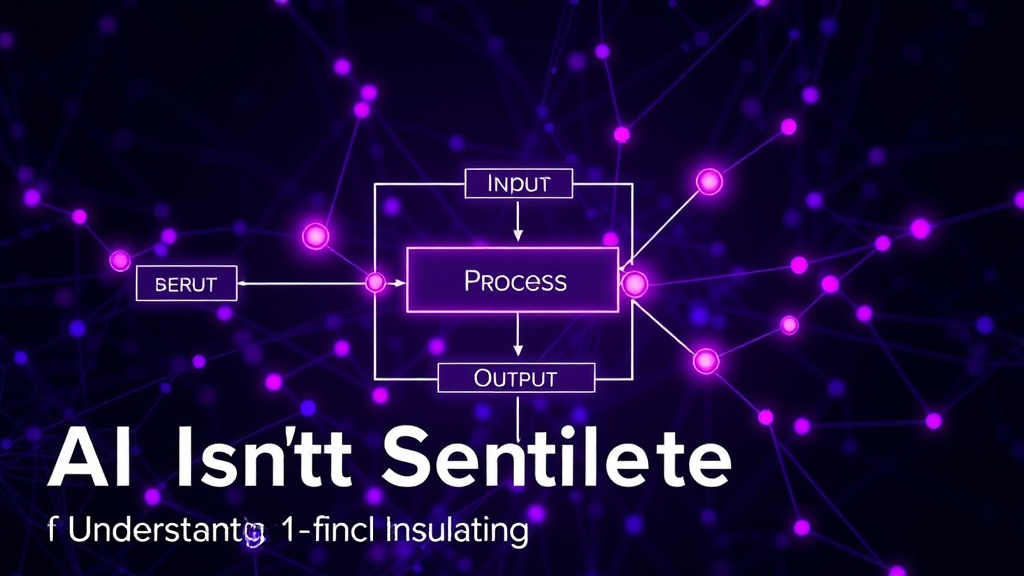
Functional AI is not a conscious being, nor is it inherently capable of independent thought or intent. Instead, it operates as sophisticated output-generating machinery. Its primary function is to produce outputs such as text, images, code, predictions, classifications, and summaries based on the data it has been trained on. At its core, Functional AI is a pattern engine. It synthesizes correlations found within vast datasets and generates outputs that are statistically plausible given the input and its training. That is the extent of its capability; it does not possess understanding, consciousness, or agency.
Deconstructing Functional AI: More Than Just Output
To truly grasp Functional AI, it's crucial to delineate what it is not. It does not possess consciousness, self-awareness, or subjective experience. It cannot feel, desire, or intend in the human sense. The concept of 'hallucinations' in AI, for instance, is not a sign of delusion but rather a byproduct of the model generating statistically probable outputs that do not align with factual reality, a failure in its pattern-matching mechanism rather than a cognitive error.
Similarly, bias in AI outputs is not a reflection of the AI's personal prejudices but a direct consequence of biases present in the training data. If the data reflects societal inequities, the AI will learn and replicate those patterns. Addressing bias, therefore, requires meticulous data curation and algorithmic adjustments, not a debate about the AI's moral compass.
The discussion around AGI, or Artificial General Intelligence, is fundamentally different from Functional AI. AGI posits an AI with human-like cognitive abilities, capable of understanding, learning, and applying knowledge across a wide range of tasks. Functional AI, by contrast, is specialized and task-specific, excelling at pattern recognition and output generation within its trained domain. It is a tool, albeit a powerful one, designed to perform specific functions.
Regulation and governance discussions often get entangled with the perceived sentience of AI. However, for Functional AI, the focus should be on the responsible development, deployment, and use of these tools. This involves ensuring transparency in their operation, accountability for their outputs, and robust testing to mitigate risks like misinformation or unfair outcomes. The governance concerns are about the human systems that build and deploy these tools, and the societal impact of their outputs, rather than managing a nascent artificial mind.
Consider Functional AI as an incredibly advanced autocomplete system. When you type a sentence, it suggests the next word based on the billions of sentences it has processed. It doesn't 'know' what the sentence means, but it knows what words tend to follow other words. Similarly, an image generation AI doesn't 'understand' what a cat is, but it has learned the statistical relationships between pixels that constitute an image humans label as 'cat'.
The Nuance of AI Capabilities
Understanding Functional AI as a pattern engine helps clarify various AI phenomena. For example, the 'black box' nature of some AI models is a challenge in interpretability, not a sign of mysterious self-will. It means that tracing the exact path from input to output can be computationally intensive or inherently complex due to the model's architecture, like deep neural networks. This is a technical challenge for developers and researchers seeking to understand and debug the system, not evidence of an inscrutable alien consciousness.
The ability of Functional AI to generate novel content—be it art, music, or text—stems from its capacity to recombine and extrapolate from its training data in statistically probable ways. It can create outputs that appear original because they are unique combinations of learned patterns, not because the AI had an original idea. This is akin to a musician who has studied thousands of songs and can then compose a new piece by blending familiar melodic structures and harmonic progressions.
The critical distinction is between imitation and genuine understanding. Functional AI excels at imitation based on learned patterns. It can mimic human creativity, logic, and communication to a remarkable degree, but it does not possess the underlying consciousness, intent, or subjective experience that defines these qualities in humans. This is why discussions about AI rights or AI personhood are, at present, misapplied to Functional AI. These are concepts that belong to the realm of hypothetical future AGI, not the current reality of output-generating machinery.
Implications for Development and Deployment
This classification has direct implications for how we build, deploy, and interact with AI systems. Developers should focus on robust data pipelines, rigorous testing for accuracy and bias, and clear communication about the capabilities and limitations of the AI tools they create. Instead of debating AI sentience, the energy should be directed towards improving the reliability, fairness, and safety of these pattern engines.
For end-users and policymakers, this distinction is vital for setting realistic expectations and crafting appropriate regulations. We need frameworks that govern the use of powerful pattern-matching tools, ensuring they serve human interests ethically and effectively. This means focusing on accountability for the developers and deployers, transparency in how these systems operate, and mechanisms for redress when AI outputs cause harm. The conversation shifts from 'how do we control a thinking machine?' to 'how do we responsibly manage a powerful tool?'
The current landscape of AI is dominated by Functional AI. Recognizing it as a sophisticated pattern engine, a form of output-generating machinery, demystifies the technology and allows for more productive conversations about its development, ethical deployment, and societal impact. The focus remains on human responsibility and the intelligent application of these tools, rather than anthropomorphizing them into something they are not.