AI Image Generation Cost Benchmark Expands to 33 Models
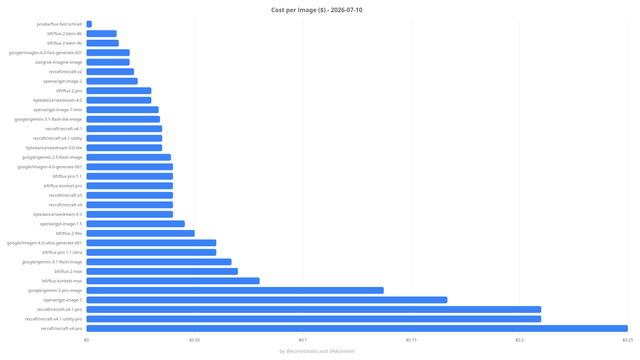
A comprehensive cost analysis of AI image generation models has been updated, now encompassing 33 distinct models and providers. This benchmark, initially covering 22 models, provides crucial data for developers, creators, and businesses evaluating the financial implications of integrating AI image generation into their workflows. The latest iteration includes additions such as Seedream models, Gemini 3.1 Flash Lite Image, and GPT Image 1.5, offering a broader spectrum of pricing and performance metrics.
The analysis highlights a significant disparity in pricing, with the cheapest model remaining Flux Fast Schnell at an astonishing $0.0025 per image. Conversely, Recraft 4 Pro holds its position as the priciest option at $0.25 per image. This 100x difference underscores the importance of careful model selection based on budget and usage requirements.
The benchmark is more than just a price list; it also incorporates latency comparisons, providing a more holistic view of model performance. Understanding both cost and speed is critical for applications requiring real-time or high-volume image generation. The original analysis, which served as a precursor to this expanded report, demonstrated that the cheapest models often offered competitive latency, suggesting that cost-effectiveness does not necessarily equate to sluggish performance.
The expansion to 33 models provides a more robust dataset for identifying trends and outliers in the rapidly evolving AI image generation market. Providers are constantly updating their models, introducing new pricing tiers, and optimizing performance. This continuous flux makes regular benchmarks essential for staying informed.
Key Findings: Price Extremes and Latency Considerations
The stark contrast between Flux Fast Schnell and Recraft 4 Pro at the two ends of the pricing spectrum is a primary takeaway. Flux Fast Schnell's ultra-low cost makes it an attractive option for high-volume, budget-sensitive applications. This could include internal tools, rapid prototyping, or scenarios where image fidelity is secondary to sheer output quantity.
On the other end, Recraft 4 Pro's premium pricing suggests it may offer superior quality, specialized features, or advanced customization options that justify the higher cost for professional or enterprise-level use cases. The report's full details, available on the author's blog, allow for a granular examination of where each model falls within this range.
Latency, often as critical as cost, is also detailed. While the specific latency figures for all 33 models are not detailed in the initial announcement, the inclusion of this metric alongside cost is a significant advantage. For instance, an application that requires instant image generation for user-facing features would prioritize low latency, even if it comes at a slightly higher cost than the absolute cheapest options. Conversely, batch processing for marketing materials might tolerate higher latency if the cost savings are substantial.
The inclusion of models like Gemini 3.1 Flash Lite Image and GPT Image 1.5 indicates a trend towards multimodal or integrated AI solutions. These models often leverage large language models for prompt understanding and then translate that into image generation, potentially offering more intuitive user experiences but also introducing new cost structures that need careful evaluation.
Navigating the AI Image Generation Landscape
The sheer number of models and providers means that manual comparison is becoming increasingly impractical for businesses. Benchmarks like this one serve as vital tools for making informed decisions. Developers can use this data to select the most cost-effective model for their specific application, balancing generation cost against required image quality and response time.
For founders, understanding these cost dynamics is crucial for financial planning and pricing strategies. The difference between generating thousands and millions of images can have a profound impact on operational expenses and profitability. Choosing the right model can be the difference between a sustainable AI-powered product and one that quickly becomes prohibitively expensive.
Creators and artists might find value in exploring the mid-range options, which could offer a balance of cost, quality, and unique stylistic capabilities. The benchmark helps demystify the often-opaque pricing structures of AI services, empowering users to make data-driven choices rather than relying on guesswork or vendor claims.
The continued evolution of AI image generation technology means that this landscape will keep shifting. New models will emerge, existing ones will be updated, and pricing strategies will undoubtedly change. This ongoing analysis provides a valuable snapshot, but it also points to the need for continuous monitoring and re-evaluation of AI infrastructure choices.
What remains unaddressed by such benchmarks, however, is the long-term strategic impact of choosing a vendor whose pricing might be aggressive now but could increase significantly once lock-in is established. Users must also consider the ethical implications and potential biases inherent in different models, factors that cost analysis alone cannot capture.