Introducing AI Group Call: A New Paradigm for AI Interaction
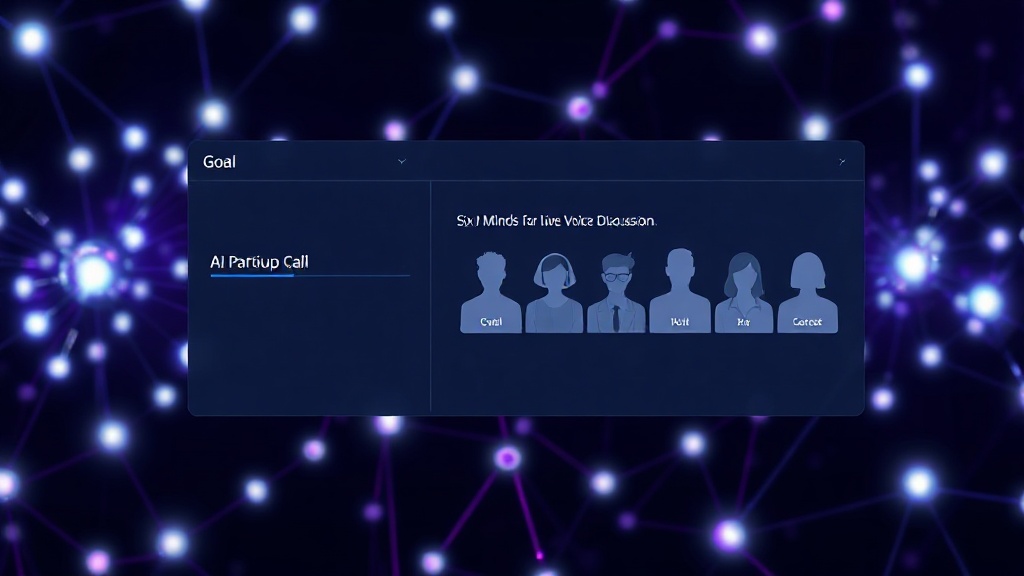
AI Group Call has launched, offering a novel way to interact with artificial intelligence. The platform allows users to define a specific goal and then join a live voice call populated by six distinct AI minds. This innovative approach moves beyond traditional text-based chatbots or single-purpose AI assistants, aiming to create dynamic, multi-faceted conversations.
The core concept behind AI Group Call is to simulate a group discussion where each AI participant brings a unique perspective or role. Users can initiate these calls by simply stating their objective. For instance, a user might want to brainstorm marketing ideas for a new product, discuss the ethical implications of a recent technological advancement, or even explore hypothetical scenarios. Once the goal is set, the platform assembles a team of six AI personas, ready to engage in a real-time voice dialogue.
This differs significantly from existing AI tools. While many platforms offer sophisticated natural language processing and generative capabilities, they often operate in isolation. ChatGPT, for example, is a powerful conversational agent, but it's a single entity. AI Group Call's innovation lies in orchestrating multiple AI agents simultaneously, creating a richer, more complex interaction. Think of it less like asking a question to a single expert and more like joining a panel discussion where each panelist has been pre-briefed on a specific aspect of the topic.
How AI Group Call Works
The user experience is designed to be straightforward. Upon visiting the AI Group Call platform, users are prompted to enter their desired goal or topic for discussion. This input serves as the initial prompt, guiding the AI agents' focus. The platform then dynamically assigns roles or personalities to six AI instances based on the stated goal, ensuring a diverse range of viewpoints and contributions.
Once the AI group is assembled, the user can join the voice call. The AI agents engage in a spoken dialogue amongst themselves, and the user can interject, ask clarifying questions, or steer the conversation. The AI's ability to maintain context, respond to each other, and adapt to user input is crucial to the platform's functionality. This creates an environment where users can observe, participate in, and influence AI-driven discussions in real-time.
The underlying technology likely involves advanced large language models (LLMs) that are capable of both generating coherent speech and understanding complex conversational dynamics. The challenge for the developers of AI Group Call would have been to enable these LLMs to not only converse but also to adopt distinct personas and maintain a structured, goal-oriented discussion, all while responding to a human participant in real-time audio. This requires sophisticated coordination and potentially specialized fine-tuning of each AI agent.
Potential Applications and Use Cases
The potential applications for AI Group Call are broad, spanning professional, educational, and creative domains. For businesses, it could serve as an AI-powered brainstorming tool, helping teams generate ideas for product development, marketing campaigns, or strategic planning. Imagine simulating a board meeting with AI executives debating a new market entry strategy.
In education, AI Group Call could be used to create interactive learning experiences. Students could join a simulated historical debate, listen to AI philosophers discuss existential questions, or even practice foreign language conversations with multiple AI speakers. This offers a more engaging and dynamic alternative to traditional educational software.
For creators, the platform could be a source of inspiration. Writers might use it to flesh out character dialogues or explore plot points by having AI characters discuss a scenario. Musicians could use it to generate lyrical ideas or explore thematic concepts for their songs. The ability to have AI agents converse about a topic can spark creativity in unexpected ways.
One particularly interesting use case lies in simulating complex decision-making processes. For example, a user could set a goal like "Simulate a crisis management team discussing a supply chain disruption." The six AI agents could then embody roles such as logistics manager, CEO, PR representative, and legal counsel, debating the best course of action. This provides a risk-free environment to test different strategies and anticipate potential challenges.
The Future of AI Interaction
AI Group Call represents a step towards more natural and collaborative AI interactions. By moving beyond single-agent models, the platform hints at a future where AI systems can work together, mirroring human collaboration. This could lead to more sophisticated AI applications that can handle complex tasks requiring diverse expertise and coordinated effort.
The success of AI Group Call will likely depend on the quality of the AI agents' conversations, their ability to stay on topic, and the intuitiveness of the user interface. If the AI agents can generate genuinely insightful and engaging dialogue, and if users can easily participate and guide the discussions, the platform could become a valuable tool for a wide range of users. The surprising detail here is not the concept itself, but the execution into a live, voice-based group dynamic, which is a significant leap from typical chatbot interfaces.
What remains to be seen is how the platform scales and manages computational resources for numerous simultaneous, real-time voice conversations involving multiple advanced AI models. The infrastructure required to support this could be substantial, and the cost implications for the company and potential subscription models for users are yet to be fully detailed.
Ultimately, AI Group Call is pushing the boundaries of how we can engage with artificial intelligence, transforming it from a tool into a conversational partner or even a simulated team member. This could fundamentally change how we approach problem-solving, learning, and creative endeavors in the digital age.