The Real AI Incident Root Cause: Oversight, Not Just Output
The narrative around AI failures often centers on the model itself—a hallucination, a biased output, or a nonsensical response. While these are critical issues, they represent only one facet of AI risk. The more pervasive threat, and the one that escalates into major incidents, lies in the governance of the systems *around* the AI. As AI tools become embedded in every layer of engineering workflows—from IDE code suggestions to customer support bots and autonomous agents—the complexity of managing them explodes. Getting AI into production is deceptively simple. Keeping it reliable, secure, and manageable post-deployment is the enduring challenge.
Consider a growing engineering team. Initially, integrating a few AI tools feels straightforward. Developers use an AI assistant for code completion, perhaps an LLM for drafting documentation. Support teams leverage AI for ticket summarization. Analysts connect AI to internal databases for insights. As adoption accelerates, the landscape shifts. Suddenly, you’re managing dozens of AI models, multiple LLM providers, various prompt engineering tools, and an array of AI agents that can interact with production systems or invoke specific APIs. The simple questions—which AI can access what, who approved which tool, what data is being used—become monumental challenges to answer accurately and consistently.
This is where AI governance transitions from a theoretical concern to a practical necessity for scaling engineering operations. It’s not about stifling innovation; it’s about building a framework that allows for rapid AI adoption while mitigating the inherent risks. Think of it less like locking down a powerful new tool and more like setting up clear, well-marked highways for autonomous vehicles—defining lanes, speed limits, and emergency protocols to ensure safe and efficient transit.
Building the AI Governance Framework: Guardrails, Budgets, and Audits
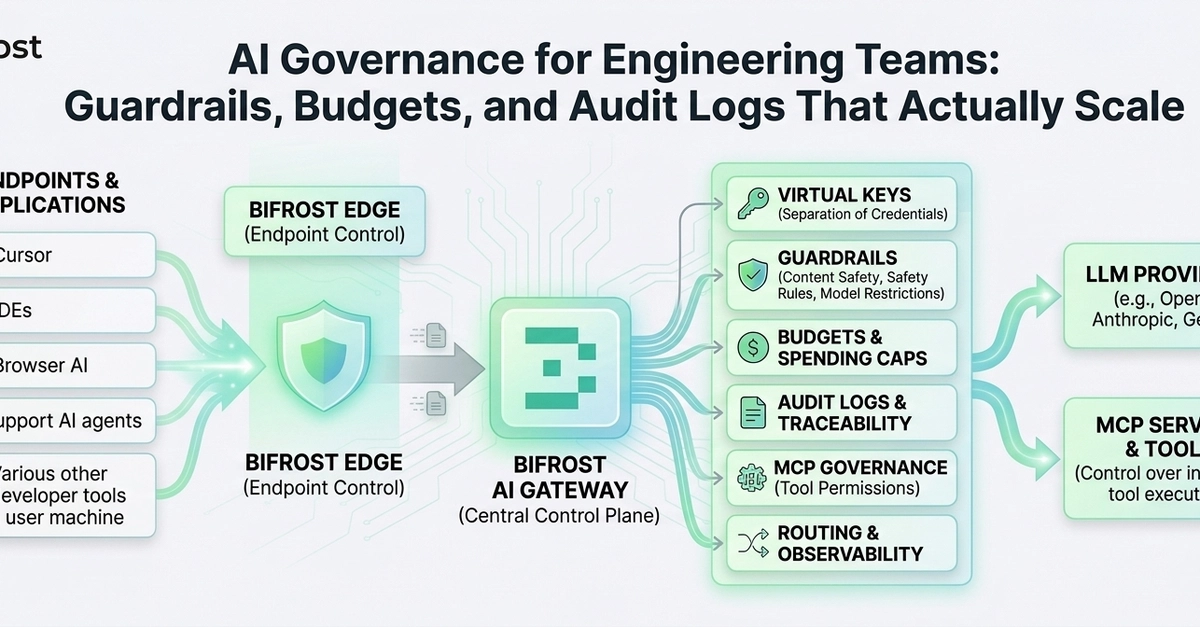
Effective AI governance for engineering teams hinges on three core pillars: guardrails, budget management, and comprehensive audit logs. Each plays a distinct but interconnected role in ensuring AI systems operate within defined boundaries and remain accountable.
Implementing Effective Guardrails
Guardrails are the operational boundaries that prevent AI systems from deviating into risky or unauthorized behavior. These aren't just abstract policies; they need to be technically enforceable. For LLMs, this means implementing content moderation filters, defining acceptable prompt/response patterns, and establishing strict access controls for sensitive data. For AI agents, guardrails dictate which specific tools or APIs they are permitted to invoke. For instance, an AI agent tasked with database querying should never be allowed to execute arbitrary code or modify production schemas without explicit, multi-stage approval. This requires a granular understanding of the AI's capabilities and the potential downstream impact of its actions. Developers need to define these rules based on the principle of least privilege, ensuring an AI tool or agent has only the permissions necessary for its intended function.
Managing AI Budgets and Resource Allocation
The cost of AI, particularly with large language models and complex agentic workflows, can escalate rapidly. Unmonitored API calls, inefficient prompt design, or redundant model usage can lead to significant, often unexpected, expenditures. Effective governance requires treating AI resources like any other critical infrastructure with a defined budget. This involves:
- Cost Tracking: Implementing systems to monitor API usage, token consumption, and compute resources per project, team, or individual AI application.
- Budget Allocation: Assigning budgets to specific AI initiatives and setting alerts for approaching or exceeding limits.
- Optimization Strategies: Encouraging or enforcing the use of more cost-effective models where appropriate, optimizing prompt lengths, and caching frequent responses.
- Resource Quotas: For certain high-cost operations or experimental features, setting hard quotas to prevent runaway spending.
This financial oversight is crucial not only for cost control but also for signaling the value and impact of AI investments. It forces teams to be deliberate about AI adoption and resource utilization.
The Necessity of Comprehensive Audit Logs
When an incident does occur, or even for routine compliance checks, the ability to trace AI actions is paramount. Comprehensive audit logs serve as the system's memory. They should capture:
- Who initiated an AI action (user, agent ID).
- What action was taken (prompt, tool invocation, model used).
- When the action occurred.
- What data was accessed or processed.
- What was the outcome (response, error, system change).
- What guardrails were applied or bypassed.
These logs are not merely for retrospective analysis. They are vital for proactive monitoring, identifying patterns of misuse or malfunction, and providing evidence for post-incident reviews. Without detailed, immutable audit logs, debugging AI issues becomes a guessing game, and establishing accountability is impossible. The surprising detail here is not the complexity of the logs themselves, but how often they are an afterthought, leading to significant blind spots when problems arise.
Scaling AI Governance: From Ad Hoc to Integrated Systems
The challenge with AI governance is its tendency to remain an ad hoc, manual process in early stages of adoption. As AI integration scales, this approach breaks down. Teams need to move towards integrated, automated governance solutions. This means embedding guardrail enforcement directly into CI/CD pipelines for AI-generated code or AI-powered features. It means integrating cost monitoring into development dashboards and budget planning tools. It means ensuring that audit log generation is a default setting for all AI interactions, not an optional configuration.
What nobody has addressed yet is the long-term cultural shift required. Engineering teams must view AI governance not as an impediment, but as an essential component of responsible AI development and deployment. This requires training, clear communication of policies, and tooling that makes adherence easy and non-compliance difficult. The goal is to make secure, reliable, and cost-effective AI usage the default path for every developer and every AI agent.