The Silent Rot of AI Evaluation Oracles
We frequently discuss model drift and agent drift in AI systems. However, a critical and often overlooked failure mode is the decay of the evaluation benchmarks themselves. Your "golden dataset" – the curated set of fixtures, expected outputs, and "known good" traces used to grade agent performance – is essentially production code. When this code ships and then goes unreviewed, it rots. This silent decay means a green dashboard no longer signifies that your AI agent is performing correctly; it signifies that the agent still aligns with a snapshot of the world captured months, or even years, ago.
This is a failure mode that senior teams repeatedly rediscover the hard way. The agent might be functioning as intended, the underlying harness might be sound, but the test oracle is what has become inaccurate. The problem is insidious because passing tests often feels like the definitive end of the story, rather than a claim that, like all code, also decays over time.
Why Golden Datasets Rot
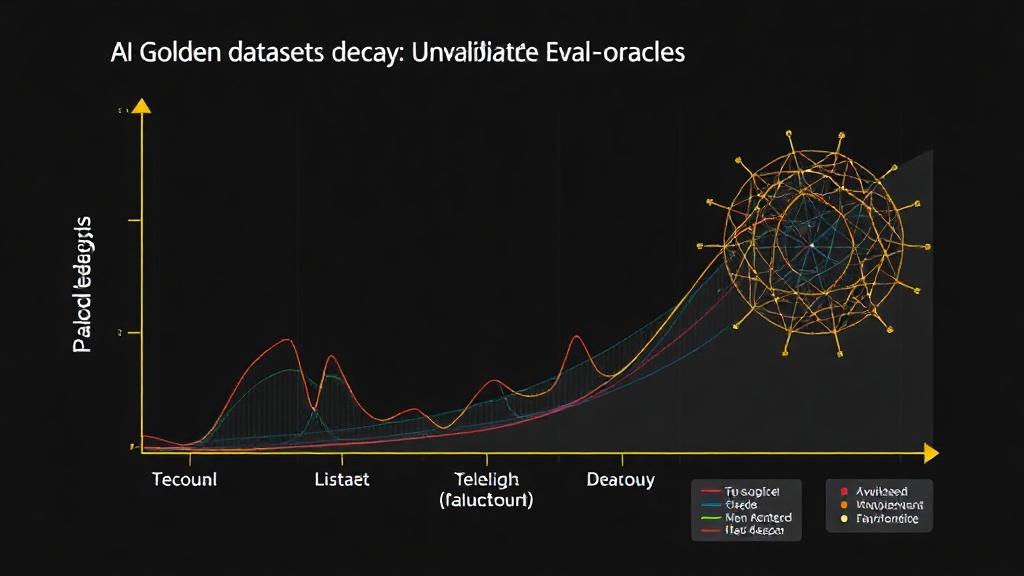
A golden dataset is a time capsule. It encodes assumptions about the world, APIs, data formats, and expected behaviors at the precise moment it was captured. Months later, these assumptions often become obsolete:
- API Changes: The structure or content of an API response you rely on may change. Your "expected output" then becomes mismatched, not because your agent is wrong, but because the API has evolved. For instance, a user profile API might add new fields or deprecate old ones, invalidating pre-recorded responses.
- Data Distribution Shifts: The real-world data distribution your AI encounters can drift. User behavior changes, new trends emerge, or external factors alter the input landscape. A dataset captured during a stable period will not reflect these new realities, leading to agents that perform well on stale data but poorly in production.
- Schema Evolution: The underlying data schemas for your application or its dependencies can change. This affects how data is stored, retrieved, and interpreted, rendering pre-defined expected outputs incorrect.
- External System Changes: Dependencies on other services or systems can introduce rot. If an external system's behavior changes in a way not anticipated when the golden dataset was created, your evaluation will be flawed.
- Human Labeling Drift: Even human-annotated datasets can suffer from "labeler drift." Over time, annotators may develop slightly different interpretations or biases, or the guidelines themselves might be implicitly updated through ongoing discussions, leading to inconsistencies with the original labeled data.
- Software Updates: Updates to libraries, frameworks, or even the operating system can alter subtle behaviors, such as floating-point arithmetic or string parsing, which might invalidate exact string matches or numerical comparisons in your golden dataset.
The core issue is that these datasets are treated as static artifacts rather than dynamic components of a production system. They are the silent judges, and if the judges are out of date, the verdicts are meaningless. This problem is particularly acute in complex systems like large language models (LLMs) or sophisticated agentic workflows, where the state space and potential interactions are vast and constantly evolving.
The Illusion of Stability
The danger lies in the perceived authority of a "golden" dataset. When tests consistently pass, teams gain confidence. This confidence is often misplaced, creating a false sense of security. The green checkmarks become a comforting illusion, masking the reality that the system's performance against the real world has likely degraded. This is akin to a ship captain navigating by a map that hasn't been updated since the last major continental shift; the instruments might read fine, but the destination is long gone.
This problem is not unique to AI. In traditional software development, regression tests are crucial. However, the expectation is that these tests are maintained, updated, and re-validated as part of the development lifecycle. For AI evaluation datasets, this maintenance step is frequently skipped. The effort of creating the initial dataset is substantial, and the idea of re-validating it, especially when it involves complex data collection, human annotation, or intricate system interactions, can seem daunting. Furthermore, the very nature of AI makes defining "correctness" more fluid than in deterministic software, making re-validation even more challenging.
Re-Validation Strategies for Robust AI
Addressing the rotting oracle problem requires a shift in mindset and process. These evaluation datasets must be treated with the same rigor as production code. Several strategies can help maintain their validity:
- Regular Re-evaluation Cadence: Establish a schedule for re-validating the golden dataset. This could be time-based (e.g., quarterly) or event-driven (e.g., after significant model updates or API changes).
- Automated Drift Detection: Implement monitoring for changes in input data distributions or API response patterns that are likely to invalidate existing test cases. This can flag potential issues before they cause widespread false positives.
- Version Control for Datasets: Treat your golden datasets like code. Store them in version control systems (like Git LFS or dedicated data versioning tools) to track changes, revert to previous states if necessary, and audit modifications.
- Human-in-the-Loop for Oracle Updates: For datasets involving subjective evaluations or complex data, incorporate a human-in-the-loop process for reviewing and updating expected outputs. This process should be as rigorous as the initial data annotation.
- Sampling Production Data: Periodically sample production data that the agent has successfully handled and use it to augment or update the golden dataset. This ensures the oracle reflects current real-world conditions.
- Focus on Relative Performance: While absolute correctness is the goal, a practical approach can be to focus on tracking relative performance improvements or degradations over time. If a new agent version performs significantly worse on a re-validated subset of the oracle, it's a clear signal of regression.
- Test Harness Self-Checks: Build checks into the evaluation harness itself. For example, if a test case consistently fails due to an API change, the harness should ideally flag this as a potential oracle issue rather than just a test failure.
The challenge is not just technical but cultural. It requires engineering teams to view evaluation datasets not as a final deliverable, but as a living, breathing component of the AI lifecycle that demands continuous attention. Without this diligence, the dashboards that promise certainty will instead deliver a dangerous illusion, leading teams down paths of misguided optimization and deployment.