Applied AI Frameworks Gain Traction in Production
The landscape of applied Artificial Intelligence is rapidly maturing, with frameworks like Retrieval Augmented Generation (RAG), AI agents, and AI-powered code security moving from research labs into production environments. This week highlights practical implementations across these domains, signaling a shift towards more robust and integrated AI solutions for complex enterprise workflows.
RAG for Enhanced Knowledge Bots with Laravel and pgvector
Retrieval Augmented Generation (RAG) is proving to be a powerful technique for creating more informed and context-aware AI applications. A notable implementation details how to build a knowledge-base chatbot using RAG within a Laravel application, leveraging the capabilities of pgvector for efficient similarity search. This approach allows chatbots to access and synthesize information from a defined knowledge base, moving beyond the limitations of pre-trained models alone.
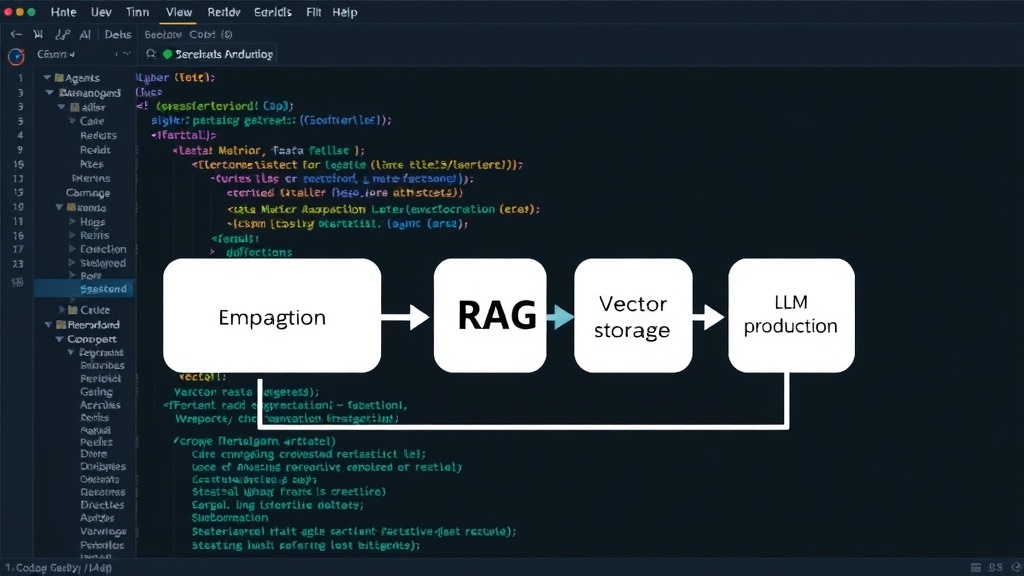
The core of this RAG implementation involves several key components:
- Data Ingestion: Documents and data are processed, chunked, and converted into vector embeddings.
- Vector Database: These embeddings are stored and indexed in a vector database like pgvector, which is an extension for PostgreSQL. This allows for rapid semantic searching.
- Querying: When a user asks a question, the query is also converted into an embedding.
- Retrieval: The system searches the pgvector database for the most semantically similar document chunks to the query embedding.
- Augmentation and Generation: The retrieved document chunks are then passed, along with the original query, to a Large Language Model (LLM). The LLM uses this augmented context to generate a more accurate and relevant answer.
This method ensures that the chatbot's responses are grounded in specific, verifiable information, making it ideal for internal documentation, customer support, or any application requiring access to a curated knowledge set. The choice of Laravel provides a robust PHP framework for backend development, while pgvector offers a scalable and familiar SQL-based solution for vector storage.
Advancements in AI Agent Orchestration and Discovery
The development of sophisticated AI agents capable of performing complex tasks is another frontier seeing significant progress. A new resource discovery specification is emerging, aimed at improving the orchestration of these agents. This specification seeks to standardize how AI agents can discover, access, and utilize various tools and services available in their environment.
Think of AI agents like highly specialized digital assistants. Without a standardized way to discover what tools are available (like a calculator, a database query tool, or an external API), they operate in isolation. This new specification aims to create a common language and protocol for agents to:
- Discover Available Tools: Agents can query a registry or service to find functions, APIs, or other agents they can leverage.
- Understand Tool Capabilities: Each tool or service will have a clear description of its function, inputs, and outputs, enabling agents to make informed decisions about its use.
- Securely Access Resources: The specification will likely include mechanisms for authentication and authorization, ensuring agents only access resources they are permitted to use.
This standardization is crucial for building complex multi-agent systems and for enabling agents to interact seamlessly with existing software infrastructure. It moves towards a future where agents can dynamically adapt their strategies based on the resources they can discover and employ.
AWS Introduces Agentic Code Security Service
The application of AI to critical enterprise functions, such as code security, is accelerating. Amazon Web Services (AWS) has introduced a new agentic code security service that leverages AI to identify and remediate vulnerabilities within codebases. This service represents a significant step in automating security practices and reducing the burden on development and security teams.
The service operates by employing AI agents that can:
- Scan Codebases: Agents analyze code for known vulnerability patterns, suspicious logic, and deviations from secure coding practices.
- Identify Potential Risks: Beyond simple pattern matching, these agents can infer potential security risks based on code context and behavior.
- Suggest and Automate Remediation: Crucially, the agents can propose fixes for identified vulnerabilities and, in some cases, automatically apply them, streamlining the security patching process.
The surprising detail here is not just the introduction of AI for code security, but the emphasis on agentic capabilities. This implies a level of autonomy and contextual understanding that goes beyond traditional static analysis tools. These agents can potentially learn from past findings and adapt their detection mechanisms, making them more effective over time. This move by AWS signals a broader trend towards embedding AI directly into the software development lifecycle (SDLC) to proactively enhance security.
What nobody has addressed yet is the long-term impact of such agentic security tools on the skills required for security professionals. Will their role shift from manual analysis to supervising and training these AI agents?
The Convergence of RAG, Agents, and Security
The convergence of these three areas—RAG, AI agents, and AI-driven security—points towards a future where AI is deeply embedded in software development and operations. RAG enhances the intelligence and context-awareness of AI systems, agents provide the capability for autonomous action and complex task execution, and AI security services ensure the integrity and safety of the software itself.
For developers, this means access to more powerful tools for building intelligent applications and for securing their code. For security professionals, it signals a transformation in how vulnerabilities are detected and mitigated. For businesses, it represents an opportunity to accelerate innovation while maintaining robust security postures. The practical applications emerging this week are not just theoretical exercises; they are becoming integral components of modern software engineering.