The Deletion Paradox in AI Memory
The industry narrative is clear: AI should remember more. Longer context windows, persistent memory, and sophisticated knowledge graphs are the holy grail. Yet, a contrarian question looms large: when an AI is asked to delete user data, can it prove it actually forgot? The answer, more often than not, is no. This isn't just a technical challenge; it's a burgeoning legal problem with a ticking clock.
Regulations like GDPR Article 17 and India's DPDP Act 2023 grant users a fundamental right to erasure. The European Data Protection Board has even designated this right as a coordinated enforcement priority for 2026. Simultaneously, the industry is doubling down on technologies like vector stores and knowledge graphs, systems inherently designed for comprehensive memory, generalization, and cross-referencing. This creates an uncomfortable tension. When a user invokes their right to be forgotten, what has truly happened under the hood?
The process of 'forgetting' in current AI systems is far from a simple deletion. It often involves marking data for eventual garbage collection, removing it from active indexes, or simply making it inaccessible through the primary user interface. Crucially, the underlying data might still exist in backups, training datasets, or intermediate processing logs. Proving complete erasure, especially from complex, distributed systems, is a monumental task.

Building Lethe: An AI Polygraph
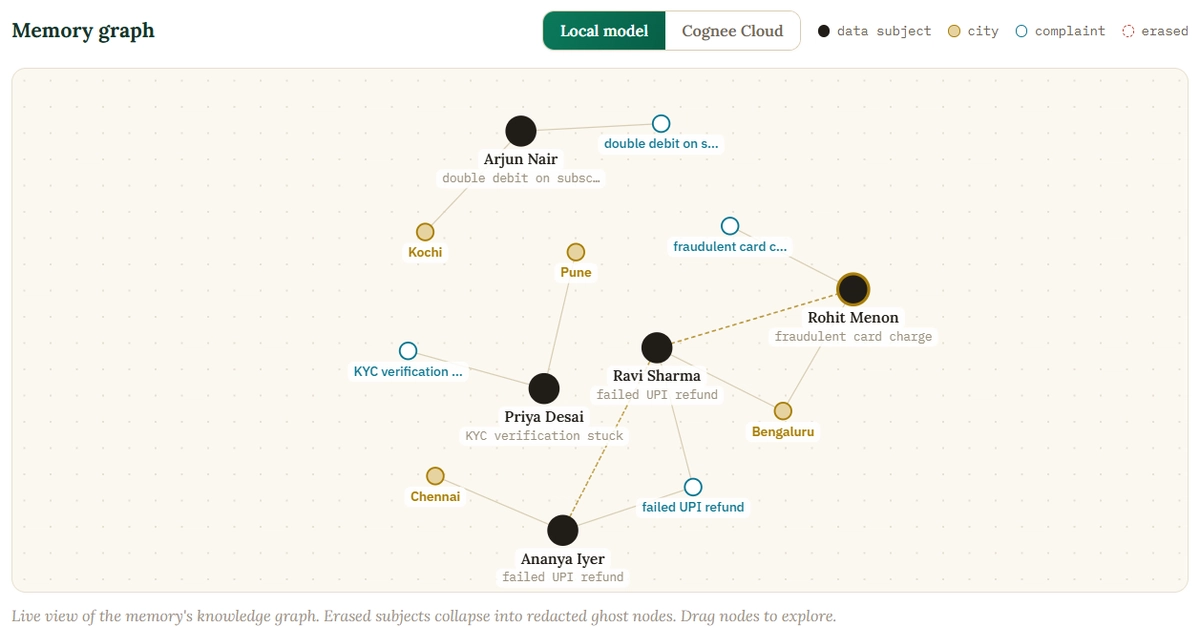
To explore this challenge, Suchita Yerramsetti built Lethe, a project conceptualized during a Cognee hackathon. Lethe acts as a 'polygraph for AI memory,' designed to interrogate AI systems about their data deletion practices. The core idea is to go beyond surface-level 'forget' commands and probe the AI's actual data handling mechanisms. Can the AI provide verifiable proof that specific user data has been irrevocably expunged, not just hidden or deprioritized?
The implications of this 'deletion paradox' are significant. If an AI system cannot definitively prove it has erased a user's data upon request, it directly contravenes data privacy regulations. This lack of verifiable erasure creates a compliance gap. For companies operating globally, especially those handling data from European citizens, this gap represents a substantial legal and financial risk. The European Data Protection Board's focus on the right to erasure in 2026 means that current, often-opaque, deletion practices will likely face intense scrutiny.
Consider the architecture of modern AI systems. Data is often ingested, processed, and stored across multiple services and databases. Vector databases, crucial for large language models (LLMs), store data in high-dimensional spaces. When a user requests deletion, the system might remove the vector embedding and associated metadata. However, the original source data, or even the embedding itself, could persist in other forms. Backups, disaster recovery systems, and even historical training data used to fine-tune models can all contain remnants of data that should have been erased.
The Legal and Technical Chasm
The problem is twofold: a technical inability to guarantee complete erasure and a legal requirement for demonstrable proof. Current AI development prioritizes learning and recall, not verifiable non-retention. This is akin to building a library where books are added constantly but never truly removed, only moved to less accessible shelves. The legal frameworks, however, demand that books requested for removal vanish entirely, leaving no trace.
What nobody has fully addressed yet is the burden of proof. Regulations grant the right to erasure, but they don't always prescribe the technical mechanisms for proving it. Developers are left in a precarious position: build complex, potentially performance-impacting systems to ensure absolute deletion, or risk non-compliance. The latter is a dangerous gamble, especially with regulatory bodies actively signaling their intent to enforce these rights.
The project Lethe highlights a critical need for new tools and methodologies. We need systems that can audit AI memory, verify data deletion, and provide auditable logs. This is not merely about privacy; it's about trust. Users must be able to rely on the promise that their data can be removed when they no longer consent to its use or storage. Without verifiable erasure, the very foundation of user consent in the age of AI erodes.
The current state of AI development is heavily focused on enhancing capabilities, often at the expense of robust data lifecycle management, particularly the 'end-of-life' phase for user data. This oversight is not sustainable. As AI becomes more integrated into every facet of our digital lives, the ability to prove data erasure will transition from a niche technical concern to a fundamental legal and operational requirement.
If your organization relies on AI systems that process user data, you have a direct responsibility to investigate your current deletion protocols. The question is not *if* regulators will scrutinize your data deletion practices, but *when*. Building systems that can provide cryptographic proof or immutable audit trails of data deletion is no longer optional. It is a prerequisite for operating legally and ethically in the evolving AI landscape.