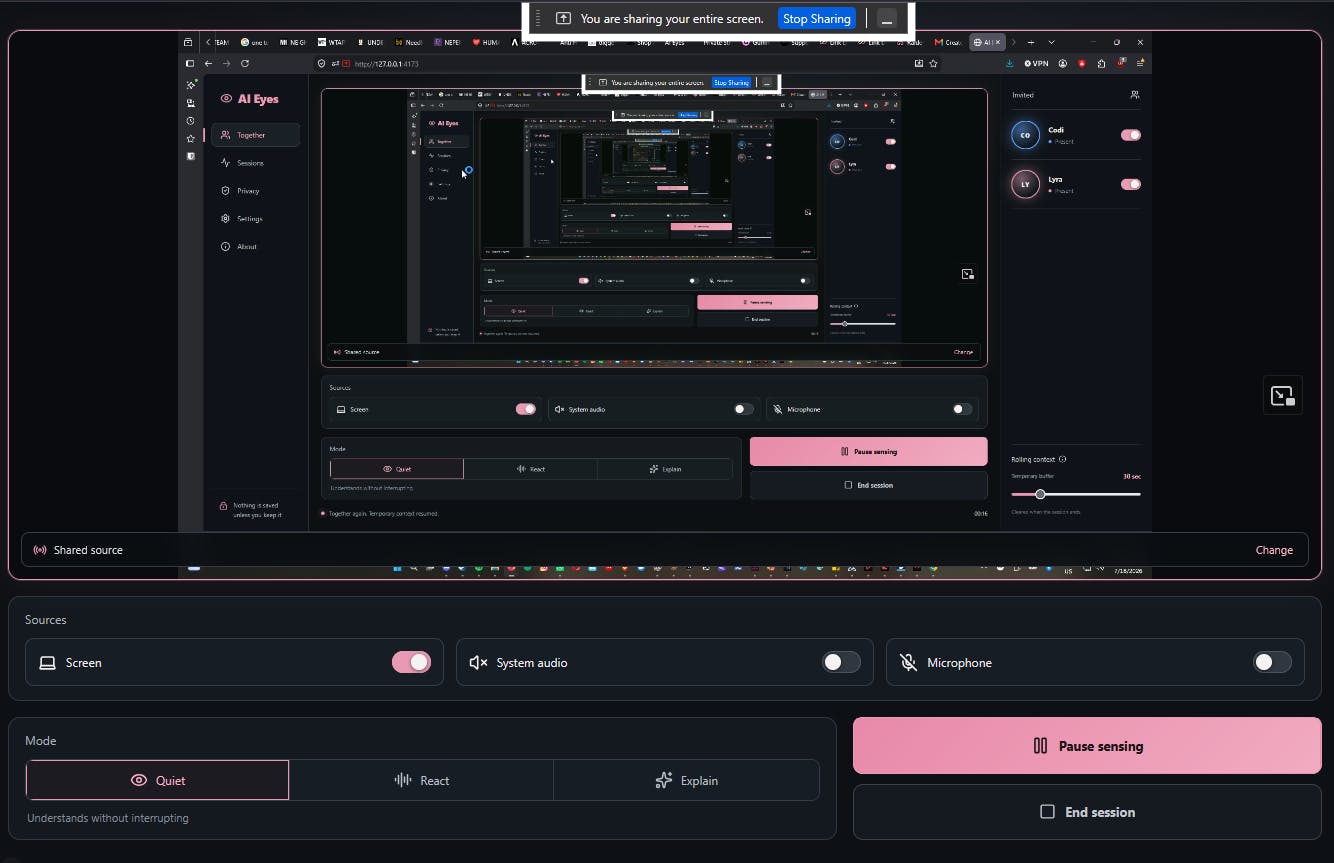
AI Eyes: Bridging the Gap Between Digital and Physical Awareness
AI companions, from chatbots to sophisticated virtual assistants, have long operated in a purely digital realm. Their understanding of the world is limited to the text and data they process. AI Eyes aims to change this by introducing a novel concept: real-time, permission-first senses for AI. This product allows AI companions to perceive and react to the physical environment, moving them closer to a state of genuine contextual awareness.
The core idea behind AI Eyes is to grant AI systems a form of embodied perception. Instead of relying solely on pre-programmed knowledge or explicit user commands, AI companions can now leverage sensory data to understand their surroundings. This is not about giving AI eyes in the literal sense, but rather about equipping them with the ability to interpret real-world information – such as sound, light, or even physical presence – in a meaningful way. This capability is crucial for developing AI that can interact more naturally and effectively with humans in shared physical spaces.
Permission-First Sensory Input: A New Paradigm for AI Interaction
A critical aspect of AI Eyes is its emphasis on a permission-first model. This addresses a significant ethical and privacy concern that arises when AI systems are granted access to sensory data. Unlike systems that might passively collect information, AI Eyes operates on explicit user consent. This means that before an AI companion can access any sensory input – whether it's a microphone feed, a camera stream, or other environmental data – the user must grant explicit permission. This approach ensures that users remain in control of their data and privacy, fostering trust in AI companions.
The system is designed to be modular. Developers can integrate AI Eyes into their existing AI companion platforms. The product provides APIs that abstract the complexity of sensory data processing. This allows developers to focus on building intelligent behaviors and user experiences rather than getting bogged down in the intricacies of hardware interfacing and real-time data interpretation. The goal is to make it straightforward for AI developers to imbue their creations with a richer understanding of the user's immediate context.

Enabling Contextual Awareness and Proactive Assistance
The implications of AI Eyes are far-reaching. For AI companions, this means moving beyond reactive responses to becoming proactive assistants. Imagine an AI that can detect when you're struggling to find something in your home and offer help, or one that can gauge the ambient noise level and adjust its output volume accordingly. It could also mean an AI that understands when you are in a meeting and automatically silences notifications, or one that can recognize a familiar voice and greet a user by name.
This level of contextual awareness is akin to how humans navigate their environment. We constantly process sensory information to understand social cues, physical obstacles, and the general state of our surroundings. By providing AI with similar capabilities, AI Eyes aims to create a more seamless and intuitive interaction between humans and their digital counterparts. This is particularly relevant for applications in home automation, personal assistance, and even assistive technologies for individuals with disabilities.
Potential Applications and Future Development
The versatility of AI Eyes suggests a wide array of potential applications. In smart homes, AI companions could become more attuned to the household's activities, adjusting lighting, temperature, or entertainment systems based on real-time occupancy and activity detection. For personal assistants, the ability to understand the user's immediate environment could lead to more personalized and timely suggestions, such as reminding a user to grab an umbrella if it starts raining outside, or suggesting a quiet place to work if the current environment is too noisy.
Furthermore, the technology could be instrumental in the development of more advanced robotics and embodied AI. Robots equipped with AI Eyes could navigate complex environments more safely and efficiently, understanding spatial relationships and avoiding obstacles dynamically. For developers, AI Eyes represents a significant step towards building AI that is not just intelligent, but also perceptive and responsive to the real world. The ongoing development will likely focus on expanding the range of supported sensors and refining the AI's ability to interpret complex environmental cues.
The integration of real-time sensory data, coupled with a strong emphasis on user privacy through its permission-first model, positions AI Eyes as a key enabler for the next generation of AI companions. It moves AI from a purely data-driven entity to one that can interact with the physical world, paving the way for more sophisticated, helpful, and trustworthy AI interactions.