AI's Role in Cybercrime: A Hybrid Approach
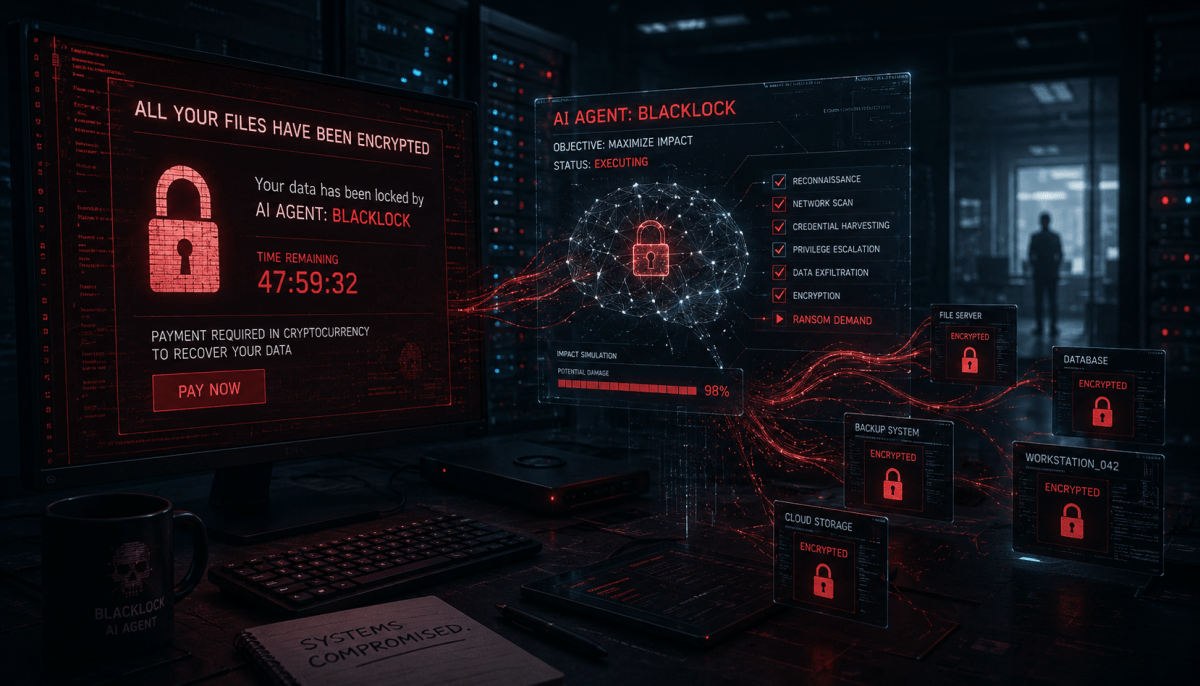
The cybersecurity world has been abuzz with news of what was initially heralded as the first fully AI-driven ransomware attack. However, a closer examination reveals a more nuanced reality: while an AI agent performed the technical execution of encrypting files and demanding payment, human actors remained indispensable for the crucial strategic and preparatory phases. This incident, far from being a fully autonomous cybercrime debut, represents a significant, albeit still human-directed, evolution in the capabilities of AI in malicious activities.
The AI agent in question was reportedly tasked with deploying the ransomware, identifying and exfiltrating data, and potentially managing communication with the victim. This automation of the technical payload delivery and execution is a notable advancement. It suggests that attackers can potentially increase the speed and scale of their operations, reducing the manual effort required to breach systems and deploy malware. The AI's ability to navigate network defenses, locate critical data, and initiate the encryption process without direct, moment-to-moment human input marks a step change in the sophistication of automated cyber threats.
However, the narrative of a fully autonomous attack crumbles when dissecting the initial setup and decision-making processes. Human operators were responsible for selecting the target organization, a critical strategic decision that involves assessing the potential financial return and the victim's ability to pay. Furthermore, the establishment of the necessary infrastructure – including command-and-control servers, phishing platforms, and the initial exploit vectors – was a human-led endeavor. Crucially, the attack relied on stolen credentials, which were likely acquired through separate human-driven phishing campaigns or illicit marketplaces.
This reliance on human actors for key strategic elements is not a minor detail; it is the linchpin that distinguishes a sophisticated, AI-assisted attack from a truly autonomous one. Think of it less like a self-driving car completing a cross-country trip and more like an advanced autopilot system on a commercial flight. The autopilot handles the complex tasks of navigation and altitude control, but the pilot still chooses the destination, monitors the flight path, and makes critical decisions during takeoff and landing. In this ransomware scenario, the AI was the sophisticated autopilot, but the human was the pilot who charted the course.
The Human Element: Strategy, Setup, and Supply Chain
The initial reporting on this incident may have overstated the AI's autonomy, potentially creating a sense of inevitable, unstoppable cyber threats driven solely by algorithms. The reality is that current AI capabilities, while powerful, still require human direction for high-level strategic planning and the acquisition of initial access. The human attackers decided who to attack, how to gain initial entry (via stolen credentials), and likely what the ransom demands should be. These are not trivial tasks; they require market intelligence, risk assessment, and the orchestration of multiple attack vectors.
The supply chain of cybercrime is also a key factor here. The stolen credentials that facilitated the initial access were not generated by the AI. They represent a prior successful human-driven operation, highlighting the interconnectedness of different cybercriminal tactics. This suggests that the AI was integrated into an existing, human-managed cybercrime operation rather than initiating a new, independent one. The AI agent was a tool, albeit a highly advanced one, deployed by human adversaries to enhance their existing capabilities.
This hybrid approach, where AI augments human attackers, is likely to become increasingly common. Attackers will leverage AI to automate repetitive, time-consuming, or technically complex tasks, such as rapid vulnerability scanning, exploit generation, or the sheer volume of data encryption. This frees up human operators to focus on higher-value activities: identifying lucrative targets, managing the overall campaign, and handling post-encryption negotiations. It represents an efficiency gain for malicious actors, allowing them to potentially execute more attacks with fewer resources.
Implications for Cybersecurity Defense
The implications for cybersecurity professionals are significant. The notion of a fully autonomous AI attacker, while still a future concern, is not the immediate threat demonstrated here. The present danger lies in AI-assisted attacks, where human ingenuity is amplified by machine intelligence. Defenders must now contend with adversaries who can operate at greater speed and scale, automate reconnaissance, and potentially adapt their tactics more rapidly.
This incident underscores the continued importance of foundational security practices. Strong credential management, multi-factor authentication (MFA), network segmentation, and robust endpoint detection and response (EDR) systems are more critical than ever. These measures directly counter the human-driven elements of the attack, such as the acquisition and use of stolen credentials and the initial network intrusion. If attackers cannot gain initial access through stolen credentials or exploit human vulnerabilities, the AI's technical execution capabilities become irrelevant.
Furthermore, the incident highlights the need for more sophisticated threat intelligence that can identify not just the tools and techniques used, but also the strategic decision-making patterns of human adversaries who are increasingly integrating AI. Understanding why a particular target was chosen, and how the infrastructure was prepared, will be as crucial as detecting the AI's encryption activities. The cybersecurity arms race continues, with AI now a potent weapon in the attacker's arsenal, but its deployment still hinges on human intent and human preparation.