What an AI Engineer Actually Does
An AI engineer bridges the gap between machine learning research and production-ready software. They don't just train models; they design, build, deploy, and maintain AI systems. This involves understanding model lifecycle management, data pipelines, MLOps principles, and the specific business problems AI can solve. Unlike a pure data scientist focused on exploration and insight, an AI engineer is concerned with the engineering rigor required to make AI reliable, scalable, and integrated into existing software architectures.
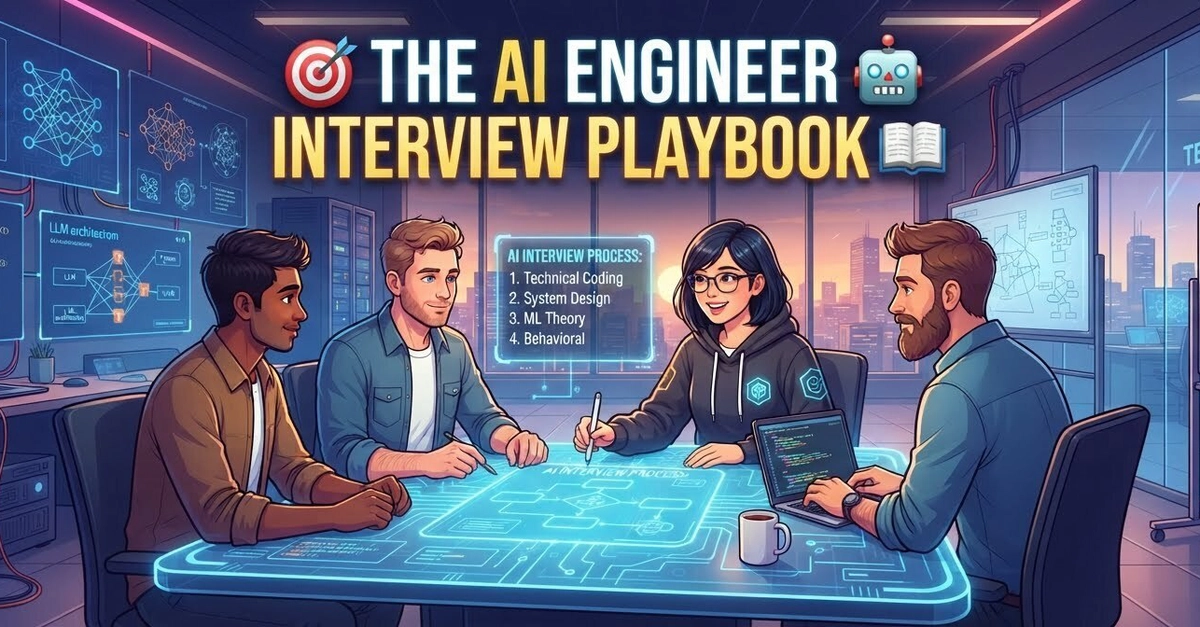
The AI Engineering Interview Process
The interview process for an AI engineer is typically multi-stage and rigorous, designed to assess a broad range of skills. Expect initial screenings to cover fundamental computer science concepts, followed by technical interviews focusing on machine learning theory, practical coding, system design, and behavioral assessments. Companies are looking for candidates who can not only discuss theoretical concepts but also translate them into working code and robust systems.
Key Technical Areas Assessed
The core technical competencies tested fall into several key domains:
Machine Learning Fundamentals
Candidates should possess a solid grasp of core ML concepts. This includes understanding different types of algorithms (supervised, unsupervised, reinforcement learning), their mathematical underpinnings, and their practical applications. Expect questions on:
- Supervised Learning: Regression, classification, decision trees, SVMs, neural networks. Understanding metrics like accuracy, precision, recall, F1-score, AUC, and when to use them.
- Unsupervised Learning: Clustering (K-means, DBSCAN), dimensionality reduction (PCA, t-SNE).
- Deep Learning: Architectures like CNNs, RNNs, Transformers. Understanding backpropagation, activation functions, and optimization techniques (SGD, Adam).
- Model Evaluation and Selection: Cross-validation, bias-variance trade-off, overfitting/underfitting, hyperparameter tuning.
Programming and Software Engineering
Proficiency in programming languages, particularly Python, is non-negotiable. Interviews will assess your ability to write clean, efficient, and maintainable code. This includes:
- Data Structures and Algorithms: Standard CS fundamentals are crucial.
- Python Proficiency: Deep understanding of Python, including its ecosystem (NumPy, Pandas, Scikit-learn).
- Object-Oriented Programming (OOP): Designing and implementing classes and modules.
- Testing and Debugging: Writing unit tests, integration tests, and effective debugging strategies.
MLOps and Production Systems
This is where AI engineering diverges significantly from pure research. Companies want to know you can get models into production and keep them running. Key areas include:
- Model Deployment: Strategies for serving models (e.g., REST APIs using Flask/FastAPI, batch processing).
- Containerization: Docker and Kubernetes for packaging and orchestrating applications.
- Cloud Platforms: Familiarity with AWS (SageMaker, EC2, S3), GCP (AI Platform, Compute Engine), or Azure (Machine Learning).
- CI/CD for ML: Automating model training, testing, and deployment pipelines.
- Monitoring and Logging: Tracking model performance, data drift, and system health in production.
- Data Engineering Fundamentals: Understanding data pipelines, ETL processes, and data storage solutions (SQL, NoSQL, data lakes).
System Design
AI system design questions assess your ability to architect scalable and robust AI solutions. These often involve designing a system to handle specific requirements, like recommending products, detecting fraud, or processing natural language. You'll need to consider:
- Scalability: How to handle increasing data volume and user traffic.
- Latency: Optimizing for fast response times.
- Availability and Reliability: Ensuring the system is always up and running.
- Cost-Effectiveness: Balancing performance with computational resources.
- Data Flow: Mapping the journey of data from ingestion to model inference.
Behavioral and Case Study Interviews
Beyond technical skills, companies assess your ability to work in a team, communicate effectively, and handle challenges. Expect questions about past projects, how you dealt with setbacks, and your problem-solving approach. Case studies often present a real-world business problem and ask you to outline an AI-driven solution, forcing you to integrate technical knowledge with business acumen.
Preparing for the 2026 AI Engineer Interview
Success requires a multi-pronged approach:
1. Solidify Fundamentals
Revisit core CS concepts, linear algebra, calculus, probability, and statistics. Ensure your understanding of ML algorithms is deep, not superficial.
2. Practice Coding
Work through LeetCode-style problems, focusing on data structures and algorithms. Practice implementing ML algorithms from scratch in Python. Familiarize yourself with libraries like NumPy and Pandas.
3. Build Production-Ready Projects
Go beyond Jupyter notebooks. Deploy a simple ML model as a REST API using Flask or FastAPI. Containerize it with Docker. Set up a basic CI/CD pipeline for model retraining. Contribute to open-source MLOps tools if possible.
4. Study System Design
Read about common ML system design patterns. Practice designing systems for various use cases. Understand trade-offs between different architectural choices.
5. Mock Interviews
Practice with peers or use online platforms for mock interviews. This helps simulate the pressure and identify weak spots in your communication and technical explanations.
6. Stay Current
The AI field evolves rapidly. Keep up with new research papers, MLOps tools, and industry best practices. Follow key figures and companies in the AI engineering space.
Passing an AI engineer interview in 2026 means demonstrating not just theoretical knowledge, but practical engineering skills and an understanding of how to build and deploy AI systems reliably and at scale. It’s a demanding role, and the interview process reflects that.