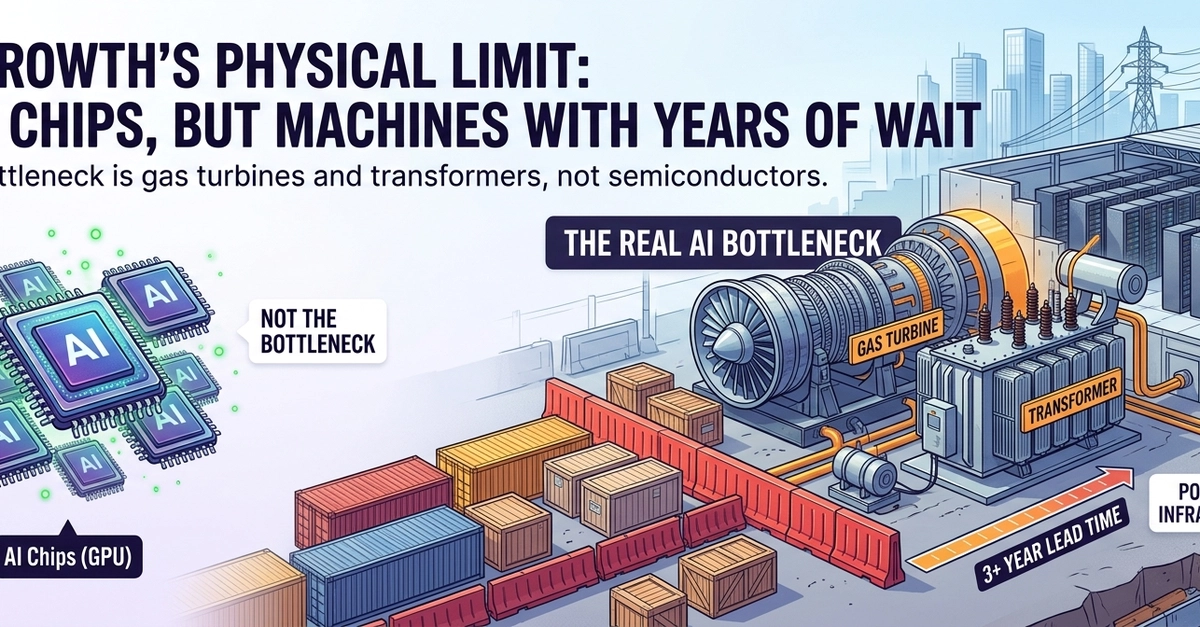
The Real Bottleneck: Power, Not Processors
The narrative surrounding the expansion of AI data centers has fixated on the scarcity of advanced semiconductors, particularly high-end GPUs. While chip availability remains a concern, a more profound and protracted bottleneck is emerging: the power infrastructure required to support these colossal computing operations. Building a modern data center involves not just racks of servers and advanced processors but also robust power generation, transmission, and distribution systems. The critical realization is that the planning, construction, and commissioning of this power infrastructure operate on timelines far exceeding those of semiconductor fabrication. This means that even if chip supply chains were to miraculously resolve overnight, the physical limitations of power delivery would still constrain AI's growth for years to come.
Data center construction timelines are intrinsically linked to power plant planning. A typical large-scale data center, especially one designed for the immense power demands of AI workloads, requires a dedicated or significantly upgraded power supply. This isn't as simple as plugging into the grid. It often involves new substations, upgraded transmission lines, and sometimes even the construction or expansion of power generation facilities. These projects are subject to lengthy regulatory approval processes, environmental impact assessments, and complex engineering challenges. The lead time for securing land, obtaining permits, constructing the physical plant, and bringing it online can easily stretch to three years, if not longer. This contrasts sharply with the months-long, albeit still constrained, lead times for high-end AI chips.
Consider the scale of power required. A single AI training cluster can consume tens or even hundreds of megawatts of power. Scaling this to thousands of such clusters, as hyperscalers and AI companies are doing, necessitates a fundamental reimagining of energy infrastructure. The problem is compounded by the fact that existing grid infrastructure in many regions was not designed for such concentrated, high-demand loads. Furthermore, the rapid pace of AI development means that projected power needs are constantly being revised upwards, making long-term planning an exercise in significant uncertainty.
The focus on GPUs, while understandable given their critical role, has perhaps obscured this more fundamental constraint. Companies that can secure reliable, high-capacity power will be able to build and scale their AI infrastructure, regardless of short-term fluctuations in chip availability. This shifts the competitive landscape. It's no longer just about who has the best chip procurement strategy; it's about who can navigate the complex and time-consuming world of energy infrastructure development.
The Machine Behind the Power
When discussing the three-year lead time, the focus is not on the servers or the GPUs themselves, but on the specialized machinery and infrastructure required for power delivery at data center scale. This includes high-voltage transformers, switchgear, uninterruptible power supplies (UPS) systems, and the complex control systems that manage power distribution. These are not off-the-shelf components that can be rapidly manufactured or sourced. They require specialized manufacturing facilities, custom engineering, and rigorous testing.
The production of large, high-capacity transformers, for instance, is a globally constrained market. These are not small units; they are massive pieces of equipment weighing hundreds of tons. Their manufacturing involves specialized foundries, lengthy production cycles for components like copper windings and specialized cooling systems, and significant logistical challenges for transportation. The demand for these transformers has surged not only from data centers but also from grid modernization efforts and renewable energy projects, creating a multi-sector demand that strains existing supply chains. A three-year lead time for such critical components is not unusual, and in some cases, it could be longer depending on market conditions and specific requirements.
Similarly, advanced switchgear and sophisticated power management systems require specialized engineering and manufacturing capabilities. These systems are crucial for ensuring power stability, redundancy, and efficient distribution within the data center. Integrating these components into a cohesive and reliable power delivery network is a complex engineering task that further adds to the project timeline. The planning phase alone for such systems is extensive, involving detailed load calculations, redundancy planning, and safety protocols.
The sheer scale of these power infrastructure projects means that even minor delays in one component can have cascading effects on the entire timeline. Unlike semiconductor manufacturing, where foundries can potentially ramp up production with significant capital investment, the physical construction of power infrastructure is inherently slower and more geographically constrained. It involves civil engineering, civil works, and the installation of massive, heavy equipment, all of which are subject to physical limitations and environmental factors.
Implications for AI Growth and Investment
This power bottleneck has significant implications for the future trajectory of AI development and the data center industry. Companies and investors that fail to account for these extended lead times risk overestimating their capacity for rapid expansion. The ability to secure power will become a primary determinant of who can scale their AI operations effectively.
For hyperscalers and large cloud providers, this means a strategic imperative to invest heavily in their own power generation and infrastructure development, or to forge deep, long-term partnerships with utility providers. This could lead to increased vertical integration, with major tech companies becoming de facto power developers. The capital expenditure required for such endeavors is immense, potentially dwarfing current investments in server hardware. This also presents an opportunity for specialized infrastructure firms that can efficiently manage the planning, construction, and operation of data center power solutions.
For startups and smaller AI companies, the challenge is even more acute. They may find it difficult to secure the necessary power allocations from grid operators or to attract the capital required for bespoke power solutions. This could lead to a concentration of AI compute power within a few dominant players who have the scale and resources to manage these complex infrastructure requirements. The