The Need for Natural Language Data Exploration
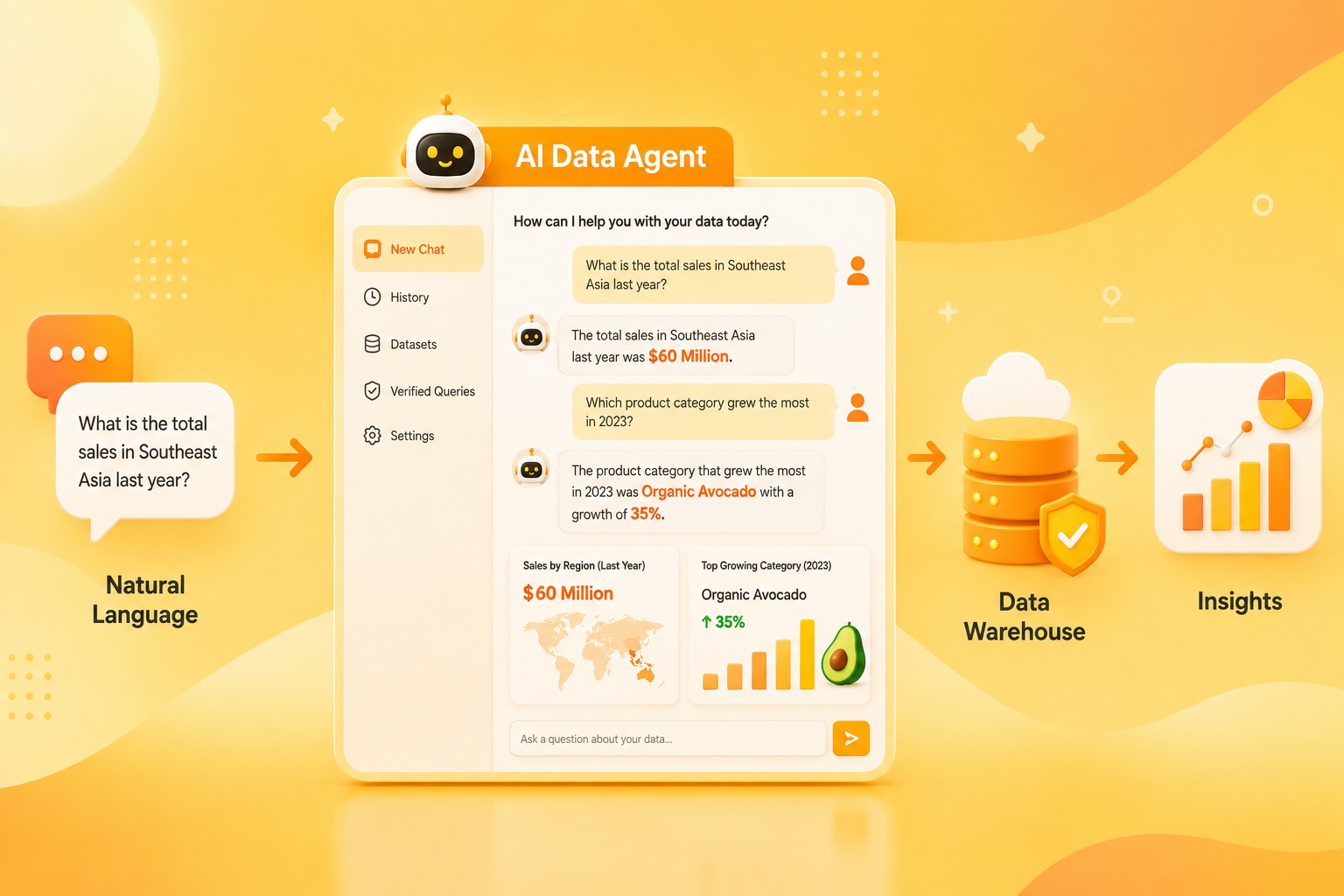
Traditional business intelligence tools often require users to be proficient in SQL or complex data visualization software. This creates a bottleneck, as business analysts, marketers, and executives must rely on data teams to extract insights. The result is a slower decision-making process and a disconnect between raw data and actionable business intelligence. The goal of this project was to bridge that gap by building an AI-powered data agent capable of understanding natural language queries and directly querying data sources to provide answers.
This approach aims to democratize data access, empowering non-technical users to explore datasets, uncover trends, and answer critical business questions without needing to write a single line of SQL. Imagine asking your sales data, "What were our top 5 performing products in Q3 last year in the EMEA region?" and receiving a precise answer, complete with supporting data, in seconds. This is the power this AI data agent unlocks.
Core Components of the AI Data Agent
Building such an agent involves several key technological components working in concert. The architecture can be broken down into distinct modules, each serving a specific purpose in the pipeline from natural language input to data-driven output.
1. Natural Language Understanding (NLU) Module
The first step is to process the user's natural language query. This module uses Natural Language Processing (NLP) techniques to understand the intent behind the question. This involves:
- Intent Recognition: Identifying what the user wants to achieve (e.g., retrieve data, aggregate, filter).
- Entity Extraction: Pinpointing key pieces of information within the query, such as product names, date ranges, regions, or specific metrics. For example, in the query "Show me sales for Product X in January," 'Product X' and 'January' are entities.
- Query Decomposition: Breaking down complex questions into smaller, manageable parts that can be translated into structured queries.
2. Data Query Generation Module
Once the NLU module has understood the query, this module translates that understanding into a format that can be executed against a data source. The most direct translation is often SQL. However, the agent could also generate queries for other data access methods like API calls or specific database query languages.
This translation is a critical step. It requires mapping natural language concepts to database schemas and query logic. For instance, the entity "sales" might map to a `SUM(revenue)` aggregation on a `sales` table, while "top 5" implies an `ORDER BY revenue DESC LIMIT 5` clause.
3. Data Execution Engine
This module takes the generated query and executes it against the actual data source (e.g., a PostgreSQL database, a data warehouse like Snowflake, or a CSV file). It handles the connection, query submission, and retrieval of results. Error handling is crucial here, as queries might fail due to syntax errors, schema mismatches, or data access issues.
4. Response Generation Module
After the data has been retrieved, this module formats the results into a human-readable response. This is more than just dumping raw data. It involves:
- Summarization: Presenting key findings concisely.
- Contextualization: Explaining what the data means in the context of the original question.
- Natural Language Generation (NLG): Crafting a grammatically correct and coherent sentence or paragraph that answers the user's query. For example, instead of just showing a table of numbers, it might say, "Your top 5 performing products in Q3 last year in the EMEA region were Product A, Product B, Product C, Product D, and Product E, generating a total of $X in revenue."
Implementation Details and Tooling
Building this agent requires leveraging several powerful AI and data tools. The choice of specific libraries and frameworks can significantly impact development speed and the agent's capabilities.
Language Models (LLMs)
Large Language Models (LLMs) are at the heart of this system. Models like GPT-3.5, GPT-4, or open-source alternatives such as Llama or Mistral are essential for both understanding the natural language input and generating coherent responses. They can also be fine-tuned or prompted to assist in query generation by mapping natural language to structured query logic.
Frameworks for Agent Development
Frameworks like LangChain or LlamaIndex simplify the process of building LLM-powered applications. They provide abstractions for:
- Chaining LLM calls: Connecting multiple LLM interactions (e.g., NLU -> Query Gen -> Response Gen).
- Data Connectors: Easily integrating with various data sources.
- Prompt Engineering: Managing and optimizing prompts sent to LLMs.
- Agents: Defining tools and workflows for LLMs to use, such as SQL databases or APIs.
Database Interaction
For querying data, standard database connectors for Python (e.g., `psycopg2` for PostgreSQL, `snowflake-connector-python` for Snowflake) are necessary. The agent needs to be able to execute SQL commands and parse the results.
Challenges and Considerations
While the concept is powerful, building a robust AI data agent is not without its challenges:
- Schema Complexity: Real-world databases have complex schemas with many tables and intricate relationships. Mapping natural language to this complexity requires sophisticated logic or extensive fine-tuning of the LLM.
- Ambiguity in Queries: Natural language is inherently ambiguous. The agent must be able to handle unclear queries, perhaps by asking clarifying questions to the user.
- Data Security and Permissions: Ensuring the agent only accesses data it is authorized to see is paramount. This requires careful integration with existing access control systems.
- Performance: Generating and executing complex queries, especially on large datasets, can be slow. Optimizing query generation and potentially using caching mechanisms is important.
- Hallucinations: LLMs can sometimes generate plausible-sounding but incorrect information. Rigorous validation of generated queries and responses against the actual data is essential.
The Future of Data Exploration
This AI data agent represents a significant step towards making data more accessible and actionable for everyone in an organization. By abstracting away the complexities of data querying, it allows business users to focus on insights and strategy rather than technical implementation. As LLMs and agent frameworks continue to evolve, we can expect these tools to become even more powerful, accurate, and integrated into everyday business workflows. The dream of a truly conversational interface to all business data is rapidly becoming a reality.