%22%20%2F%3E%0A%20%20%3C%2Fsvg%3E)
The AI Cost Conundrum
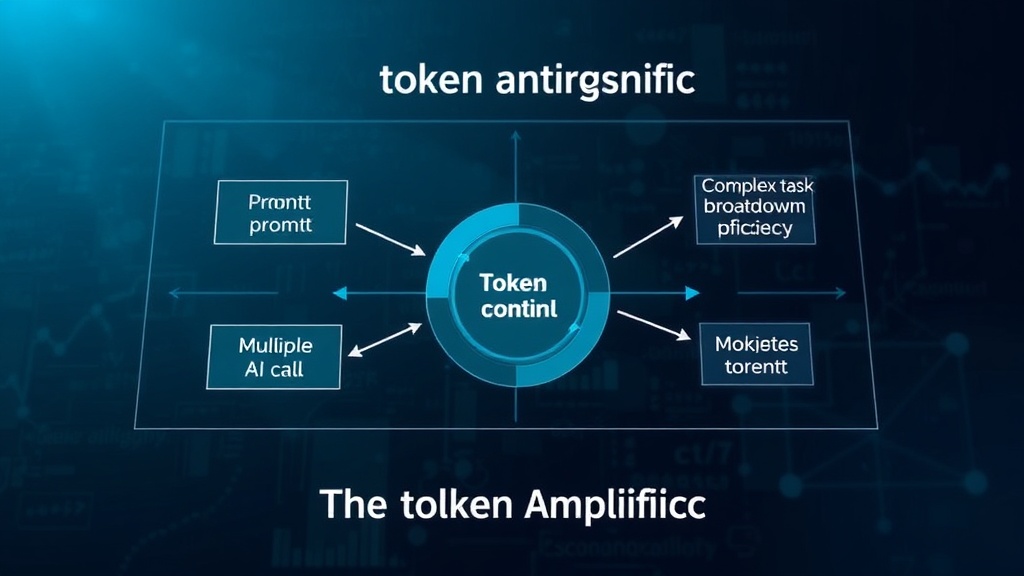
The artificial intelligence industry is grappling with a persistent paradox: as AI models become more sophisticated and efficient, their operational costs can still spiral out of control. This isn't a failure of engineering; it's a consequence of how we interact with and task these powerful systems. The core of the issue lies in what's termed 'token amplification,' a phenomenon where the inherent capabilities of advanced models lead to the generation of more complex, and thus more costly, computational tasks.
Think of it like this: you hire a brilliant, lightning-fast personal assistant who can draft an entire novel in minutes. Initially, you might ask them to write a simple email. But because they are so capable, you start asking them to research historical accuracy, develop complex plot twists, and generate multiple character backstories. The assistant is still incredibly efficient at each individual step, but the sheer volume and complexity of the amplified requests quickly outweigh the per-task speed advantage, leading to a higher overall bill than if you had just asked for the simple email.
This is precisely what is happening in the AI economy. Newer, more powerful Large Language Models (LLMs) and other generative AI systems are demonstrably better at understanding nuance, generating creative content, and performing complex reasoning. This improved capability, however, often encourages users and developers to push them further, assigning more intricate, multi-step tasks. Each step, each generated token, incurs a cost. When a model can perform 100 steps of complex reasoning where a previous model could only manage 10, the total token count—and thus the cost—can increase exponentially, even if each individual step is more computationally efficient.
Token Amplification in Practice
Token amplification manifests in several key ways. Firstly, as models become better at understanding context and intent, they can handle longer, more detailed prompts. A user might not just ask for a summary of a document; they might ask for a summary, followed by a comparative analysis with another document, then a creative rewrite in the style of a specific author, and finally, a translation into three different languages. Each of these sub-tasks, while handled efficiently by the advanced model, adds to the total token expenditure.
Secondly, complex AI-driven workflows often involve multiple calls to an AI model, or even sequences of different models. For instance, a customer service chatbot might first use an LLM to understand the user's query, then query a knowledge base, then use another LLM to synthesize the information into a coherent response, and finally, use a third model to detect the sentiment of the user's original request. While each individual LLM call might be optimized for speed and cost, the cumulative effect of these chained operations can be substantial. The original prompt might be relatively short, but the intermediate processing and the final output can involve thousands, if not tens of thousands, of tokens.
This dynamic is particularly acute in areas like code generation, creative writing, and complex data analysis. A developer might ask an AI to write a function, but then follow up with requests to refactor it, add extensive error handling, generate unit tests, and document it thoroughly. The AI can perform all these tasks with remarkable accuracy and speed, but the sheer number of tokens generated—from the initial code to the final documentation—can quickly become a significant expense for the developer or the platform hosting the AI service.
The Economic Implications
The economic fallout of token amplification is profound. For AI providers, it means that despite significant investments in model optimization and hardware efficiency, the actual cost per user interaction can be unpredictable and difficult to manage. This directly impacts pricing strategies, profit margins, and the overall economic viability of AI-powered services. Companies offering AI APIs face the challenge of setting prices that reflect the potential for usage to balloon unexpectedly.
For businesses and individual users, it means that the promise of cost-effective AI solutions can be a mirage. While the per-token cost might be low, the number of tokens consumed can escalate rapidly, making it difficult to budget for AI expenditures. This can stifle innovation, as teams may become hesitant to integrate AI into workflows if the costs are too volatile or too high. It creates a scenario where the most advanced AI tools, which should democratize capabilities, can inadvertently become luxury goods accessible only to those with substantial budgets.
The situation is akin to the early days of cloud computing, where the pay-as-you-go model promised flexibility but also led to surprise bills due to unmonitored resource consumption. With AI, the complexity of generative tasks makes monitoring and predicting usage even more challenging. Developers building applications on top of LLMs are particularly exposed, as they rely on the underlying models' capabilities, which can be arbitrarily complex.
Addressing the Paradox
Several strategies are emerging to combat token amplification. One approach involves developing more advanced prompt engineering techniques and AI orchestration layers that can intelligently break down complex tasks into smaller, more manageable, and cost-effective sub-tasks. This involves building systems that can reason about the most efficient way to achieve a desired outcome, rather than simply executing a linear sequence of commands.
Another avenue is the development of specialized AI models that are optimized for specific tasks, rather than relying solely on massive, general-purpose LLMs for everything. A model trained specifically for summarization, for example, might be far more efficient at that single task than a general LLM attempting to perform summarization as part of a larger workflow. This echoes the principle of specialized tooling in traditional software development.
Furthermore, research into more efficient model architectures and inference techniques continues. Techniques like quantization, distillation, and sparse attention mechanisms aim to reduce the computational footprint of AI models. However, these advancements primarily address the efficiency of processing a given task, not the amplification of the tasks themselves. The fundamental challenge remains: how to align the economic incentives with the actual utility derived from increasingly capable AI.
Ultimately, navigating the AI economy requires a nuanced understanding of both model capabilities and usage patterns. As AI continues to integrate into more aspects of our digital lives, managing the cost paradox will be crucial for sustained growth and widespread adoption. The race is on to find solutions that allow us to harness the power of advanced AI without being crippled by its escalating expense.