The Problem: Climate Disasters as Decision Bottlenecks
Climate disasters transcend mere meteorological events; they represent complex decision-making challenges. When forecasts indicate a severe El Niño, governments face pressing questions that raw data alone cannot answer. These include identifying the most vulnerable districts, strategically allocating scarce water resources, predicting crop failures, advising farmers on alternative planting strategies, and, crucially, understanding the rationale behind AI-driven recommendations. Traditional dashboards, while rich in charts and data visualization, often fall short in providing actionable decisions. This gap between data presentation and decision support was the primary motivation for building the El Niño 2026 Decision Copilot.
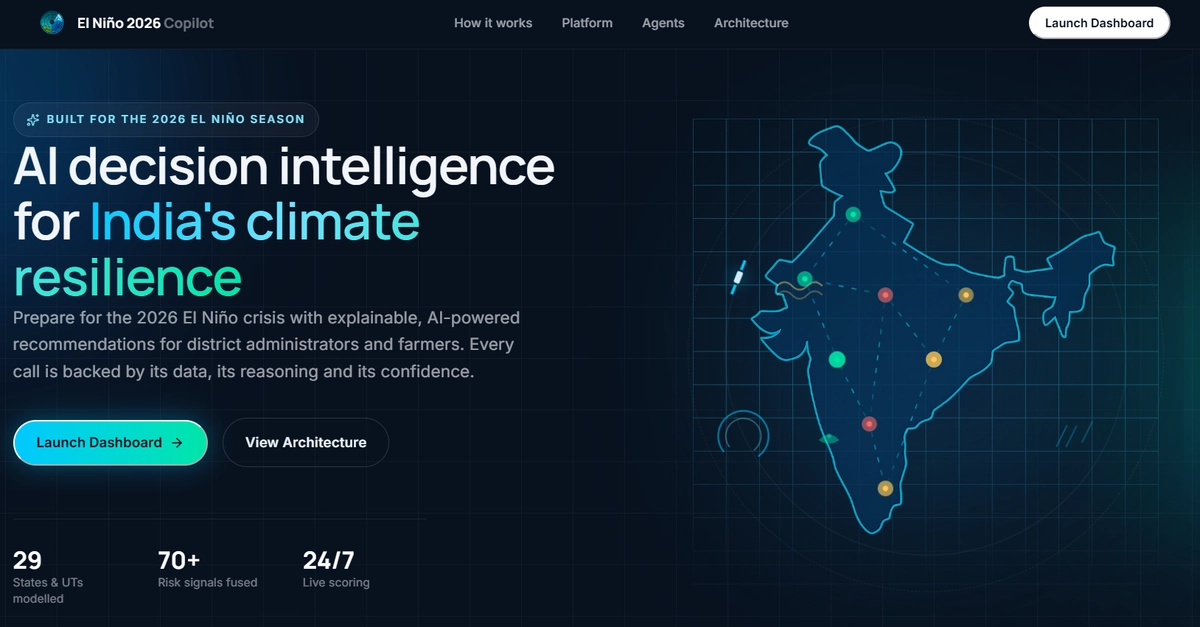
This AI-powered decision intelligence platform emerged from the Google Cloud Gen AI Academy APAC Hackathon. It aims to translate complex climate predictions into concrete, understandable actions for those on the front lines of climate resilience: district administrators and farmers.
Building the Decision Copilot: Technology Stack and Approach
The development of the El Niño 2026 Decision Copilot was underpinned by a suite of powerful Google Cloud technologies, including Gemini, Vertex AI, and BigQuery. The platform's core functionality revolves around providing explainable AI, ensuring that users not only receive recommendations but also understand the reasoning behind them. This is critical for building trust and enabling effective adoption, especially in high-stakes scenarios like disaster preparedness.
Gemini, Google's advanced multimodal AI model, likely played a role in processing diverse data inputs, potentially including weather patterns, historical agricultural yields, soil conditions, and socio-economic data. Vertex AI, Google Cloud's unified machine learning platform, would have been instrumental in training, deploying, and managing the AI models. This includes feature engineering, model selection, hyperparameter tuning, and creating robust prediction pipelines.
BigQuery, Google Cloud's fully managed, serverless data warehouse, served as the foundational data repository. It enabled the ingestion, storage, and analysis of vast datasets required for accurate forecasting and decision-making. The ability of BigQuery to handle petabyte-scale data and perform complex SQL queries efficiently is crucial for a system that needs to process and correlate numerous variables impacting climate and agricultural outcomes.
Functionality for Administrators and Farmers
The El Niño 2026 Decision Copilot is designed with two primary user groups in mind, each with tailored functionalities:
For District Administrators: Resource Allocation and Impact Assessment
District administrators are tasked with managing resources and coordinating responses across potentially large and diverse geographical areas. The copilot provides them with:
- Vulnerability Mapping: Predictive analytics identify districts most likely to be affected by El Niño-induced weather anomalies, such as droughts or unseasonal rainfall. This allows for proactive resource pre-positioning.
- Optimized Resource Allocation: Based on predicted impacts and available resources (water, food supplies, emergency personnel), the AI recommends the most effective distribution strategies. This moves beyond simple data dashboards to suggest concrete allocation plans, prioritizing areas and needs based on predicted severity.
- Scenario Planning: The platform can simulate various El Niño scenarios and their potential impacts, enabling administrators to develop contingency plans and understand the trade-offs of different response strategies.
The explainability feature is paramount here. Administrators need to justify resource decisions to higher authorities and affected populations. Understanding why a particular district is flagged as high-risk or why a specific water allocation is recommended builds confidence and facilitates better governance.
For Farmers: Crop Decisions and Risk Mitigation
Farmers are at the sharp end of climate variability, with their livelihoods directly dependent on weather patterns and crop yields. The copilot offers them:
- Crop Failure Prediction: By analyzing localized weather forecasts, soil data, and historical performance, the AI predicts the likelihood of failure for currently sown crops.
- Sowing Recommendations: For farmers planning future sowing cycles, the AI suggests climate-resilient crops that are more likely to thrive under anticipated El Niño conditions. This includes recommendations for drought-resistant varieties or crops with shorter growing seasons.
- Best Practice Guidance: Beyond crop selection, the copilot can offer advice on water management techniques, pest control strategies adapted to changing conditions, and optimal harvesting times to minimize losses.
The platform's ability to explain its crop recommendations is vital. A farmer might be hesitant to deviate from traditional crops. Understanding that the AI suggests a different variety due to specific soil moisture predictions and temperature anomalies for the coming season makes the advice more palatable and actionable.
The Importance of Explainable AI in Crisis Management
The inclusion of explainable AI (XAI) is not an afterthought; it is a fundamental requirement for a decision copilot in a crisis scenario. When lives and livelihoods are at stake, blind reliance on AI is insufficient. Users must be able to interrogate the system's outputs.
For instance, if the AI recommends diverting water from District A to District B, administrators need to know the underlying factors. Is it based on projected rainfall deficits, critical crop water needs in District B, or a combination? Similarly, a farmer needs to understand why a particular alternative crop is suggested. Is it due to predicted lower water availability, higher average temperatures, or increased risk of a specific pest infestation associated with El Niño?
This transparency fosters trust, enables users to override AI suggestions with their own expert knowledge when necessary, and ultimately leads to more effective and responsible decision-making. It transforms the AI from a black box into a collaborative partner, a true 'copilot' that augments human judgment rather than replacing it.
Future Implications and Scalability
The El Niño 2026 Decision Copilot, born from a hackathon, demonstrates the potential for AI to address critical societal challenges. Its success hinges on the integration of advanced AI models with robust cloud infrastructure and a deep understanding of user needs. The use of Google Cloud services suggests a pathway for scalability, allowing the platform to be deployed and adapted for other regions or future climate events.
The challenge ahead involves not just refining the AI models with more data and incorporating real-time feedback loops, but also ensuring widespread accessibility and training for the intended users. The true measure of its success will be its impact on reducing the human and economic costs associated with climate-induced disasters in India and potentially beyond.