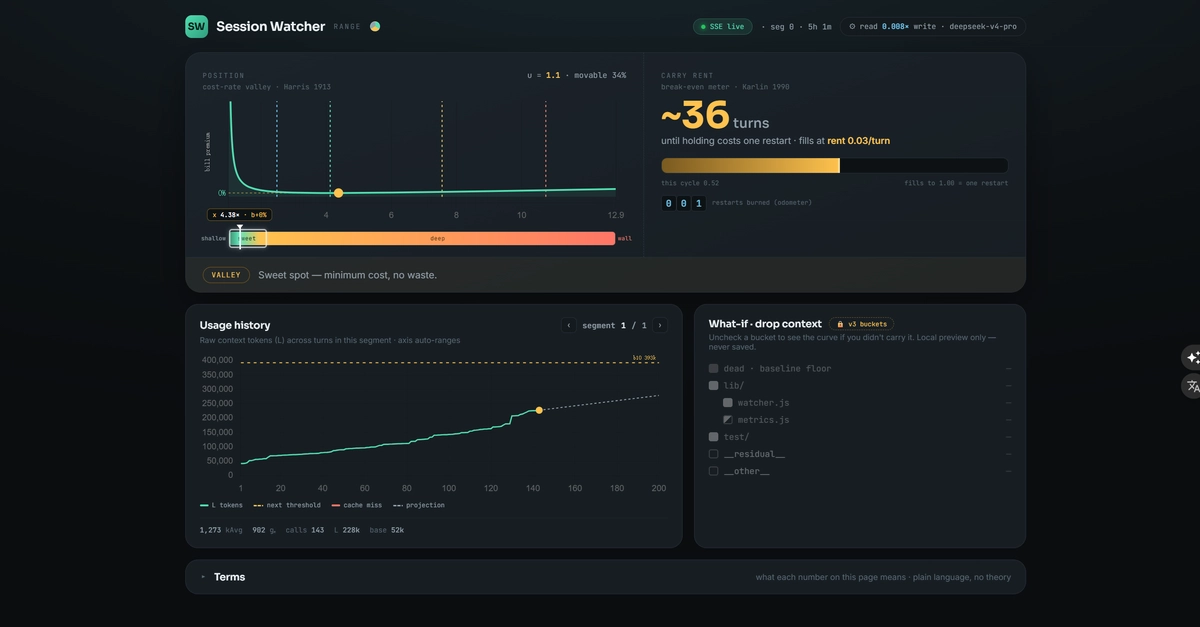
Managing the context window of large language models (LLMs) like Claude presents a recurring challenge for developers and power users. The common advice—restart when the model feels sluggish or use a compaction command—is akin to a warehouse manager reordering stock only when shelves appear empty. This reactive approach often leads to either discarding valuable, recently used context prematurely or retaining outdated, costly information for too long. To address this, a novel approach draws parallels between AI context and historical inventory management, proposing a data-driven method for optimizing context usage and cost.
The Inventory Analogy: Context as Stock
The core insight is that AI context, much like physical inventory, incurs costs and degrades in utility over time. When running long-duration AI sessions, such as extensive coding or creative writing sessions with an agent like Claude, the context window fills up. Early on, this context is highly relevant and frequently accessed. As a session progresses, older parts of the context become less relevant, yet they continue to consume computational resources, effectively acting as 'dead stock' or 'garbage inventory' that incurs carrying costs. The challenge lies in determining the optimal point to 'clear' or 'compact' this context without losing essential historical information or incurring unnecessary expenses.
To quantify this, rigorous analysis of over 150 coding sessions and 1,016 transcripts was conducted. The cost structure of AI context was mapped onto inventory theory, specifically using principles from a 1913 formula developed by Arthur Middleton. This formula, originally designed for managing physical stock levels, proved remarkably applicable. It suggests that context behaves like inventory: it has a 'holding cost' associated with its presence in the model's memory and a 'shortage cost' when relevant information is missing, forcing a costly rebuild or restart.
The critical factor identified is the 'hidden slope' of context relevance and cost. As a session progresses, the marginal utility of older context diminishes, while the computational cost of retaining it remains relatively constant or even increases due to processing overhead. This creates a trade-off that needs to be managed. The 1913 formula provides a mathematical framework to balance these competing costs.
The 1913 Formula and Its Application
Arthur Middleton's 1913 inventory formula, often simplified as the Economic Order Quantity (EOQ) model in its more modern iterations, fundamentally addresses how to minimize total inventory costs by balancing ordering costs and holding costs. In the context of AI, these translate to:
- Holding Cost: The computational resources and financial expense incurred by the LLM provider (and thus the user) to maintain the context window. This is analogous to warehouse rent, insurance, and spoilage for physical goods.
- Shortage Cost: The cost incurred when essential information is no longer in the context, forcing a restart, a lengthy re-explanation, or the loss of valuable 'warm' context. This is like losing sales due to stockouts or the cost of expedited shipping to meet demand.
The critical insight from applying this to AI context is that there exists an optimal 'reorder point'—or in this case, a 'clear point'—for context. This point is not arbitrary but can be calculated based on the observed 'slope' of context utility decay and its associated cost. The formula helps determine when the cost of retaining old context outweighs the potential cost of losing it.
The analysis suggests that instead of relying on vague heuristics like 'sluggishness,' users should monitor session length and the number of turns. By tracking the cumulative cost and the perceived relevance of the context, one can derive a specific metric. This metric, derived from the 1913 inventory model, points to a single, actionable number that indicates when to initiate a context cleanup or session restart. For example, if a session has accumulated a certain number of turns or a specific cumulative cost, and the relevance of the earliest context has demonstrably dropped below a calculated threshold, it's time to act.
The 'Single Number' for Context Management
The practical outcome of this analysis is the identification of a 'single number' that acts as a trigger for context management. This number represents the optimal point to clear or compact the AI's memory. It is derived by analyzing the relationship between the number of turns in a session, the associated cost, and the estimated decay rate of context relevance. While the exact calculation can be complex, it boils down to finding the inflection point where the marginal cost of retaining context exceeds its marginal benefit.
Consider a scenario where a user is working on a complex coding project. Early turns involve setting up the environment, defining initial requirements, and generating boilerplate code. As the session progresses, the user refines algorithms, debugs errors, and adds new features. The initial setup instructions, while important at the start, become less critical as the project evolves. The 1913 formula helps quantify when these early instructions have become 'dead inventory'—taking up space and computational resources without providing significant ongoing value—and it's more cost-effective to clear them than to keep them.
The surprising detail here is not the application of a century-old formula to a cutting-edge technology, but how directly the economic principles of inventory management translate. The 'holding cost' of AI context is a tangible, measurable expense. The 'shortage cost' of losing context is also quantifiable, often in terms of lost productivity or the need for extensive re-prompting. This framework moves context management from a subjective 'feel' to an objective, data-driven decision.
The derived 'single number' can be presented as a threshold. For instance, it might be a specific number of turns, a cumulative cost in dollars (if available through API usage tracking), or a combination thereof, adjusted by an estimated relevance decay factor. When this threshold is reached, the user is prompted to either use a `/compact` command or to consider starting a new session, ensuring that computational resources are used efficiently and costs are minimized without sacrificing the continuity of valuable context.
Implications for AI Users and Providers
For individual users of LLMs, this methodology offers a path to more cost-effective and efficient AI interactions. By understanding and applying this principle, developers can maintain longer, more productive sessions without the fear of unnecessary costs or the frustration of losing valuable, 'warm' context. It empowers users to move beyond reactive 'sluggishness' alerts and adopt a proactive, economically sound strategy.
For AI providers and platform developers, this analysis highlights the importance of providing users with better tools for context management. Insights into session length, cost, and potential relevance decay could be surfaced directly to users. Furthermore, it underscores the economic realities of LLM inference. The computational 'inventory' is finite and costly, and efficient management is key to sustainable scaling and profitability. This analytical framework could inform the design of future AI interfaces and cost-tracking mechanisms, making AI more accessible and predictable for a wider range of applications.
The fundamental question that remains is how to best automate the detection of context relevance decay. While turn count and cumulative cost are good proxies, true relevance is semantic. Future work might involve developing lightweight models or heuristics that can estimate the diminishing semantic value of older context segments, further refining the 'single number' trigger for optimal context clearing.