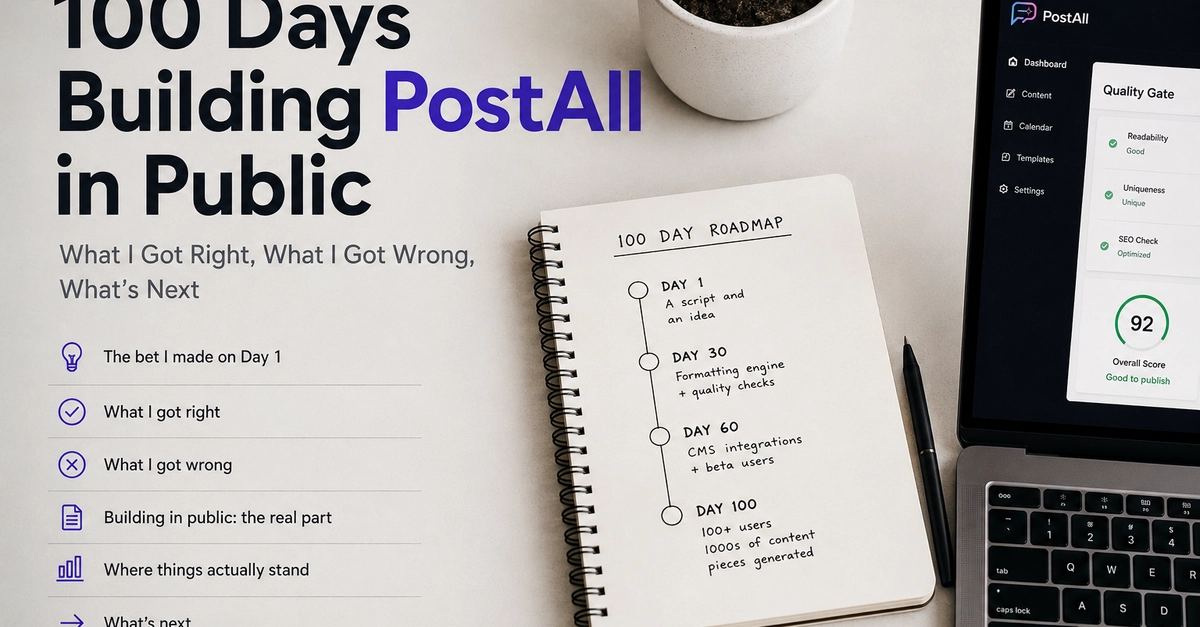
On Day 1, PostAll was a simple script calling the OpenAI API to generate text. By Day 100, it had evolved into a platform featuring a sophisticated formatting engine, a three-stage quality assurance process, and direct integrations with WordPress, Ghost, and Webflow. This transformation wasn't the result of meticulous planning, but rather a reactive adaptation to unforeseen challenges, highlighting a critical shift in understanding what makes AI content truly valuable.
The Flawed Initial Thesis: Prompts Are Not Enough
The foundational bet made on Day 1 was straightforward: businesses require content, AI can produce it, and therefore, the primary hurdle must be the generation process itself. The assumption was that mastering prompts would solve most of the problem, with everything else being mere technical plumbing. This hypothesis, however, proved short-lived, collapsing within two weeks.
The reality that emerged was starkly different. The actual difficulty lay not in the AI's output, but in everything surrounding it. Ensuring that AI-generated text could be reliably rendered as a coherent blog post, a professional LinkedIn update, or a well-structured social media caption presented a significant engineering challenge. The output needed to be consistently structured, formatted, and tailored for specific platforms. This realization marked the first major pivot for PostAll, moving the focus from prompt engineering to the complex ecosystem of content delivery.
The initial vision was to build a tool that simplified AI content creation. The reality demanded a robust content management solution. This meant developing a sophisticated formatting engine capable of transforming raw AI output into presentable content. It also necessitated a framework for handling different content types and platform requirements. The founder, Aakash Gour, found himself not just building a better prompt generator, but a mini-content publishing system.

Introducing the Three-Part Quality Gate
Beyond formatting, ensuring the quality and usability of AI-generated content became paramount. Simply accepting raw output from an AI model, even with well-crafted prompts, often resulted in generic, repetitive, or factually inaccurate material. To address this, PostAll implemented a three-part quality gate. This system was designed to catch common issues before content reached the user or their audience.
The first part of the gate likely involved automated checks for basic grammar, style consistency, and adherence to predefined content guidelines. This is akin to a spell checker on steroids, but also incorporating checks for brand voice and tone. The second stage probably introduced a human-in-the-loop element, allowing users to review, edit, and approve content. This acknowledges that AI can assist, but human oversight remains crucial for nuanced content, especially for professional use cases. The final stage could involve further checks for SEO optimization, readability scores, or even plagiarism detection, ensuring the content is not only well-written but also effective for its intended purpose.
This multi-stage quality control process is a testament to the evolving understanding of AI content's limitations. It moves beyond the 'generate and go' model to a more controlled and professional workflow. It’s a clear signal that for AI-generated content to be viable for businesses, it needs to meet professional publishing standards. The effort required to build and refine these gates demonstrates that the 'plumbing' is, in fact, a significant portion of the engineering challenge.
CMS Integrations: Bridging AI and Publishing Workflows
The final piece of PostAll's evolution was the integration with popular Content Management Systems (CMS) like WordPress, Ghost, and Webflow. This wasn't just about exporting text files; it was about seamlessly embedding AI-generated content directly into existing publishing workflows. For businesses, this means reducing the manual effort of copying and pasting, reformatting, and uploading content to their websites.
These integrations signify a mature understanding of the user's needs. A content creator or marketer doesn't want a standalone AI tool; they want an AI tool that fits into their existing ecosystem. By connecting with WordPress, Ghost, and Webflow, PostAll became a more powerful solution, directly impacting productivity. It transforms the tool from a novelty into a practical asset for content teams.
The decision to integrate with these specific CMS platforms also reflects a strategic market choice. WordPress powers a significant portion of the web, Ghost is favored by many independent publishers and Substack-like newsletters, and Webflow appeals to designers and businesses seeking polished web presences. This broad coverage suggests an ambition to serve a wide range of content creators and businesses.
What's Next for PostAll?
The journey over these 100 days has been one of continuous learning and adaptation. The initial focus on prompt engineering gave way to building robust systems for formatting, quality assurance, and publishing. This evolution suggests that the future of AI content tools lies not just in better generation models, but in comprehensive solutions that integrate AI into professional workflows.
The founder's candid admission of being