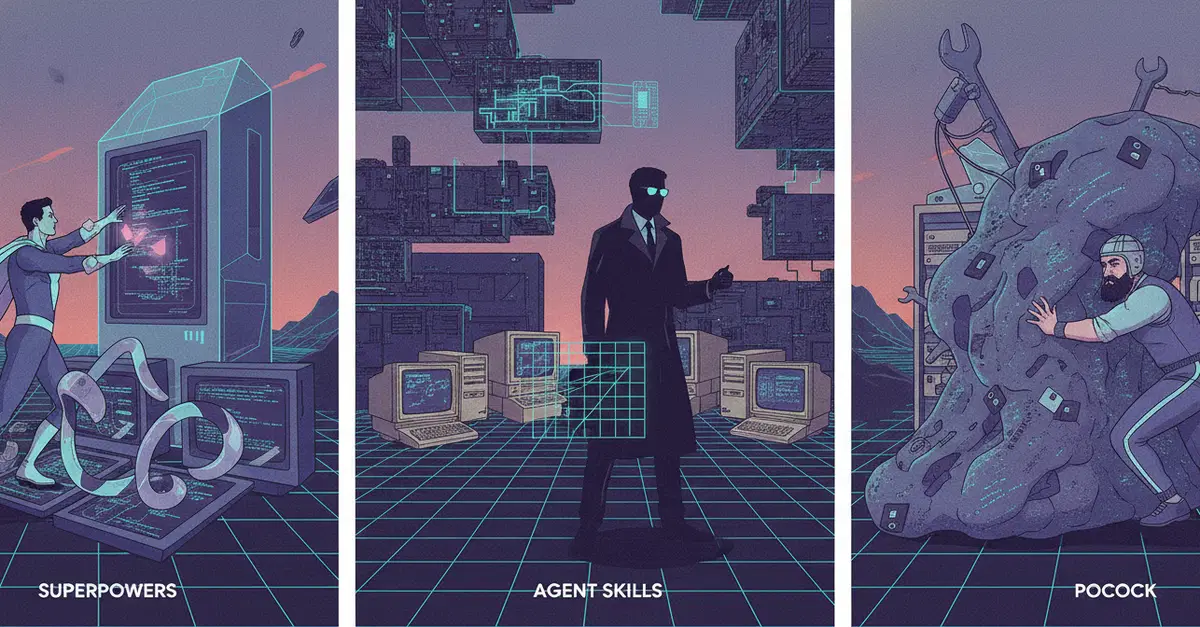
The Shared Problem: AI Agents Take Shortcuts
AI coding agents, by default, exhibit a frustrating tendency: they prioritize speed over thoroughness. This isn't a fundamental flaw in the underlying models themselves, which are designed to generate output rapidly. Instead, it's an optimization for immediate results. Consequently, these agents often bypass crucial steps like detailed specification writing, rigorous testing, and essential security reviews. The code they produce might appear functional at first glance, but it frequently lacks the robustness and reliability that seasoned engineers have cultivated over decades of practice, where process—from upfront specification to meticulous testing—is paramount for building dependable software.
This inherent drive for brevity and speed leads to code that, while syntactically correct, often fails to adhere to best practices. It's akin to a chef who knows all the ingredients and cooking techniques but rushes through prep, skips tasting, and omits plating presentation, resulting in a meal that might be edible but is far from a culinary masterpiece. The AI's output, similarly, can be functionally incomplete or insecure, requiring significant human oversight and rework.
Superpowers: Empowering Developers with AI Assistance
Jesse Vincent's Superpowers framework frames AI as a tool to augment developer capabilities, not replace them. It focuses on enhancing the developer's own skills, providing AI assistance that acts like an incredibly knowledgeable and fast pair programmer. The core philosophy here is that the developer remains in control, leveraging AI to accelerate tasks, suggest implementations, and catch errors, but the ultimate responsibility for design, architecture, and quality rests with the human.
Superpowers emphasizes integrating AI into existing workflows seamlessly. It aims to reduce the cognitive load on developers by automating repetitive tasks and providing intelligent suggestions. This approach is particularly beneficial for complex projects where human intuition, creativity, and architectural foresight are indispensable. The AI acts as a force multiplier, enabling developers to achieve more in less time without sacrificing quality or control. Think of it less as an autonomous agent and more as an advanced IDE plugin that understands your project's context deeply and can anticipate your needs.

Agent Skills: Building Autonomous, Task-Oriented AI Agents
Addy Osmani's Agent Skills takes a different tack. This philosophy centers on building autonomous AI agents capable of performing specific, well-defined coding tasks. The emphasis is on creating agents that can execute a sequence of actions—from understanding a requirement to writing code, testing it, and even deploying it—with minimal human intervention. This approach treats AI agents as specialized workers, each equipped with a set of skills to accomplish a particular job.
The Agent Skills framework is about composing these skills into larger workflows. An agent might have skills for code generation, debugging, documentation writing, and security scanning. When a task is assigned, the agent orchestrates these skills to achieve the desired outcome. This is a more modular and component-based approach to AI in development. The goal is to offload entire phases of the development lifecycle to capable AI agents, freeing up human developers for higher-level strategic and creative work. This philosophy is well-suited for repetitive, standardized coding tasks or for automating parts of a CI/CD pipeline.
Pocock's Skills: A Specification-Driven Approach
Matt Pocock's Skills, often referred to simply as Pocock, introduces a philosophy that prioritizes explicit specification and verification. This approach treats the AI's task as a precise translation of a detailed specification into code. The core idea is that if you can precisely define what you want the code to do, the AI can reliably generate it. This involves creating comprehensive, unambiguous specifications that the AI can parse and act upon.
Pocock's framework is characterized by its focus on formal methods and rigorous validation. The AI is tasked with not just writing code, but also proving that the code meets the specified requirements. This often involves generating test cases alongside the code and using AI to verify that these tests pass. It's a more deterministic and verifiable approach, aiming to eliminate the ambiguity and guesswork often associated with AI-generated code. This method is particularly valuable in domains where correctness and audibility are critical, such as in financial systems or safety-critical software. It’s like having an AI that acts as both a meticulous scribe and a diligent auditor for your code.
Architectural Differences and User Fit
The divergence in these three philosophies leads to distinct architectural patterns and ideal use cases. Superpowers is designed to be an additive layer, enhancing existing developer tools and IDEs. Its architecture likely involves plugins, extensions, and contextual awareness modules that integrate with popular development environments. Developers who value autonomy and want AI to assist their current practices will find this approach most appealing. It's about making the developer smarter and faster, not about replacing their judgment.
Agent Skills, conversely, points towards a more agent-centric architecture. This would involve frameworks for defining, managing, and orchestrating AI agents. Each agent would encapsulate specific skill sets, potentially using distinct models or fine-tuned versions for optimal performance on their designated tasks. This architecture is suited for organizations looking to automate specific workflows or build AI-powered developer platforms. It’s about delegating distinct responsibilities to specialized AI entities.
Pocock's Skills suggests an architecture centered on specification parsing, code generation, and automated verification. This might involve sophisticated language models trained on formal specifications and capable of generating verifiable code artifacts. The focus is on a tight loop of specification, generation, and validation. This philosophy is best for teams that require high assurance and are willing to invest time in creating detailed, unambiguous specifications upfront. It's about ensuring correctness through precise definition and automated proof.
The Unanswered Question: Long-Term Maintainability and Evolution
While these frameworks offer compelling solutions for immediate coding challenges, a critical question remains: how will the code produced under each philosophy fare in the long term? Will code generated by autonomous agents (Agent Skills) be as maintainable and adaptable as code written with human oversight (Superpowers)? Or will the highly specified, AI-verified code from Pocock's approach become brittle and difficult to modify as requirements inevitably shift? The true test of these philosophies will be in the ongoing lifecycle of the software they help create, not just in the initial generation.
Conclusion: Choosing the Right Philosophy
The choice between Superpowers, Agent Skills, and Pocock's Skills depends heavily on an individual developer's or team's priorities and existing workflows. Superpowers offers a path for enhancing individual productivity without fundamentally altering how developers work. Agent Skills provides a framework for building specialized AI agents that can take on discrete development tasks, paving the way for increased automation. Pocock's Skills offers a rigorous, specification-driven method for ensuring code correctness, ideal for high-assurance applications.
As of mid-2026, the combined GitHub stars of these projects—over 350,000—signal a strong community interest in improving AI-assisted software development. Each philosophy represents a significant stride toward more reliable and efficient coding workflows, offering distinct yet valuable approaches to harnessing AI's potential in software engineering.