The Expanding Role of AI in Software Development
AI coding assistants have rapidly evolved from simple autocompletion tools to sophisticated partners capable of writing tests, reviewing code, parsing logs, debugging production issues, and even contributing to architectural decisions. The efficiency gains these tools offer are undeniable, accelerating development cycles and reducing developer toil. However, this increased integration brings to the forefront a critical, often overlooked, question: where does your code actually go when these tools process it?
Recent events have amplified this concern. The decision by Claude Code to restrict access for users in China coincided with a security bulletin from China's Ministry of Industry and Information Technology highlighting data transmission risks associated with AI coding tools. These parallel developments underscore a growing unease among developers and organizations about the data privacy and security implications of relying on these powerful AI assistants.
Understanding Code Context for AI Assistants
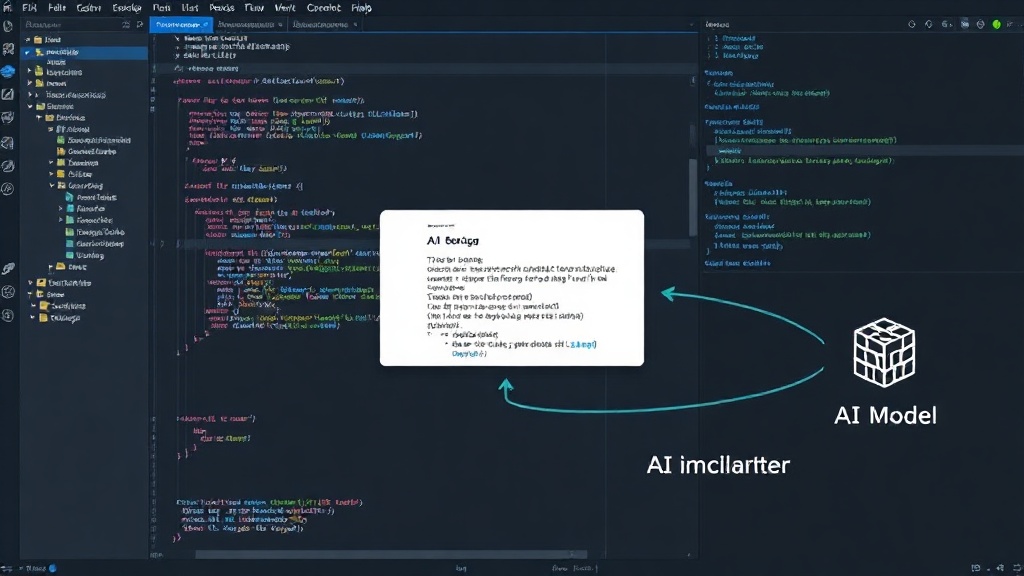
When you grant an AI coding assistant access to your working directory, it typically indexes your entire repository, not just the file you currently have open. This comprehensive indexing is essential for the AI to understand the broader context of your project, enabling more relevant and accurate suggestions. Tools like Cursor, GitHub Copilot, and others operate on this principle, building a knowledge base of your codebase to enhance their functionality.
However, this deep access raises significant questions about data handling and security. Developers working with massive, production-grade codebases often struggle with navigation. Files are scattered, functions call each other across numerous directories, and making a single change can feel like a high-stakes operation. When pair-programming with AI, feeding the AI the correct code context becomes paramount. Providing too much code can lead to token waste and AI confusion, while traditional search methods like grep often flood users with irrelevant matches, including comments, text strings, and similarly named functions in unrelated files.
Beyond Text Search: AST-Aware Semantic Analysis
The limitations of simple text-based search highlight the need for more advanced methods. Moving beyond basic string matching to Abstract Syntax Tree (AST)-aware semantic analysis offers a more profound understanding of code. This approach allows AI assistants to grasp the structure, relationships, and meaning of code elements, rather than just their textual representation. This is a critical step towards truly intelligent code assistance.
Companies like Serena MCP are developing solutions that leverage AST-aware semantic analysis to provide AI assistants with a deeper understanding of code context. This enables more precise code generation, refactoring, and debugging. Instead of just finding lines that contain specific keywords, the AI can understand that a function named `calculate_total` in one file is semantically equivalent to another `compute_sum` in a different module, even if their implementation details vary. This level of understanding is what transforms an AI coding tool from a glorified autocomplete into a genuine programming partner.
Data Transmission and Security Risks
The core of the security concern lies in how and where the code data is transmitted and processed. When a developer's code is sent to an AI service, it leaves their local environment. The crucial questions are:
- Where is the data stored? Is it retained by the AI provider, or is it ephemeral?
- Who has access to this data? Are there strict access controls in place to prevent unauthorized viewing or use?
- How is the data secured in transit and at rest? Are industry-standard encryption protocols employed?
- What are the provider's data retention policies? How long is code data kept, and how is it eventually purged?
- Is the code used for training future models? If so, are there anonymization techniques employed to protect intellectual property?
Without clear answers and robust security measures from AI tool providers, developers risk exposing proprietary algorithms, sensitive data structures, and other confidential intellectual property. The convenience offered by AI coding tools must be weighed against these potential security vulnerabilities. For organizations with strict compliance requirements or valuable IP, the default assumption should be that any code sent to a third-party AI service is potentially compromised until proven otherwise.
Mitigation and Future Considerations
Addressing these concerns requires a multi-faceted approach. For developers, it means being judicious about which tools they use and understanding their terms of service regarding data handling. For AI providers, it necessitates greater transparency and the implementation of strong security practices, including end-to-end encryption, robust access controls, and clear data retention policies. Some tools may offer on-premises or private cloud deployment options, which can mitigate some of the risks associated with data transmission.
The future of AI in software development hinges on building trust. As these tools become more deeply embedded in workflows, the underlying security and privacy mechanisms must be as advanced as the AI capabilities themselves. Developers and organizations need assurance that their code is handled responsibly, protecting both their intellectual property and their overall security posture. The question of 'where does it go' must have a clear, secure, and transparent answer.