The Unseen Leak: How AI Assistants Compromise API Keys
The rise of AI-powered coding assistants promises to accelerate development workflows. Tools like GitHub Copilot, Cursor, and others ingest vast amounts of code and project context to provide intelligent suggestions, automate repetitive tasks, and even generate entire functions. However, this deep integration creates an unforeseen security risk: the inadvertent exposure of sensitive API keys and credentials. When an AI assistant has access to a developer's repository, any API key present in configuration files (like .env), code comments, or even temporary files can be processed and, critically, included in chat transcripts, log files, or bug reports shared with the AI service. This isn't a theoretical vulnerability; it's a direct consequence of how these tools operate. The moment an API key lands in a file that the AI can read, it has the potential to be transmitted to external servers, creating a significant security blind spot.

The core issue lies in the AI's need for context. To be effective, these assistants must understand the surrounding code and project structure. This requires access to local files and potentially sensitive information. Unlike traditional IDEs that keep processing local, AI assistants often send code snippets and contextual data to cloud-based models for analysis. While many services employ data sanitization and anonymization techniques, the presence of hardcoded or easily accessible API keys in the codebase presents a direct vector for leakage. A developer might use a key for a testing service, a database, or a third-party API, assuming it remains confined to their local environment. Yet, when interacting with an AI assistant, that key can silently travel outside the secure perimeter.
The Need for a Local-Only Secret Manager
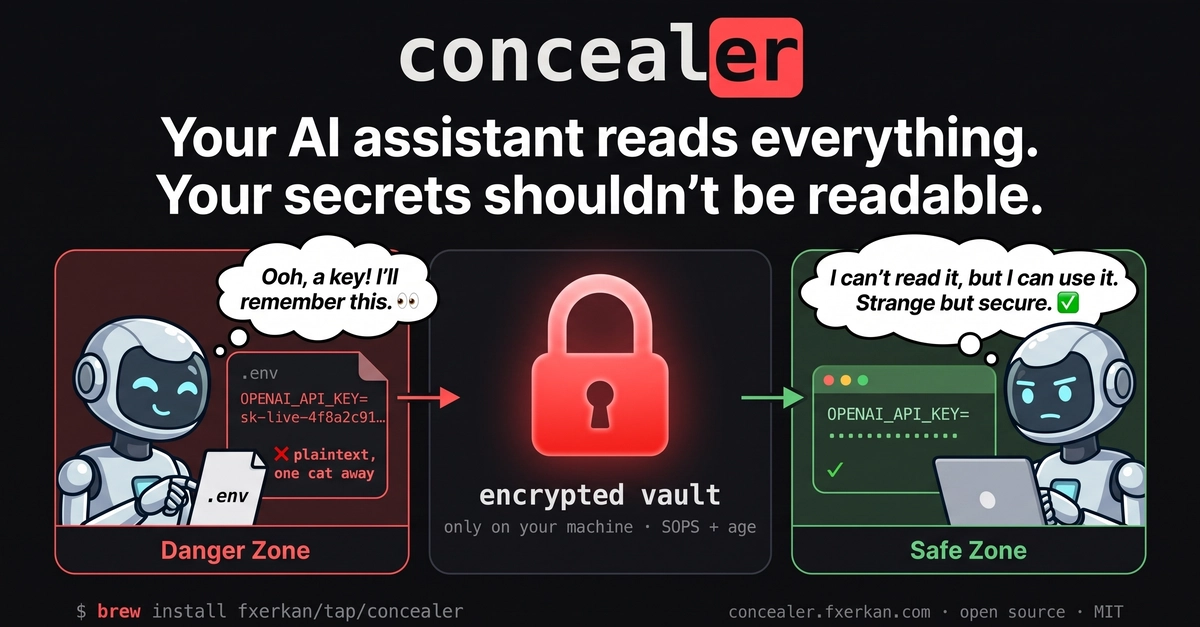
The inherent risk of cloud-based AI assistants processing sensitive credentials has spurred the development of alternative solutions. The most effective approach is to keep secrets strictly local and only expose masked or redacted versions to the AI. This is the principle behind concealer, a project designed to act as a local-only AI secret manager. Instead of allowing AI assistants direct access to sensitive files, concealer intercepts requests for secrets, provides the AI with placeholder or masked data, and ensures that actual credentials never leave the developer's machine. This strategy is crucial for maintaining security in an era where AI is becoming an indispensable part of the development toolkit. The goal is to enable developers to leverage AI's productivity gains without compromising their application's security posture or their organization's data integrity.
concealer, for instance, is built as a single Python file, emphasizing simplicity and ease of integration. It operates by creating a local proxy or wrapper around sensitive data. When an AI assistant needs access to a credential (e.g., an API key for a database), it queries concealer. The manager then returns a masked version of the key or a predefined placeholder string, such as 'API_KEY_REDACTED'. The actual secret remains encrypted and inaccessible to the AI model and its associated cloud services. This local-first approach provides a robust defense against accidental credential exposure, which is a growing concern as AI coding tools become more ubiquitous.
How Concealer Works: A Technical Overview
The architecture of a local secret manager like concealer is straightforward but effective. It typically involves a lightweight service running on the developer's machine. This service acts as a gatekeeper for all secrets. Developers configure concealer with their actual API keys and other sensitive information, which are stored securely, often using local encryption. When an AI coding assistant, or any other application configured to use the manager, requests a secret, the request is routed to concealer instead of directly accessing the configuration file.
concealer then performs a lookup and returns a manipulated version of the secret. This manipulation can take several forms: it might return a static, anonymized string (e.g., 'sk-********************' for Stripe keys), a unique but temporary token that is not the actual key, or simply a placeholder indicating that a secret exists but cannot be revealed. The AI assistant receives this masked data and uses it to generate code or provide context, never seeing the real credential. The actual key remains safely stored and encrypted on the developer's local system, preventing it from being logged, transmitted, or exposed in any external communication channels associated with the AI service.

The advantage of this model is its minimal disruption to the developer experience. Developers continue to interact with their AI assistants naturally, while concealer operates transparently in the background. The setup is typically a matter of installing the tool and configuring environment variables or application settings to point to the local manager. This makes it a practical solution for individual developers and teams looking to mitigate the risks associated with AI-assisted coding without sacrificing productivity. The success of such tools hinges on their ability to be unobtrusive while providing a critical layer of security.
The Broader Implications for AI and Security
The emergence of tools like concealer highlights a critical tension in the current AI development landscape: the drive for innovation versus the imperative of security. As AI assistants become more deeply integrated into software development, the attack surface for credential theft expands. This isn't limited to API keys; database passwords, private keys, and other forms of sensitive information are equally at risk. The trend suggests a growing need for specialized security solutions tailored to the unique challenges posed by AI-driven development environments.
What remains to be seen is how AI providers will adapt. Will they offer more robust built-in mechanisms for handling secrets, or will the responsibility fall entirely on developers and third-party tools? The current model, where sensitive data can be inadvertently shared, is unsustainable for enterprises and security-conscious individuals. The development of local-first secret managers is a necessary evolution, providing a much-needed layer of protection. As AI coding assistants continue to evolve, so too must the security practices and tools that surround them. The implicit trust developers place in these tools to handle their codebase responsibly needs to be matched by explicit, verifiable security measures.