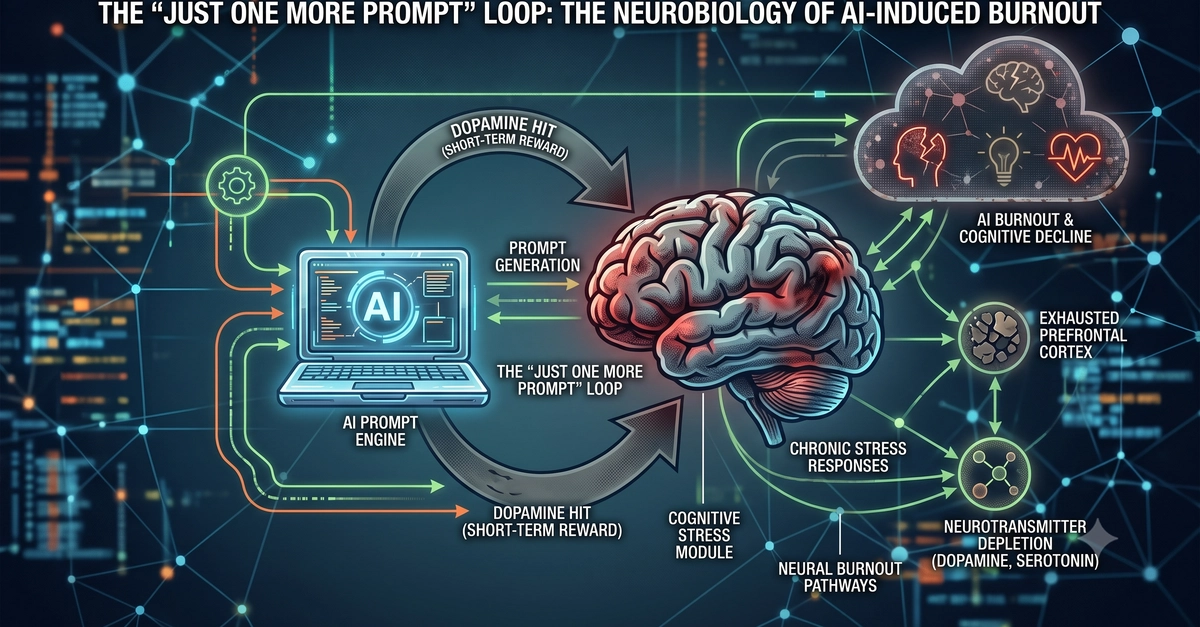
The Compulsive Loop of AI Interaction
It's 2:00 AM. A stubborn bug has eluded you for three hours. Sleep beckons, but your fingers are already on the keyboard, typing one more instruction into the AI coding assistant. Your heart rate quickens, an unusual response for someone seated at a desk. You repeat the same mantra from an hour ago: “Just one more prompt, and I’ll fix it.” This scene is becoming a familiar narrative for many who write code, create content, or otherwise engage with generative AI tools daily. This isn't the dread-filled, cursor-staring burnout of the past. Instead, the work feels compulsively engaging, almost too engaging to stop. This unique dynamic warrants close examination.
Over the last year, developers, writers, and researchers have begun describing a specific kind of exhaustion emerging from prolonged AI-assisted work. It’s characterized not by a lack of motivation, but by an inability to disengage, even when fatigue sets in. This phenomenon is often referred to as the "Just One More Prompt" loop.
Traditional burnout often manifests as cynicism, detachment, and a feeling of ineffectiveness. The new AI-induced burnout, however, presents differently. It’s marked by a persistent, almost addictive engagement with the AI tool, even when the user is aware of diminishing returns or the need for rest. This engagement is driven by the intermittent reward system inherent in interacting with these models. Each prompt, whether it yields a breakthrough or a minor adjustment, can trigger a small dopamine release, reinforcing the behavior. Think of it less like a tireless marathon and more like a slot machine; you keep pulling the lever, hoping for that next big win, even when you know you should walk away.
This neurobiological mechanism is key to understanding why users find it so hard to disengage. The brain's reward pathways, particularly those involving dopamine, are activated by unpredictable rewards. When an AI provides a correct answer, a useful code snippet, or a creative idea, it acts as a positive reinforcement. This makes the user want to repeat the action that led to the reward. The uncertainty of whether the *next* prompt will be the one that solves the problem or generates the perfect output keeps users hooked. This is compounded by the feeling of progress, however incremental. Every successful interaction, no matter how small, contributes to a sense of forward momentum, making it difficult to step away and rest.
The Dopamine Cycle and Cognitive Load
The core of this AI-induced burnout lies in the interplay between the dopamine reward cycle and cognitive load management. When we engage with AI tools, especially for complex tasks like debugging or creative writing, we are constantly evaluating the output. This evaluation process requires significant cognitive effort. However, the potential for a quick, AI-generated solution can override our natural inclination to cease effort when fatigued. The brain becomes conditioned to seek that dopamine hit associated with a successful AI interaction, even if the overall task is draining.
The AI assistant acts as a cognitive prosthesis, augmenting our capabilities. This is incredibly powerful, but it also means our decision-making processes become intertwined with the tool's availability. When faced with a complex problem, the immediate availability of an AI to generate potential solutions can feel like a shortcut. However, this shortcut often bypasses the necessary cognitive downtime that allows for true problem-solving and prevents exhaustion. Instead of stepping away to allow the subconscious mind to process, users are tempted to make another pass with the AI, further depleting mental resources.
This continuous loop of prompting, evaluating, and seeking rewards can lead to a state of hyperfocus that prevents the brain from entering restorative states. Sleep deprivation, reduced attention spans, and an inability to focus on non-AI-related tasks are common consequences. The brain, constantly stimulated by the unpredictable rewards of AI interaction, struggles to downshift to lower energy states necessary for recovery. This is akin to a car’s engine running at high RPMs for too long; eventually, it overheats and suffers damage.
Furthermore, the perceived efficiency of AI can mask the underlying cognitive cost. Users might feel like they are being highly productive because they are rapidly generating output. However, the mental energy expended in prompt engineering, output evaluation, and the constant pursuit of that next reward can be far more draining than traditional, linear work. This disconnect between perceived productivity and actual mental expenditure is a hallmark of this new burnout.
Identifying and Mitigating AI Burnout
Recognizing AI-induced burnout requires an honest assessment of one’s interaction patterns. Are you finding it difficult to stop prompting, even when you know you should? Do you feel a compulsive urge to check AI outputs or engage with the tool? Are you experiencing fatigue that doesn't resolve with short breaks but rather with extended periods away from the AI?
Mitigation strategies must address both the behavioral and neurobiological aspects. Firstly, setting strict time limits for AI tool usage is crucial. Treat AI sessions like focused sprints, with planned breaks and clear end points. Secondly, cultivate awareness of the dopamine loop. Acknowledge that the urge to prompt is often driven by the reward mechanism, not necessarily by a genuine need for another AI-generated solution.
Implementing a “no-AI” period, similar to digital detoxes, can help reset the brain’s reward pathways. This means stepping away from AI tools entirely for a set duration, focusing instead on tasks that require deep, unassisted thought or creative problem-solving. Encouraging collaborative problem-solving with human colleagues can also provide a different kind of engagement that doesn't rely on the same reward mechanisms.
For organizations employing AI tools, fostering a culture that prioritizes well-being and sustainable work practices is paramount. This includes educating employees about the potential for AI-induced burnout and encouraging them to set boundaries. Leaders should model healthy usage habits and ensure that performance expectations do not implicitly reward the compulsive use of AI tools. Ultimately, AI should be a tool to augment human capabilities, not a driver of exhaustion.
What remains unaddressed is how the design of AI interfaces and the economic incentives driving their adoption might inadvertently exacerbate this problem. Will future AI tools incorporate features to manage user engagement and prevent compulsive use, or will they be optimized purely for interaction metrics?