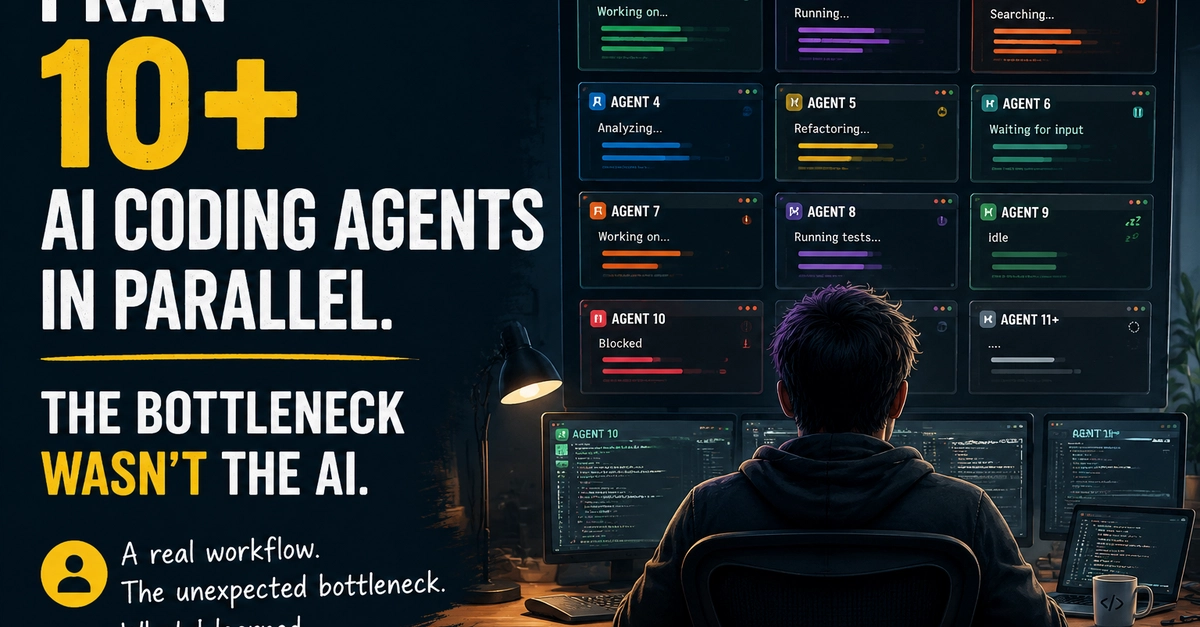
The Parallel Processing Paradox
The promise of AI coding agents is to accelerate development cycles. Initially, this promise holds true. A single agent, given a task, follows a straightforward workflow: receive instruction, generate code, await review, and proceed. This model works well for one or two agents. The real shift, however, occurs when developers begin running multiple agents concurrently.
Imagine a scenario where one agent is busy implementing a new feature, another is diligently fixing bugs, a third is exploring a novel technical approach, a fourth is performing code reviews, and a fifth is automating repetitive tasks. This parallel execution initially feels like a massive leap in productivity. The perceived bottleneck shifts from the speed of manual coding to the AI's generation speed. However, as the number of active agents scales, a surprising truth emerges: the bottleneck isn't the AI's processing power or code generation speed. It's the human developer's capacity to manage, review, and integrate the output from these numerous agents.
The Human Bottleneck Revealed
When a developer runs more than 10 AI coding agents simultaneously, the sheer volume of tasks and outputs becomes overwhelming. The workflow transforms from a simple "task → review → continue" loop for one agent to a complex, multi-threaded juggling act for the developer. Each agent produces code, suggestions, or analyses that require human attention. This attention is finite. The developer must context-switch between different agents, understand their distinct outputs, verify their correctness, and decide how to integrate them into the project. This constant demand on cognitive load and decision-making capacity creates the new bottleneck.
The types of agents also contribute to this complexity. The author's setup, for instance, involves not just one type of AI but a diverse array of agents, including:
- Claude for general tasks and reasoning.
- GitHub Copilot for inline code suggestions and completion.
- Various specialized agents for specific functions like unit test generation or documentation.
This heterogeneity means the developer must adapt their review process for each agent's output, understanding its strengths, weaknesses, and typical error patterns. It’s less like managing a team of identical assistants and more like managing a diverse group of specialists, each with their own communication style and expertise.
The surprising detail here is not the capability of the AI agents themselves, which are increasingly sophisticated, but the fundamental human limitation they expose. We’ve automated the creation of code to a degree, but the critical oversight, strategic decision-making, and final integration still rely on human intelligence, which has not scaled at the same pace as AI generation.
Rethinking Parallel AI Workflows
The implication for developers is clear: simply launching more AI agents doesn't automatically translate to linear productivity gains. The focus must shift from optimizing AI generation speed to optimizing human-AI interaction and workflow management. This involves several key areas:
1. Enhanced Review and Validation Strategies
Developers need more efficient ways to review and validate AI-generated code. This could involve developing better automated testing strategies that can quickly catch regressions introduced by AI. It might also mean creating AI-assisted review tools that can summarize changes, highlight potential issues, or even pre-validate code snippets based on project context and coding standards.
2. Improved Agent Orchestration and Management
Managing over 10 agents requires a robust orchestration layer. Developers need tools that can prioritize tasks, manage dependencies between agents, aggregate outputs, and provide a unified dashboard for monitoring and control. Think of it less like managing individual browser tabs and more like managing a sophisticated CI/CD pipeline with human oversight at key stages.
3. Strategic Task Allocation
Not all tasks are equally suitable for parallel AI execution. Developers must become adept at identifying which tasks benefit most from AI assistance and which require deeper human involvement. Understanding the strengths and weaknesses of different AI agents and matching them to the appropriate sub-tasks within a larger feature or bug fix is crucial.
4. Cognitive Load Management
Ultimately, the bottleneck is cognitive. Developers need strategies to manage context switching, reduce mental fatigue, and maintain focus. This might involve time-boxing agent review sessions, establishing clear communication protocols for agent outputs, and ensuring sufficient breaks to maintain peak performance. The goal is to leverage AI as a powerful assistant, not to drown in its output.
The Future of AI-Assisted Development
The current state of AI coding agents presents a fascinating challenge. The technology is rapidly advancing, capable of generating complex code with impressive accuracy. Yet, the human element remains the critical factor. As AI agents become more capable, the value of the developer shifts from pure code generation to higher-level tasks: architectural design, complex problem-solving, strategic decision-making, and the crucial act of synthesis. If you're a developer working with multiple AI agents, you're likely already feeling this strain. The question isn't whether AI can write code, but how we, as humans, can most effectively collaborate with an ever-increasing swarm of AI assistants to build better software, faster.