The Problem: AI Agent Amnesia
Running multiple AI coding agents, like Claude Code or GitHub Copilot, often leads to a frustrating experience. When one agent hits its usage limit or a natural stopping point, its entire context – the task plan, ongoing edits, and specific constraints – vanishes. This forces developers to manually summarize and transfer this crucial information to the next agent, a process prone to errors and omissions. This fragmentation of knowledge significantly hinders productivity and the ability to tackle complex coding projects that span multiple AI interactions.
Developer David Bisina experienced this friction firsthand and developed Relay, a Go daemon designed to manage these transitions. Relay redefines the agent handoff from a manual, error-prone task into a structured protocol, ensuring continuity and preserving the agent's accumulated knowledge.
How Relay Works: The Signed Handoff Protocol
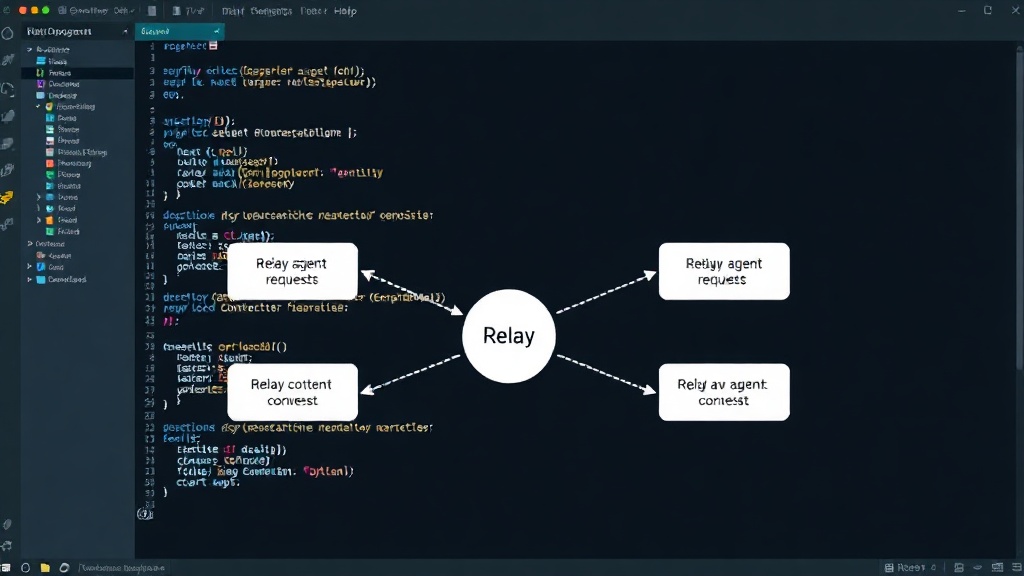
Relay operates by actively monitoring the usage of the AI provider and intercepting task requests. When an agent approaches its usage threshold, Relay intervenes to capture the current state before it's lost. The core mechanism involves several key steps:
1. Usage Detection: Relay continuously monitors the active provider's quota. It achieves this through various means: proxy headers when available, direct inspection of session files, or, as a last resort, by counting requests. Once usage crosses a predefined threshold, Relay triggers the handoff process.
2. State Capture: Before the current agent's context is lost, Relay captures its essential state. This includes the current input prompt, the agent's response, and any relevant metadata. This captured state is essentially a snapshot of the agent's 'memory' at the point of interruption.
3. Handoff Protocol Initiation: Relay then constructs a signed message containing the captured state. This message acts as a verifiable record of what the previous agent knew and accomplished. The signing ensures the integrity and authenticity of the context being passed forward.
4. State Injection: When a new agent is invoked, Relay intercepts the request. Instead of passing a fresh, empty prompt, Relay injects the signed context from the previous agent. This allows the new agent to seamlessly resume the task with full awareness of the prior work, constraints, and plan.
5. Provider Agnosticism: A critical design goal of Relay is its independence from specific AI providers. It aims to work with any agent that can be proxied or whose session state can be accessed. This flexibility is key to its utility in diverse AI development workflows.
The 'Signed' Aspect: Trust and Verifiability
The 'signed' component of Relay's protocol is crucial. In the context of AI agents, where output can be complex and subtle, ensuring the integrity of the passed context is paramount. A signed handoff provides:
- Authenticity: It verifies that the context originated from a trusted Relay instance and wasn't tampered with by an intermediary or malicious actor.
- Integrity: It guarantees that the data within the handoff message has not been altered since it was signed by the originating agent's Relay instance.
- Non-repudiation (Potential): While not fully implemented in the initial release, a robust signing mechanism could eventually allow for non-repudiation, preventing an agent or Relay instance from denying that it passed a specific piece of context.
This signing process adds a layer of security and reliability that is often missing in ad-hoc manual context transfers. It's akin to having a notary public verify the contents of a document before it's handed to the next party.
Beyond Context Loss: Workflow Enhancements
Relay's protocol offers benefits that extend beyond simply preventing context loss due to usage limits. It fundamentally changes how developers interact with sequences of AI coding tasks:
- Complex Task Decomposition: Developers can break down large, complex coding tasks into smaller, manageable chunks, each handled by an AI agent. Relay ensures that the context flows seamlessly between these chunks, allowing for sophisticated multi-agent workflows.
- Iterative Refinement: When an AI agent produces an output that needs refinement, Relay can capture the request for refinement and the agent's output, then pass it to another agent (or the same agent, if its context is reset) for further work without manual intervention.
- Constraint Enforcement: Specific instructions, such as "do not refactor this particular function" or "prioritize performance over readability for this module," can be reliably passed along, ensuring consistent adherence to project requirements.
- Reduced Cognitive Load: By automating the context transfer, developers are freed from the mental overhead of remembering and re-articulating all previous steps and constraints. This allows them to focus on higher-level architectural decisions and problem-solving.
Implementation and Future Directions
Relay is implemented as a Go daemon, making it relatively lightweight and efficient to run. The project is open-source, hosted on GitHub, inviting community contributions and improvements. Future developments could include:
- Broader Provider Support: Expanding compatibility to a wider range of AI coding agents and platforms.
- Advanced State Management: Implementing more sophisticated methods for capturing and serializing complex agent states, potentially including intermediate code snippets or debugging information.
- Policy-Based Handoffs: Allowing users to define custom policies for when and how handoffs should occur, beyond simple usage limits (e.g., based on task complexity, time elapsed, or specific keywords in output).
- Centralized Management: Developing a dashboard or interface for managing multiple Relay instances and monitoring agent interactions across an organization.
The development of Relay addresses a critical gap in the current AI agent ecosystem. By formalizing the handoff process, it paves the way for more robust, reliable, and scalable AI-assisted software development workflows.