The Illusion of Effortless Code
Last month, a subtle bug surfaced in a personal project. It wasn't catastrophic, just a value failing to update as expected. Opening the relevant file, I scanned it top to bottom, only to find myself utterly lost. The code itself wasn't the problem; it was clean, well-organized, and precisely what I'd instructed it to do. The issue was that I had never truly internalized its logic. I had generated it, given it a cursory glance, and moved on. This happened dozens of times without me ever pausing long enough to grasp how it actually worked.
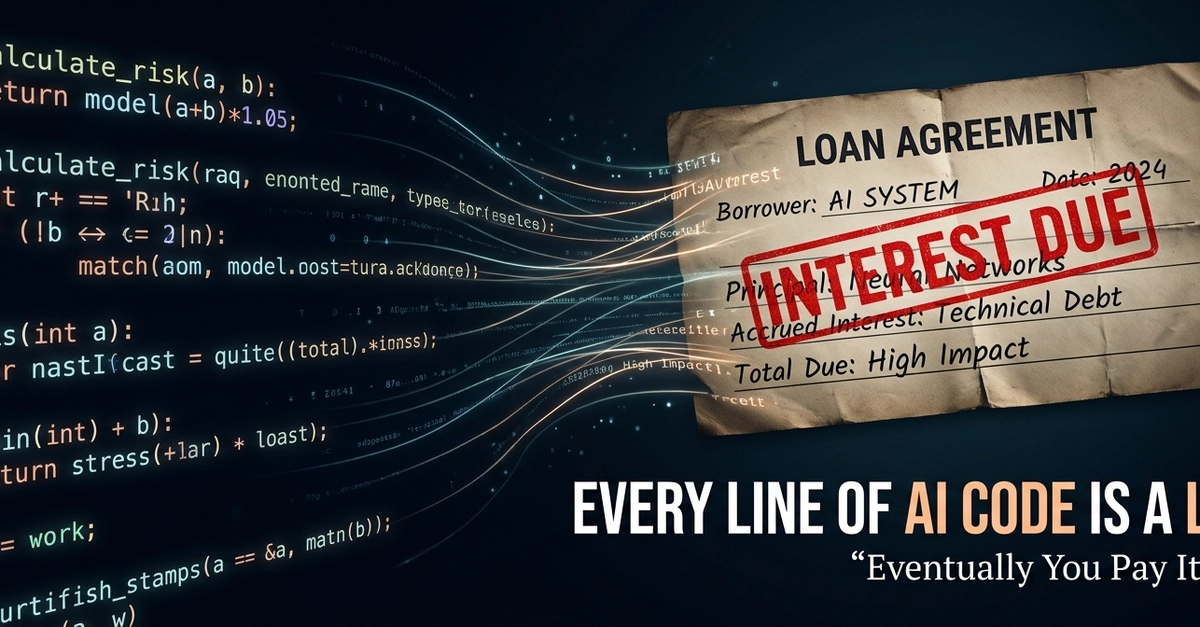
The stark realization hit: I couldn't fix a bug in my own project because I didn't truly own the code. This experience reframed my perspective on AI-generated code. It's not a gift; it's a loan. For a personal side project, built in a relaxed evening mode where AI often takes the wheel, I'd describe a requirement, and the AI would generate it. I'd accept it and continue building the next feature, deferring the comprehension of the code to a later, never-arrived, date.
This pattern is becoming increasingly common. Tools like GitHub Copilot, Amazon CodeWhisperer, and others are integrated directly into developer workflows, offering instant code suggestions and completions. The allure of speed and reduced cognitive load is undeniable. Developers, especially those working on personal projects or in rapid prototyping environments, find themselves leveraging these tools extensively. The ease with which complex functions or boilerplate code can be generated allows for faster iteration and the exploration of more ambitious ideas. It feels like getting a head start, a shortcut that bypasses the tedious parts of development.
However, this convenience comes with an implicit cost. Each line of AI-generated code, accepted without full understanding, functions like a small, interest-free loan. The principal is the code itself, and the interest is the deferred understanding and future maintenance burden. When a bug appears, or when requirements evolve, the developer must confront the code they didn't fully build. This confrontation can be disorienting, as the original context and reasoning behind the AI's output are often lost.

The Compounding Interest: Maintenance and Debugging
The problem compounds quickly. Imagine a project where 50% of the code was AI-generated and accepted without deep review. When a bug emerges, tracing its origin might involve sifting through both human-written and AI-generated logic. If the AI produced a subtly flawed piece of code, the developer who accepted it might not recognize the flaw because they didn't build the mental model for that segment. They are essentially debugging code written by a black box, with their own prior acceptance adding another layer of indirection.
This is particularly true for code that is not immediately executed or tested. Developers might accept code snippets for features they plan to implement later. When that time comes, the original intent might be hazy, and the AI's output, while syntactically correct, might not align with the now-evolved project architecture or requirements. Debugging such code is akin to trying to understand a foreign language without a dictionary – you might recognize some words, but the meaning and structure elude you.
The cognitive overhead of managing AI-generated code can be significant. Instead of a single mental model for the entire codebase, developers might find themselves managing multiple fragmented models: one for their own code, and several disparate, often incomplete, models for the AI-generated portions. This fragmentation increases the effort required for any change, whether it's fixing a bug, refactoring, or adding a new feature. The initial time saved by AI generation is often reclaimed, and then some, during the maintenance phase.
Ownership and Accountability in the Age of AI
The core issue boils down to ownership. When a developer accepts AI-generated code, they are implicitly taking ownership of it. But true ownership requires understanding. Without understanding, the developer cannot be fully accountable for the code's behavior, its security implications, or its long-term maintainability. This lack of deep understanding creates a vulnerability, not just in the codebase, but in the developer's own expertise and confidence.
Consider the security implications. An AI might generate code that appears functional but contains subtle vulnerabilities. If a developer accepts this code without thorough review, they are introducing potential security risks into their project. The AI model itself is trained on vast datasets, which may include insecure code patterns. While AI providers are working to mitigate this, the responsibility ultimately falls on the human developer to ensure the code's integrity. Without a deep understanding of the generated code, identifying and rectifying these vulnerabilities becomes a much harder task.
The temptation to treat AI as an infallible code generator is strong. It's easy to fall into the trap of accepting suggestions without critical evaluation. However, this approach undermines the very skills that make a developer valuable: problem-solving, critical thinking, and deep system understanding. The AI is a powerful assistant, a pair programmer, but it is not a replacement for the developer's own intellect and judgment. The 'loan' of code must be repaid with diligent review, comprehension, and integration into the developer's own mental model of the project.
Repaying the Loan: Best Practices for AI Code Usage
To avoid the pitfalls of deferred understanding, developers must adopt new practices when working with AI code generation tools. The 'loan' metaphor provides a useful framework: treat every line of AI-generated code as a debt that needs to be repaid. This means actively engaging with the code, not just accepting it.
Firstly, review thoroughly. Never accept AI-generated code blindly. Read it, understand its purpose, and verify that it aligns with your project's architecture and coding standards. Ask yourself: 'Why did the AI write it this way?' and 'Is there a simpler or more efficient way?'
Secondly, refactor and rewrite. If a piece of AI-generated code doesn't feel right, or if you don't fully grasp it, refactor it. Rewrite sections in your own style, incorporating your understanding. This process solidifies your ownership and improves the code's clarity for future maintenance.
Thirdly, test rigorously. Ensure that AI-generated code is covered by comprehensive unit and integration tests. This not only verifies functionality but also serves as a form of documentation, explaining how the code is expected to behave. If tests fail, you'll be forced to confront the AI's output.
Finally, prioritize learning. Use AI as a tool to learn new patterns or syntax, but always follow up with focused study. If the AI generates code using a library or pattern you're unfamiliar with, take the time to understand it independently. Treat the AI's suggestions as starting points for deeper exploration, not endpoints.
The future of software development will undoubtedly involve AI. These tools offer immense potential for productivity gains. However, embracing them without a clear understanding of their implications can lead to technical debt that is far more costly than the time saved. By treating AI-generated code as a loan that requires repayment through understanding and diligent practice, developers can harness its power responsibly, ensuring the long-term health and maintainability of their projects.