The Shifting Landscape of Software Development
The way software is built has undergone a seismic shift. For years, developers prided themselves on writing every line of code. This meticulous approach, while ensuring deep understanding and control, often meant projects moved at a deliberate pace. Today, that paradigm is rapidly evolving. Many developers, including those who once cherished crafting every character, now find themselves acting more as architects and reviewers than pure coders.
This transition is largely fueled by the advent of sophisticated AI code generation tools. These tools can translate high-level specifications into functional code with remarkable speed. The advantage is clear: new ideas can be realized as working software much faster than before. However, this acceleration comes with its own set of challenges. A significant risk is the tendency to repeatedly fall into the same coding pitfalls, even with AI assistance.
The core issue arises from the repetitive nature of instructing an AI. Developers often find themselves repeating the same directives across different projects. "This part should be a plugin." "That functionality needs to remain outside the core module." "No domain logic should reside within the shell component." "Please, for the love of all that is holy, do not invent a fourth way to handle tabbed interfaces." The AI, in its unfailing compliance, would generate code that appeared correct, only for the developer to discover a slightly different, yet fundamentally similar, implementation of the same pattern days later. This constant cycle of re-specification and review, while faster than traditional coding, still introduced friction and inefficiency.
This recurring need to guide the AI, to steer it away from common mistakes or suboptimal patterns, highlighted a gap. The AI could generate code, but it lacked an ingrained understanding of project-specific architectural decisions or established best practices that a human developer would naturally apply. It was like having an incredibly fast but somewhat naive assistant who needed constant, precise instruction on what *not* to do, and how to structure things consistently.
The realization was that instead of repeating the same foundational architectural explanations to the AI for every new Angular project, a more robust solution was needed. This led to the conceptualization of a standardized, reusable shell – a pre-defined structure that encapsulated common patterns and best practices. This shell would serve as a strong starting point, reducing the need for verbose, repetitive prompts and minimizing the risk of AI-introduced inconsistencies.
From Problem to Open-Source Solution
The need for a consistent, AI-friendly starting point for Angular projects became undeniable. The developer, Norbert Rosenwinkel, recognized that many of the explanations he was providing to AI code generators were essentially the same, project after project. These explanations covered fundamental architectural decisions: what should be a plugin, what should be part of the core, the separation of concerns regarding domain logic and the shell, and the avoidance of redundant UI patterns like multiple tab implementations.
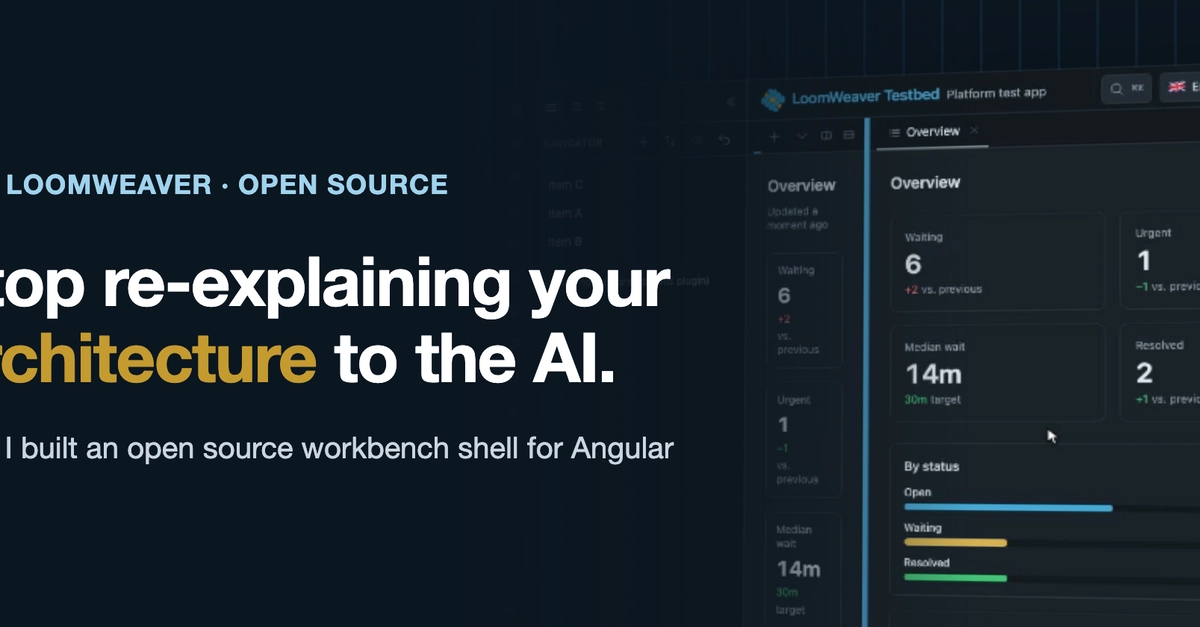
Instead of reiterating these guidelines every time, the logical next step was to encapsulate them. This led to the development of an open-source shell specifically designed for Angular applications. The goal was to create a foundational structure that developers could leverage from the outset, significantly reducing the overhead of initial project setup and AI prompting. This shell acts as a blueprint, embedding common architectural patterns and best practices directly into the project structure.
Think of it less like a standard project template and more like a well-defined framework for *how* to build within Angular, especially when leveraging AI assistance. It provides a clear set of rules and conventions that both the developer and the AI can adhere to. This pre-defined structure minimizes ambiguity, allowing the AI to generate more predictable and consistent code that aligns with the intended architecture.
The benefits are manifold. Firstly, it drastically cuts down on the time spent on initial setup and boilerplate code. Developers can start focusing on the unique business logic of their application much earlier. Secondly, it promotes consistency across projects. By using a standardized shell, teams can ensure that new applications follow established architectural principles, making them easier to understand, maintain, and scale. This is particularly valuable in larger organizations or teams where multiple developers contribute to various projects.
Furthermore, by providing a clear, opinionated structure, the shell helps mitigate the risks associated with AI-generated code. Instead of the AI potentially inventing novel, unproven patterns, it is guided by a proven, well-structured foundation. This reduces the likelihood of encountering subtle bugs or architectural flaws that are difficult to debug in AI-generated code. The developer's role shifts further towards high-level design and critical code review, ensuring the AI's output adheres to the established shell's principles.
The decision to make this shell open-source is a critical one. It allows the broader Angular community to benefit from this solution, contributing to its improvement and adaptation. Open-sourcing fosters collaboration, enabling other developers to identify potential issues, suggest enhancements, and tailor the shell to their specific needs. This collective effort can lead to a more robust and versatile foundation for Angular development, ultimately benefiting everyone in the ecosystem.
What remains to be seen is how this approach scales across different types of AI models and their evolving capabilities. As AI becomes more sophisticated in understanding context and adhering to complex architectural constraints, the nature of the prompts and the necessity of such shells might evolve. However, for the current landscape, a well-designed, open-source shell offers a tangible improvement in developer efficiency and code quality when working with AI code generation.