AI coding agents can modify an unfamiliar file in seconds. The slower, more important question is often: Why does this code look this way?
The answer might be lost in fragmented local agent conversations. Git captures code changes, but not the context of the discussions that led to them. This gap leaves AI agents, and developers themselves, operating with incomplete information, potentially leading to suboptimal edits or misunderstandings of existing logic.
Developer Chenxiachan recognized this limitation and built a solution: a local query layer for their ThoughtDAG tool. This enhancement allows developers and coding agents to deliberately retrieve relevant conversation history before making edits.
Querying Code History Before Editing
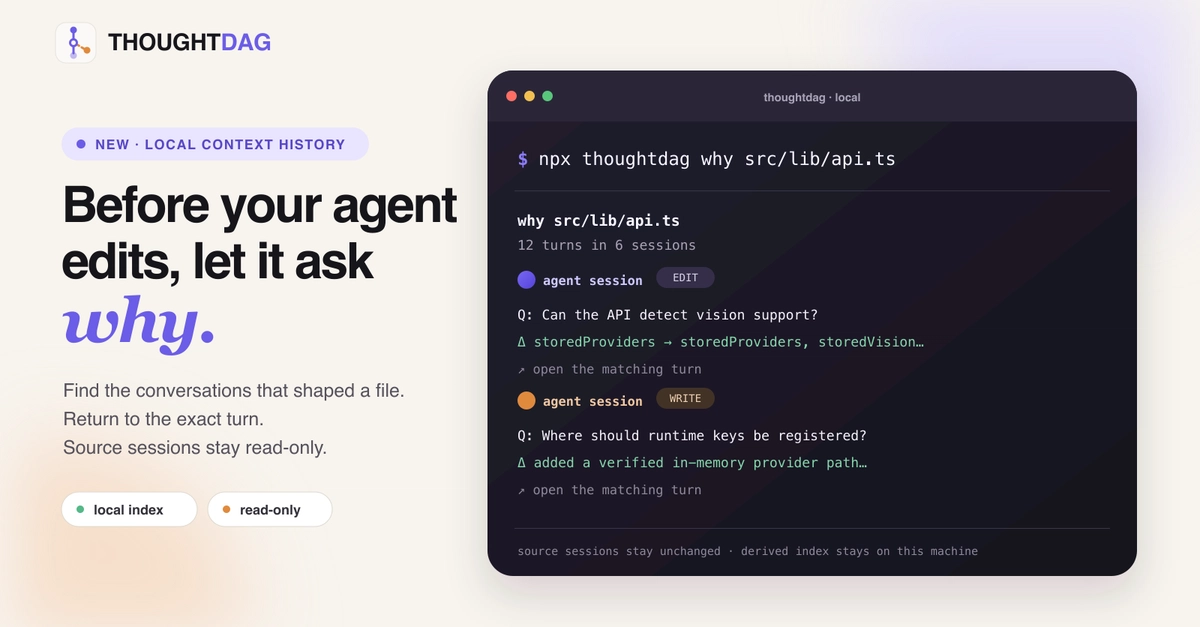
The core innovation lies in ThoughtDAG's ability to search local agent transcripts. When an agent encounters a file it hasn't seen before, or when a developer wants to understand the provenance of existing code, they can use a simple command.
npx thoughtdag why src/lib/api.ts
This command triggers ThoughtDAG to scan supported local agent transcripts. It identifies turns that directly changed, read, or discussed the specified file. The output provides links to these source turns, effectively reconstructing the conversational context around the file's evolution. This moves beyond merely seeing *what* changed in Git to understanding *why* it changed, based on the agent's reasoning, explorations, and decisions.
The problem is that observation is not explanation. An AI agent might see a block of code and its commit history. It can infer that a change was made to fix a bug or add a feature. But it doesn't inherently understand the nuances of the bug, the rejected alternative approaches, or the specific constraints that led to the final implementation. This is where conversational history becomes vital.
Consider a complex function. A developer might have spent hours debugging it, trying several incorrect hypotheses before landing on the correct fix. An AI agent, without access to that debugging dialogue, might see the final, correct code and assume it was straightforward. If the agent then proposes an edit based on a misunderstanding of the original problem, it could reintroduce subtle bugs or inefficiencies.
The Limitations of Current AI Agents
Most AI coding assistants operate on a stateless or limited-state model concerning their own past interactions. They might remember the immediate context of the current editing session, but they lack a persistent, queryable memory of their own reasoning process across sessions or even across different files. This is akin to asking a new employee to take over a complex project without access to any documentation or past meeting notes – they can start working, but their initial efforts will be inefficient and prone to error.
The lack of historical context means AI agents might:
- Re-solve problems that have already been explored and discarded.
- Introduce changes that conflict with unstated assumptions or constraints from previous discussions.
- Fail to leverage optimizations or architectural decisions made in earlier, unrelated conversations.
- Generate code that is syntactically correct but semantically misaligned with the project's long-term goals.
ThoughtDAG's `why` command directly addresses this by providing a bridge between the code artifact and the reasoning process. It doesn't just show code; it shows the dialogue surrounding the code.
Bridging the Gap: Developers and Agents
This tool is valuable for both human developers and AI agents. For developers, it provides a way to refresh their memory about why a particular piece of code was written a certain way, especially in large or legacy codebases where they might not be the original author or haven't touched the file in months.
For AI agents, it offers a mechanism to gain crucial context before acting. Imagine an AI agent tasked with refactoring a module. Without historical context, it might perform a superficial refactor. With access to ThoughtDAG's history, it could understand that a specific structure was chosen due to performance constraints discovered in a previous debugging session, or that a certain variable naming convention was adopted after extensive team discussion. This allows the AI to make more informed, more intelligent suggestions and edits.
The integration with ThoughtDAG is significant because it leverages existing local data. Many developers use AI assistants locally, generating transcripts of their interactions. ThoughtDAG taps into this readily available data source, turning a potential privacy concern (local logs) into a powerful knowledge retrieval system. The tool acts as a