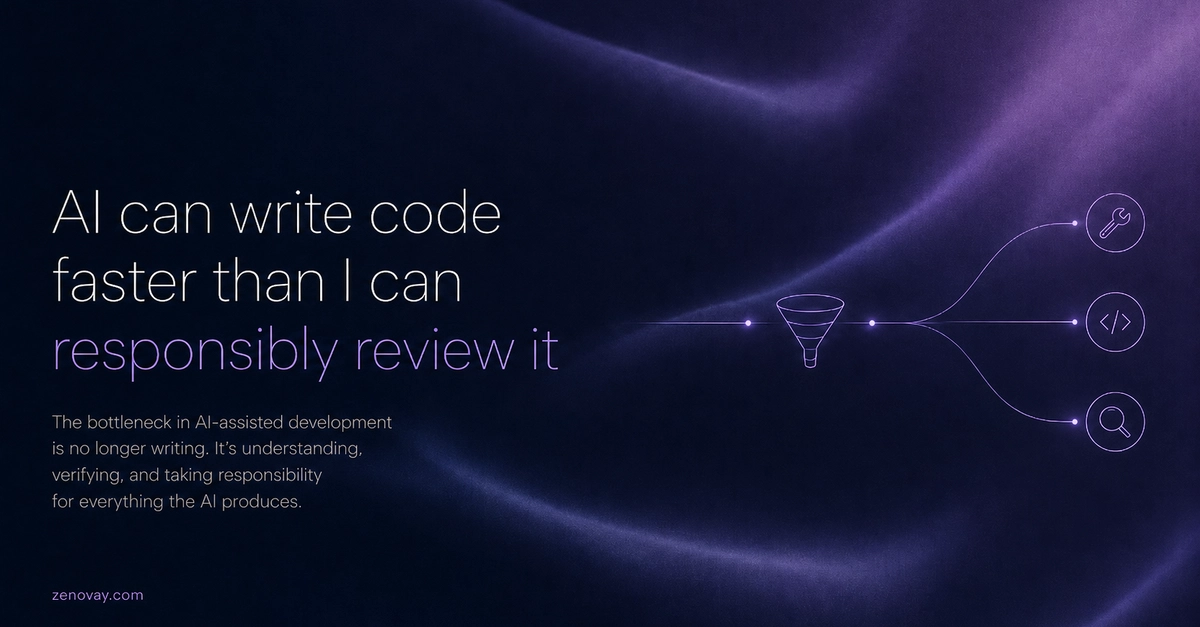
The Unforeseen Bottleneck: Human Comprehension
The rapid advancement of AI code generation tools, like Claude Code, presents a significant, yet often overlooked, challenge for software development. While these tools excel at scaffolding features, debugging, refactoring, and explaining codebases, their speed has outpaced a developer's ability to build and maintain a reliable mental model of the generated code. The bottleneck has shifted from writing code to human attention and comprehension. A developer might spend their morning coffee break using an AI to generate a substantial change, only to be confronted with a 700-line diff that, while syntactically correct and passing all tests, cannot be fully explained or trusted by the human reviewer.
This phenomenon creates a subtle but critical tension. On one hand, the sheer volume of code an AI can produce in a short time feels like immense leverage and a highly productive session. Files change, tests materialize, and errors vanish. The terminal output is green, signaling success. Yet, upon closer inspection of a large diff, the developer may find themselves unable to confidently articulate the rationale behind every decision the AI made. This disconnect between perceived progress and actual understanding is the core of the problem.

The Illusion of Progress in Large Diffs
The satisfaction derived from a large, green diff can be misleading. It signifies that the code compiles and passes automated checks, but it doesn't guarantee that the code is optimal, secure, or even fully aligned with the project's long-term architectural goals. The AI's output, while technically functional, might introduce subtle complexities or dependencies that are not immediately apparent. This is particularly true when AI is used for refactoring or explaining unfamiliar parts of a codebase. The explanation might be accurate at a surface level, but without a deep, internalized understanding of the surrounding architecture, the developer cannot fully validate the AI's reasoning or its implications.
This situation is akin to being handed a perfectly assembled IKEA furniture piece that you didn't build yourself. It looks complete and functional, but if a single screw is slightly off, or if you need to disassemble and reassemble it later, your ability to do so confidently is compromised. The AI has done the heavy lifting, but it has also obscured the intricate details of its own construction, leaving the human reviewer playing catch-up. The risk is that subtle architectural flaws or security vulnerabilities could be embedded within this AI-generated code, only to surface later when the system is under stress or requires modification.
The Human Cognitive Load: A New Frontier
The fundamental challenge lies in the differing cognitive processes of AI and humans. AI models can process vast amounts of data and identify patterns to generate code that adheres to learned best practices and syntax. However, they do not possess genuine understanding, intent, or the ability to reason about complex, emergent system behaviors in the way a human engineer does. Human review, therefore, becomes not just about catching syntax errors or functional bugs, but about validating the architectural integrity, the long-term maintainability, and the inherent security of the code. This requires a deep dive into the 'why' behind each line of code, a 'why' that an AI cannot truly articulate beyond its training data.
The speed at which AI generates code means that the volume of code to be reviewed can become overwhelming. If an AI can write a feature in an hour that would take a human a day, and the human still needs a day to *responsibly* review it, the net gain in productivity is questionable. The review process itself becomes the bottleneck. This puts pressure on development teams to either accept a higher level of risk by performing superficial reviews or to invest significantly more time in understanding AI-generated code, potentially negating the speed benefits.
Reimagining the Code Review Process
The implications for the software development lifecycle are profound. The traditional code review, where a peer examines code for correctness and adherence to standards, needs to evolve. It's no longer sufficient to check if the code works. Developers must now develop strategies for efficiently verifying the quality, security, and maintainability of AI-generated code. This might involve:
- Enhanced Static Analysis: Leveraging more sophisticated static analysis tools that can go beyond basic linting to identify potential architectural issues or security anti-patterns.
- AI-Assisted Review Tools: Developing AI tools specifically designed to help humans understand AI-generated code, perhaps by summarizing complex sections, highlighting potential risks, or generating natural language explanations of the AI's decision-making process.
- Focus on High-Level Architecture: Shifting the focus of human review from line-by-line scrutiny to ensuring that the AI-generated code integrates seamlessly with the overall system architecture and adheres to established design patterns.
- Test Coverage Verification: Rigorously verifying not just that tests exist, but that they are comprehensive and actually test the intended functionality and edge cases, as AI can sometimes generate tests that look good but miss critical scenarios.
- Human-in-the-Loop Training: Using the review process to provide feedback to the AI models themselves, helping them learn to generate more understandable and robust code over time.
The core issue is that AI-generated code, while appearing functional, lacks the inherent narrative and intent that a human developer imbues into their work. The review process needs to bridge this gap, ensuring that the code is not just written, but truly understood and owned by the development team. Without this adaptation, the efficiency gains promised by AI code generation could inadvertently lead to less reliable, harder-to-maintain, and potentially less secure software systems.