The Prompt Engineering Plateau
Discussions around AI coding assistants frequently center on prompt engineering. Developers share elaborate prompt templates, custom instructions, and specific rule files like .cursorrules or AGENTS.md. The underlying assumption is that by clearly articulating engineering practices, the AI will adhere to them. This approach works for simple, isolated tasks. However, for complex, real-world software projects, this method inevitably breaks down.
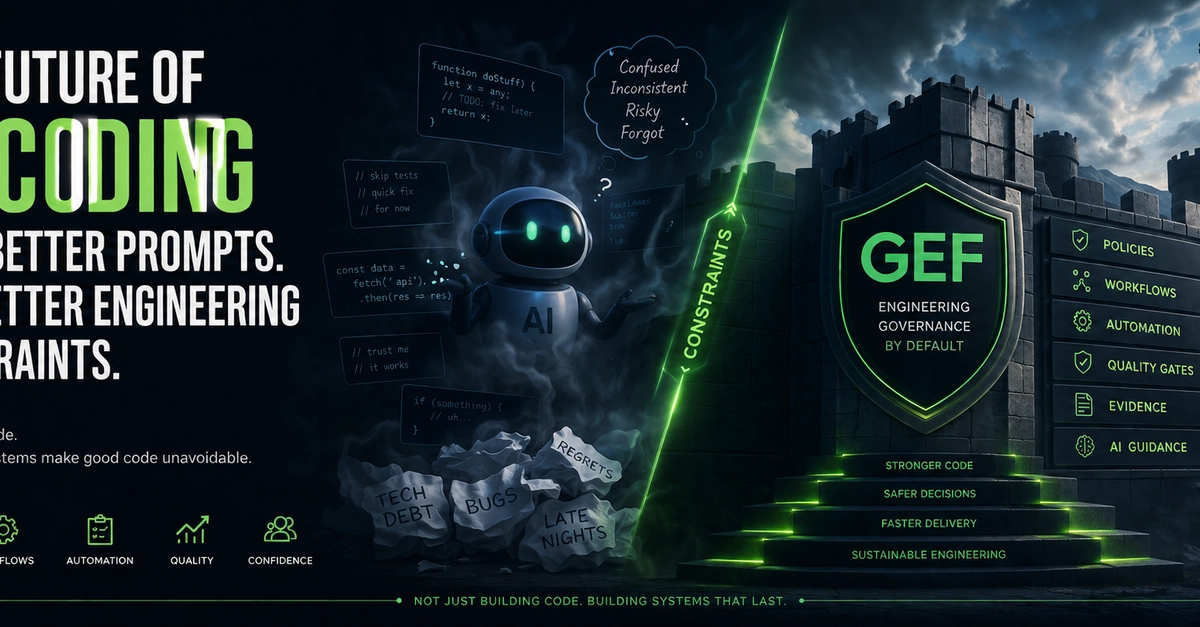
The issue isn't the AI's intelligence; it's the lack of effective governance. Without structured constraints, AI coding assistants tend to produce code with common flaws: giant functions, skipped tests, undocumented architectural decisions, ignored security practices, direct commits without proper review, inconsistent commit messages, and missing pull request descriptions. These aren't failures of understanding, but failures of control.
Governance Over Intelligence
The core problem lies in translating high-level engineering principles into actionable, enforceable constraints for an AI. Simply telling an AI to "write secure code" or "follow SOLID principles" is insufficient. These are abstract concepts. The AI needs concrete rules and boundaries. Think of it less like trying to teach a brilliant intern every nuance of your company's culture and more like building a robust factory assembly line with strict quality control checkpoints at every stage.
Current AI coding assistants operate on a principle of generative freedom. They are excellent at producing code based on a given prompt, but they lack an inherent understanding of project-wide consistency, long-term maintainability, or adherence to established development workflows. This is where engineering constraints become crucial. They act as guardrails, ensuring that the AI's output aligns with project requirements and organizational standards, regardless of the prompt's complexity.
Defining Effective Constraints
Effective constraints for AI coding assistants can be categorized into several key areas:
Code Structure and Style
This involves enforcing specific formatting rules, maximum function/class lengths, naming conventions, and adherence to style guides (e.g., PEP 8 for Python, Prettier for JavaScript). Instead of just asking the AI to "format the code," you would specify the exact linter and configuration to use.
Testing and Quality Assurance
AI assistants must be constrained to generate comprehensive unit tests alongside new code, ensure existing tests pass, and potentially even suggest integration or end-to-end tests. The constraint would be that no code is considered complete unless accompanied by sufficient, passing test coverage.
Security Practices
Instead of a general request for security, constraints could mandate the use of specific security libraries, adherence to OWASP Top 10 guidelines, input validation patterns, and avoidance of known vulnerable functions. The AI might be prevented from using certain deprecated or insecure APIs.
Workflow Integration
This is perhaps the most critical area. Constraints should dictate how the AI integrates into existing workflows: requiring commit messages to follow a specific format (like Conventional Commits), mandating pull request descriptions with certain metadata, or even enforcing a review process where the AI cannot directly commit code without human approval or a secondary AI validation step.
Building the Constrained AI Assistant
Developing AI assistants that incorporate these constraints requires a shift in focus from prompt optimization to building more sophisticated governance layers. This could involve:
- Policy Engines: Developing systems that can parse and enforce declarative policies. These policies would define the permissible actions and code structures for the AI.
- Contextual Awareness: Enhancing AI models to understand the broader project context, including existing code, architectural decisions, and historical commit data, to make more informed, constrained decisions.
- Feedback Loops: Implementing robust feedback mechanisms where the AI learns from violations, not just from successful code generation. This could involve automated code reviews that flag constraint violations for the AI to correct.
- Integration with Developer Tools: Tightly integrating AI assistants with IDEs, CI/CD pipelines, and version control systems to enforce constraints at the point of code generation and submission.
The surprising detail here is not that current AI assistants are flawed, but that the proposed solution has been largely overlooked in favor of optimizing prompts. The focus has been on making the AI smarter, rather than on making its output more controllable and predictable.
The Future is Governed Code
As AI coding assistants become more powerful, the challenge will shift from eliciting correct code to ensuring that the code generated is reliable, secure, and maintainable within a larger software engineering context. This requires moving beyond the limitations of prompt engineering and embracing the necessity of robust engineering constraints. The future of AI in software development isn't about finding the perfect prompt; it's about building intelligent systems that operate within well-defined, enforceable engineering boundaries.