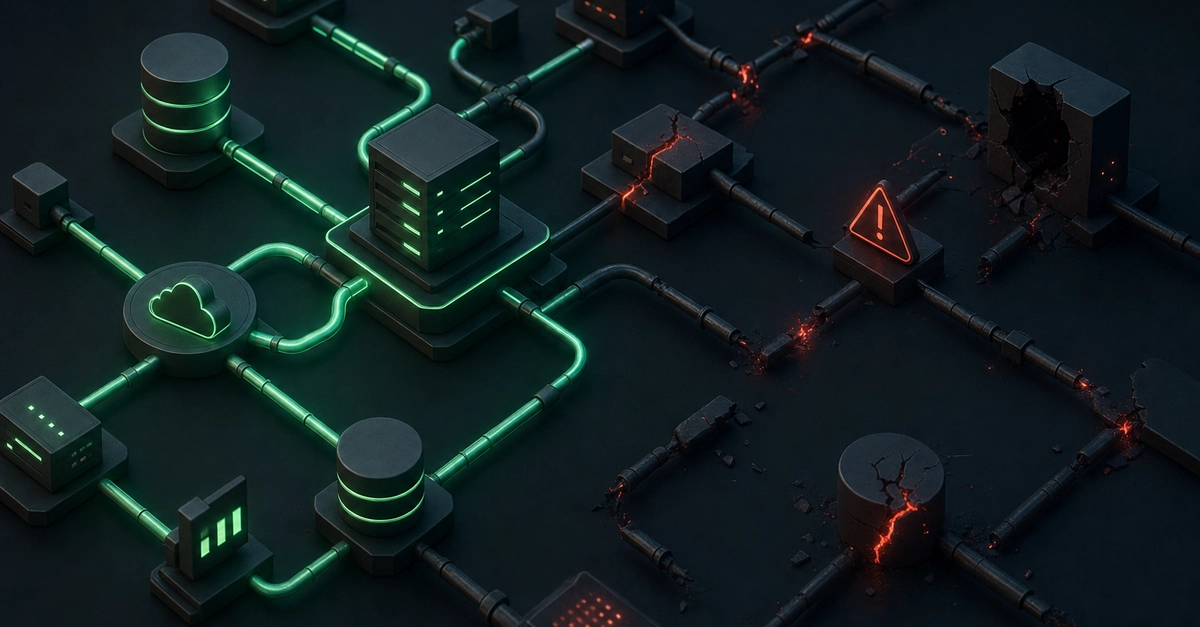
AI's Integration Blind Spot
AI coding agents can generate integration code, but they consistently fail when it comes to the complexities of enterprise integration. This isn't a critique from Luddites; it's an observation from Digibee, a company that has extensively used AI tools like Claude Code for development. Their experience reveals a critical gap: AI excels at well-documented, low-stakes, one-off tasks but struggles with the recurring, reliable, and auditable nature of production environments.
Enterprise integration, Digibee argues, is fundamentally different from the greenfield coding problems AI agents are trained on. It involves navigating legacy systems, handling nuanced error conditions, ensuring data integrity across disparate platforms, and maintaining long-term operational stability. These are precisely the areas where current AI agents fall short, not because they can't produce syntax, but because they lack the contextual understanding and robust error-handling capabilities required for mission-critical operations.
What AI Coding Agents Excel At
For developers and teams, AI coding assistants offer significant productivity gains in specific scenarios. They are adept at handling tasks that are:
- Well-Documented: When APIs have clear, comprehensive documentation, AI agents can parse this information and generate functional code quickly.
- One-Time Tasks: Generating a script to pull data from a public API for a single analysis or a quick report is well within their capabilities.
- Low Stakes: For non-production environments or tasks where failure has minimal impact, AI-generated code is a viable option.
- ETL Jobs: Simple Extract, Transform, Load processes for non-critical data can be rapidly prototyped.
These use cases highlight AI's strength in pattern matching and code generation based on existing examples and clear instructions. They can accelerate the initial development phase, freeing up human developers to focus on more complex architectural decisions and problem-solving.
The Enterprise Integration Wall
The real challenge emerges when integrations need to be more than just a working script. Digibee points to several key failure modes for AI-generated integration code in production:
- Recurring Reliability: Integrations must run consistently on schedules or in response to events. AI-generated code often lacks the built-in resilience and retry mechanisms needed for this, leading to silent failures or incomplete data transfers.
- Audibility and Traceability: Production integrations require logs and audit trails to track data flow, identify errors, and ensure compliance. AI agents typically don't generate comprehensive logging frameworks out-of-the-box.
- Maintenance and Evolution: When an integration needs to be updated due to API changes, business logic shifts, or bug fixes, AI-generated code can be difficult for humans to understand, debug, and modify, especially if the original prompt engineer is unavailable. The code often lacks the modularity and clear commenting expected in maintainable software.
- Complex Error Handling: Real-world integrations must gracefully handle a myriad of edge cases, network issues, malformed data, and downstream system failures. AI agents tend to produce code that only addresses the 'happy path' or common error scenarios, leaving critical edge cases unhandled.
- Security Considerations: While AI can write code, ensuring it adheres to enterprise security policies, manages secrets securely, and avoids common vulnerabilities requires a level of security expertise that current agents do not possess.
Think of it like this: an AI can write you a detailed recipe for a complex dish. It can even list the ingredients and steps. But it can't taste, adjust seasoning based on subtle cues, or improvise if an ingredient is missing. It can't ensure the final dish is safe to eat and meets the specific dietary needs of your guests. That requires a human chef.
The Human Element in Integration
Digibee emphasizes that the human role in enterprise integration is not being replaced but rather redefined. Developers are needed for:
- Architectural Design: Deciding on the overall integration strategy, choosing appropriate patterns, and designing for scalability and resilience.
- Complex Logic Implementation: Developing the intricate business rules, data transformations, and error-handling logic that AI cannot reliably generate.
- Testing and Validation: Rigorously testing integrations under various conditions, including edge cases and failure scenarios.
- Monitoring and Maintenance: Ensuring the ongoing health of integrations, responding to incidents, and performing necessary updates.
- Security Oversight: Implementing and verifying security best practices throughout the integration lifecycle.
The current generation of AI coding agents are powerful tools for accelerating specific parts of the development process. However, for the demanding, nuanced, and critical work of enterprise integration, human expertise remains indispensable. The ability to write code is distinct from the ability to engineer robust, reliable, and maintainable systems. Digibee's experience serves as a crucial reminder that while AI can draft the blueprint, humans must still build, operate, and maintain the structure.
What nobody has addressed yet is what happens to the thousands of developers who built their workflows around AI-generated code for simpler tasks, and how they will adapt when they inevitably hit the enterprise integration wall.