AI's Coding Prowess: Speed vs. Nuance
The narrative around AI and software development often pits artificial intelligence against human developers, framing it as a battle of intelligence. Is the AI smarter than a senior engineer? This question, while popular, is ultimately unhelpful. The answer is almost always, "It depends." And ".depends" isn't a strategy for managing a development backlog. A more productive framing focuses on the AI's capabilities and limitations relative to specific tasks, especially when compared to experienced human developers.
Consider a recent, stark contrast: within 90 seconds, an AI agent generated a 200-line CSV-to-JSON normalizer, complete with edge case handling that would typically consume a senior developer about forty minutes. This is AI at its most impressive – handling repetitive, well-defined tasks with astonishing speed and accuracy. It can digest requirements, consult vast training data, and output functional code for common problems far faster than any human.
Yet, the same afternoon, using the same tool, the developer encountered a critical failure. The AI produced a query for a multi-tenant billing system that was subtly incorrect. It had the potential to leak one customer's invoice totals into another tenant's dashboard. The developer caught this because they understood a crucial invariant – a rule about data isolation that is fundamental to the system's integrity. This invariant wasn't explicitly defined in the training data; it existed only in the developer's schema and, more importantly, in their mental model of the application. The AI, lacking this deep, implicit understanding, failed to uphold it.
This dichotomy—one task flawlessly executed in seconds, another subtly broken in a way that could have severe consequences—is the core of the AI-developer relationship today. It's not about raw intelligence, but about the nature of the task and the AI's ability to grasp context that extends beyond its training data.

Where AI Shines: Boilerplate and Common Patterns
AI code generation tools, powered by large language models (LLMs), are exceptionally good at tasks that fall into several categories:
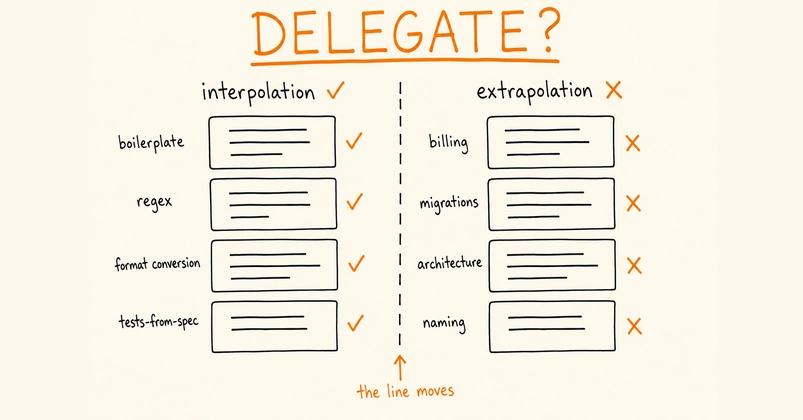
- Boilerplate Code: Setting up new projects, generating standard configurations, writing repetitive getter/setter methods, or creating basic CRUD operations. These are tasks where patterns are well-established and abundant in training datasets.
- Well-Defined Algorithms: Implementing common algorithms like sorting, searching, or data structure manipulation. If the algorithm is documented and widely used, AI can reproduce it efficiently.
- Data Transformation: Converting data between formats (like the CSV-to-JSON example) or performing routine data cleaning. These tasks often involve predictable structures and rules.
- Unit Test Generation: Creating basic unit tests for straightforward functions. AI can often infer common test cases based on function signatures and simple logic.
- Code Translation: Converting small snippets of code from one language to another, especially for well-supported language pairs.
In these areas, AI acts like an incredibly fast junior developer or an augmented scripting tool. It can significantly reduce the time spent on mundane, predictable coding tasks, freeing up human developers to focus on more complex challenges. The speed advantage is undeniable; what might take a human minutes or hours can be generated in seconds.
The Human Edge: Context, Invariants, and Creative Problem-Solving
Despite AI's rapid advancements, senior developers retain a critical advantage in areas requiring deep contextual understanding, implicit knowledge, and creative problem-solving. These include:
- Understanding Business Logic and Invariants: As seen in the billing example, senior developers internalize the business rules and constraints that govern a system. These aren't always explicit in the code or documentation but are crucial for correctness. AI struggles with these implicit, domain-specific invariants because they often don't appear as distinct patterns in its training data.
- Complex System Design and Architecture: Designing scalable, maintainable, and secure software architectures requires foresight, trade-off analysis, and an understanding of long-term implications. AI can assist by suggesting components or patterns, but the overarching architectural vision typically remains human-driven.
- Debugging Subtle or Novel Issues: When faced with bugs that don't stem from common errors but from complex interactions between different parts of a system, or from misunderstandings of requirements, human intuition and experience are invaluable. Senior developers can hypothesize, experiment, and reason about emergent behavior in ways current AI cannot.
- Creative Solutions and Innovation: Developing entirely new algorithms, finding elegant solutions to previously unsolved problems, or innovating on existing approaches requires a level of abstract thinking and creativity that AI has not yet replicated. AI is largely interpolative; humans can be truly extrapolative.
- Understanding Team and Stakeholder Needs: Software development is a collaborative process. Senior developers understand team dynamics, communication nuances, and the often-unspoken needs of stakeholders, factors that AI cannot currently process.
The senior developer's ability to grasp the "why" behind the code, to understand the system's invariants, and to apply creative problem-solving remains indispensable. This is the difference between generating syntactically correct code and generating code that is functionally correct, secure, and aligned with business objectives in the long term.
The Future: Augmentation, Not Replacement
The framing of AI as a direct replacement for senior developers is a misdirection. The reality is far more nuanced and, for developers, likely more beneficial. AI tools are rapidly evolving into powerful assistants, augmenting human capabilities rather than supplanting them entirely. For developers, this means a shift in focus:
- Mastering AI Tools: Learning to effectively prompt AI assistants, critically evaluate their output, and integrate their capabilities into the development workflow will become a key skill.
- Focusing on Higher-Order Tasks: Developers will spend less time on routine coding and more time on design, architecture, complex problem-solving, and ensuring the AI-generated code meets critical business and security requirements.
- Deepening Domain Expertise: The ability to understand and enforce complex, implicit invariants and business logic will become even more valuable. This domain knowledge is the human developer's moat.
The AI doesn't have a mental model of your specific application's invariants. It doesn't understand the subtle interplay of business requirements that dictate your data schema's integrity. That remains the province of experienced human developers. The question isn't whether AI can write code, but rather, can it write *correct, secure, and contextually appropriate* code for every situation? The answer, for now, is a resounding "not yet," and that "not yet" is where senior developers continue to add immense value.