The Solo Founder's Dilemma, Amplified
For solo founders and small teams, critical decisions often rest on a single pair of shoulders. Whether to expand into a new market, pivot a struggling product, or invest in new technology, these choices carry immense weight and risk. Traditional boards of advisors offer valuable perspective but are often prohibitively expensive and slow for early-stage operations. This gap in strategic guidance is precisely what Vincent Julijanto and his collaborator Steven aimed to address with FounderOS.
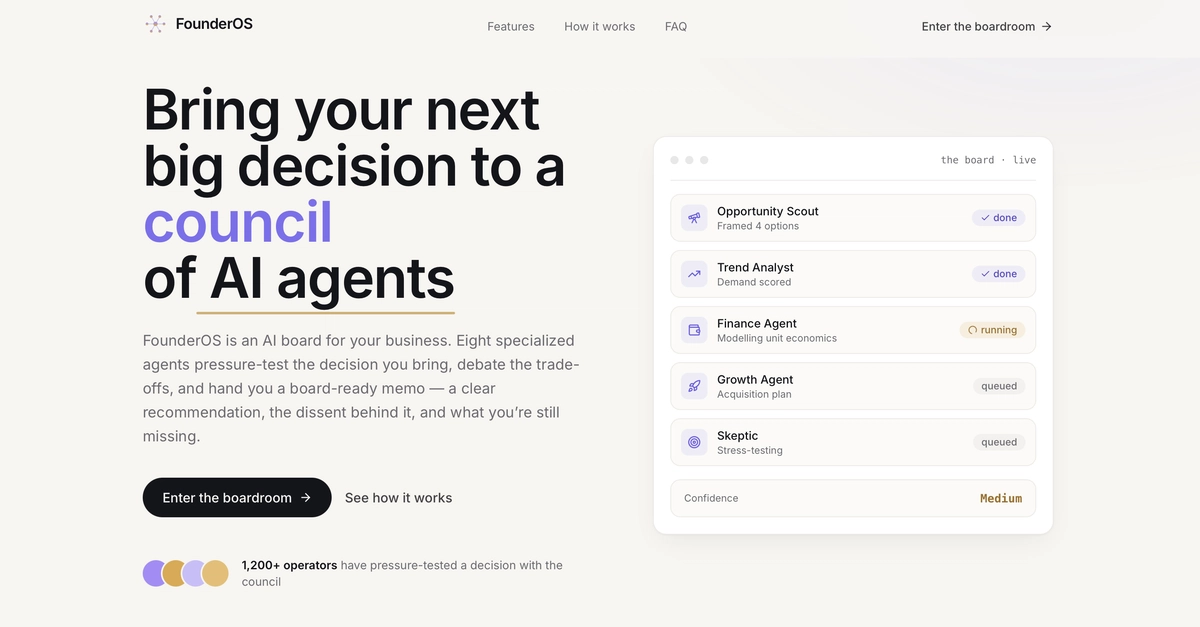
Their solution, born from a Qwen hackathon, is an AI board of directors. The core concept is to simulate the diverse perspectives of an expert advisory board. Users present a single, significant decision, and eight specialized AI agents then deliberate on it. The output isn't a simple consensus but a "board memo" that preserves the nuances of the debate, including any dissenting opinions and the conditions under which those opinions might change. This focus on maintaining disagreement was crucial, differentiating FounderOS from a mere conversational chatbot.
The true test of such a system, however, lies in its ability to handle complex, self-referential problems. The team recently put FounderOS to a unique test: asking its AI board whether the platform itself should migrate to a newer version of its underlying AI model, Qwen.

Simulating Expertise with Specialized Agents
FounderOS is architected with a suite of eight distinct AI agents, each embodying a specific advisory role. These roles are designed to cover a broad spectrum of business concerns, ensuring that a decision is evaluated from multiple angles. While the exact roles can be customized, the general archetypes include agents focused on:
- Technical Feasibility: Assesses the practical challenges and resources required for implementation.
- Market Impact: Evaluates how the decision might affect the product's position in the market and its competitive landscape.
- Financial Viability: Analyzes the cost-benefit implications, potential ROI, and impact on budget.
- User Experience: Considers how the change might affect end-users, their workflows, and satisfaction.
- Scalability: Predicts the long-term implications for growth and infrastructure.
- Risk Management: Identifies potential downsides, security concerns, and mitigation strategies.
- Strategic Alignment: Checks if the decision fits with the overarching business goals and vision.
- Legal/Compliance: Reviews any regulatory or legal considerations.
When a user inputs a decision, these agents are prompted to analyze the situation from their specific domain expertise. The system then aggregates their findings, arguments, and recommendations into a coherent memo. The key innovation is that the system doesn't smooth over disagreements. If the 'Financial Viability' agent strongly advises against a costly migration, while the 'Technical Feasibility' agent sees it as a necessary upgrade, that tension is preserved in the final output.
The Migration Conundrum: A Self-Referential Test
The decision to migrate to a newer Qwen model presented a fascinating internal challenge for FounderOS. The core question was: "Should we migrate FounderOS to Qwen 1.5?" This isn't a hypothetical business scenario; it's a direct question about the platform's own infrastructure and future development. The implications are multifaceted:
- Performance Gains: Newer models often offer improved reasoning, faster inference, and better understanding of complex prompts. This could translate to a more responsive and intelligent FounderOS.
- Cost Implications: Migrating and running on a new model might involve different API costs, infrastructure requirements, or development overhead.
- Development Effort: Adapting the existing agent logic and prompt engineering to a new model version can be time-consuming and requires specialized skills.
- Potential for Instability: New versions can introduce unforeseen bugs or regressions, potentially disrupting the current stable operation of FounderOS.
- Future-Proofing: Sticking with an older model might lead to obsolescence and increased difficulty in integrating future advancements.
The AI board, composed of agents representing these diverse concerns, was tasked with weighing these trade-offs. The prompt likely included details about the current Qwen version, the proposed Qwen 1.5, and the specific operational context of FounderOS.
Deliberations and the Board Memo
The output of this self-referential deliberation was a board memo that captured the internal debate. The agents would have considered the potential benefits of Qwen 1.5 – perhaps enhanced context window, improved multilingual capabilities, or more nuanced factual recall – against the costs and risks. For instance, the 'Financial Viability' agent might have flagged increased operational expenses, while the 'Technical Feasibility' agent might have noted the need for significant re-prompting and agent fine-tuning.
The surprising detail here is not the outcome itself, but the very act of the AI board engaging in such a nuanced, self-evaluative process. It moves beyond simple Q&A to a form of meta-cognition, where the system analyzes its own underpinnings. The memo likely detailed specific points of contention. Perhaps the 'Risk Management' agent flagged a higher probability of subtle behavioral drift in the new model, which the 'User Experience' agent would then translate into potential user frustration. Conversely, the 'Strategic Alignment' agent might have argued that adopting the latest Qwen model is crucial for maintaining FounderOS's image as a cutting-edge AI tool.
Ultimately, the memo would have provided Julijanto and his team with a structured overview of the pros and cons, highlighting which agents were in favor, which were opposed, and crucially, what evidence or conditions would sway the dissenting opinions. This detailed breakdown is the core value proposition of FounderOS: providing actionable intelligence, not just a single answer.
Implications for AI-Driven Decision Making
The FounderOS migration test serves as a compelling demonstration of advanced AI application. It showcases how specialized AI agents can be orchestrated to simulate complex human decision-making processes. The ability to preserve and present dissenting viewpoints is particularly significant. It means users don't just get a final recommendation; they get the underlying reasoning, the potential pitfalls, and the areas of disagreement. This transparency is vital for building trust and enabling informed human oversight.
For founders and business leaders, tools like FounderOS represent a step towards democratizing high-level strategic advice. While not a replacement for human intuition and experience, an AI board can offer a systematic, data-informed perspective, acting as a powerful co-pilot. The ability to stress-test decisions against a virtual panel of experts before committing resources could fundamentally alter how early-stage companies navigate uncertainty. The question now is how widely such sophisticated AI advisory systems will be adopted and how they will evolve to tackle even more complex strategic challenges.