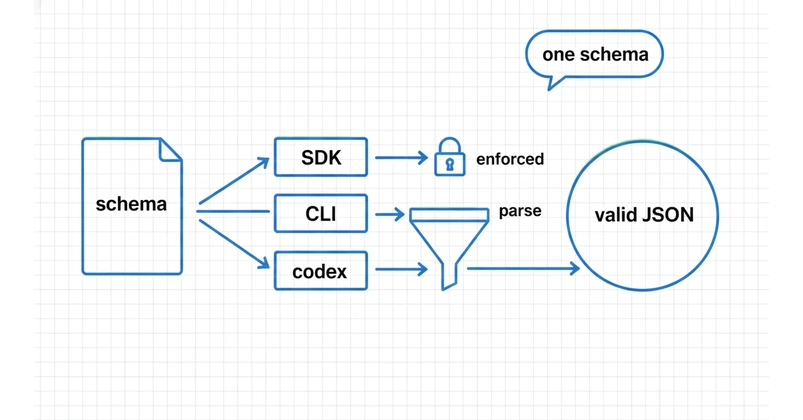
The JSON Shape Problem: When Valid Isn't Enough
On March 3rd, 2026, a critical planning step in a content pipeline encountered an unexpected failure. The task was simple: extract entities from a given text and return them as JSON. The AI model performed its duty, delivering perfectly valid JSON. Any standard parser would have accepted it without complaint. The issue wasn't with the JSON's syntax, but its structure. The model returned a simple array of strings, like ["prompt-caching", "context-windows", ...]. However, the downstream system was expecting a structured object with a specific key, such as {"entities": ["prompt-caching", "context-windows", ...]}. This mismatch, between syntactically correct JSON and structurally incorrect JSON, brought the pipeline to a halt.
This scenario highlights a subtle but significant challenge in integrating large language models (LLMs) into automated workflows. While LLMs have become adept at generating human-readable text and even code, their ability to consistently adhere to precise output schemas, especially when dealing with structured data formats like JSON, is not always guaranteed. The problem is not that the models are broken or producing invalid syntax; rather, they are failing to meet the implicit or explicit structural requirements of the consuming application. This can be likened to a chef perfectly preparing a dish, but plating it in a bowl when the diner specifically requested it on a flat plate – the ingredients are correct, but the presentation breaks the dining experience.
Testing Across AI Backends: A Varied Landscape
To understand the scope of this issue, an investigation was conducted across three different AI backends. The goal was to assess how consistently each backend could produce JSON output that conformed to a predefined schema, specifically an object containing a single key, 'entities', whose value is an array of strings.
The prompt used for testing was straightforward:
Extract the key entities from the following text and return them as a JSON object with a single key named "entities". The value of this key should be an array of strings. Do not include any other keys or text outside of the JSON object.The text provided for extraction was a technical excerpt discussing AI concepts. The expected output was a JSON string like:
{
  "entities": [
    "entity1",
    "entity2",
    "entity3"
  ]
}
Backend A: The Strict Adherer
This backend demonstrated a high degree of reliability in conforming to the requested JSON structure. In multiple test runs, it consistently returned the expected object format, with the 'entities' key and an array of strings as its value. This backend appears to have robust internal mechanisms or fine-tuning that prioritizes adherence to structured output formats when explicitly requested. For developers integrating this backend, the risk of encountering structural JSON errors is relatively low, making it a more predictable choice for automated data extraction tasks.
Backend B: The Occasional Deviator
Backend B showed a mixed performance. While it frequently produced the correct JSON structure, there were instances where it reverted to returning a simple JSON array of strings, similar to the initial problem described. These deviations were not predictable and occurred even when the prompt was identical. This inconsistency makes Backend B a less reliable option for pipelines that strictly require structured JSON. Developers using this backend would need to implement additional validation layers or fallback mechanisms to handle the cases where the output format is incorrect, adding complexity and potential points of failure to their systems.
Backend C: The Structural Maverick
Backend C exhibited the most significant issues with structural adherence. It not only produced the simple JSON array of strings but also, on occasion, returned JSON with entirely different structures, including multiple keys or nested objects that were not requested. In some cases, it even included introductory or explanatory text before or after the JSON block, which, while parseable by some lenient parsers, violated the strict requirement of returning *only* the JSON object. This backend requires the most caution and robust error handling when used for structured data extraction. Developers might consider this backend suitable for tasks where flexibility in output is acceptable or where extensive post-processing and validation are already part of the workflow.
The Root Cause: Implicit vs. Explicit Constraints
The core of the problem lies in how LLMs interpret and enforce constraints. When a prompt requests JSON, the model understands the syntax. However, the distinction between a valid JSON array and a valid JSON object with a specific key is a structural one that the model may not always prioritize. This is particularly true for models that are primarily trained on large volumes of free-form text, where strict adherence to predefined schemas is less common. The model might interpret the request for JSON as a suggestion for data serialization rather than a rigid schema requirement.
Think of it like asking a highly creative artist to draw a specific object. They can draw the object perfectly, but if you asked them to draw it *inside* a specific pre-drawn box, they might draw the object beautifully but place it slightly outside the box, or forget the box entirely, focusing instead on the object's details. The AI’s focus can drift from the structural constraint to the content extraction task itself.
The surprising detail here is not that LLMs sometimes fail to produce perfectly structured JSON, but the *variability* in this failure mode across different models. Some models are clearly better tuned for structured output than others, suggesting that the underlying architectures, training data, and fine-tuning processes play a crucial role in determining their reliability for these specific tasks.
Mitigation Strategies for Developers
For developers building AI-powered pipelines, several strategies can mitigate the risk of structurally invalid JSON:
- Schema Validation: Implement a JSON schema validator after receiving output from the AI. This validator should check not only for valid JSON syntax but also for the presence and type of expected keys and values. Libraries like
jsonschemain Python or similar tools in other languages are essential. - Prompt Engineering: Refine prompts to be as explicit as possible about the required structure. Use examples (few-shot prompting) that demonstrate the exact JSON format expected. Phrases like "Return *only* a JSON object with the following structure..." can be more effective than simply asking for JSON.
- Model Selection: Choose AI backends known for better performance in structured data generation. If possible, benchmark different models on your specific task to identify the most reliable one.
- Post-processing and Fallbacks: Develop robust post-processing logic that can attempt to correct minor structural deviations (e.g., wrapping an array in an object if the 'entities' key is missing) or gracefully handle errors when corrections are not possible.
- Fine-tuning: For critical applications, consider fine-tuning a base model on a dataset of examples where the AI consistently produces the desired JSON structure. This can significantly improve adherence to specific output formats.
The Unanswered Question: When Will LLMs Be Truly Schema-Aware?
While these mitigation strategies can help, they represent workarounds for a fundamental limitation. The long-term question remains: when will LLMs inherently understand and consistently enforce structural constraints as a core part of their output generation, rather than treating them as secondary instructions? As AI becomes more integrated into complex, automated systems, the reliability of its structured output will be paramount. Developers need AI backends that can function as predictable components, not just as sources of creative text that *might* be parsable.