Quantization Trade-offs Explored for Qwen3.8 27B
The pursuit of efficient large language models (LLMs) often leads developers to quantization. This process reduces the precision of model weights, shrinking memory footprints and accelerating inference. However, aggressive quantization can degrade model performance. Recent benchmarks focusing on the Qwen3.8 27B model highlight these trade-offs, particularly the stark contrast between 4-bit and 1-bit quantization levels.
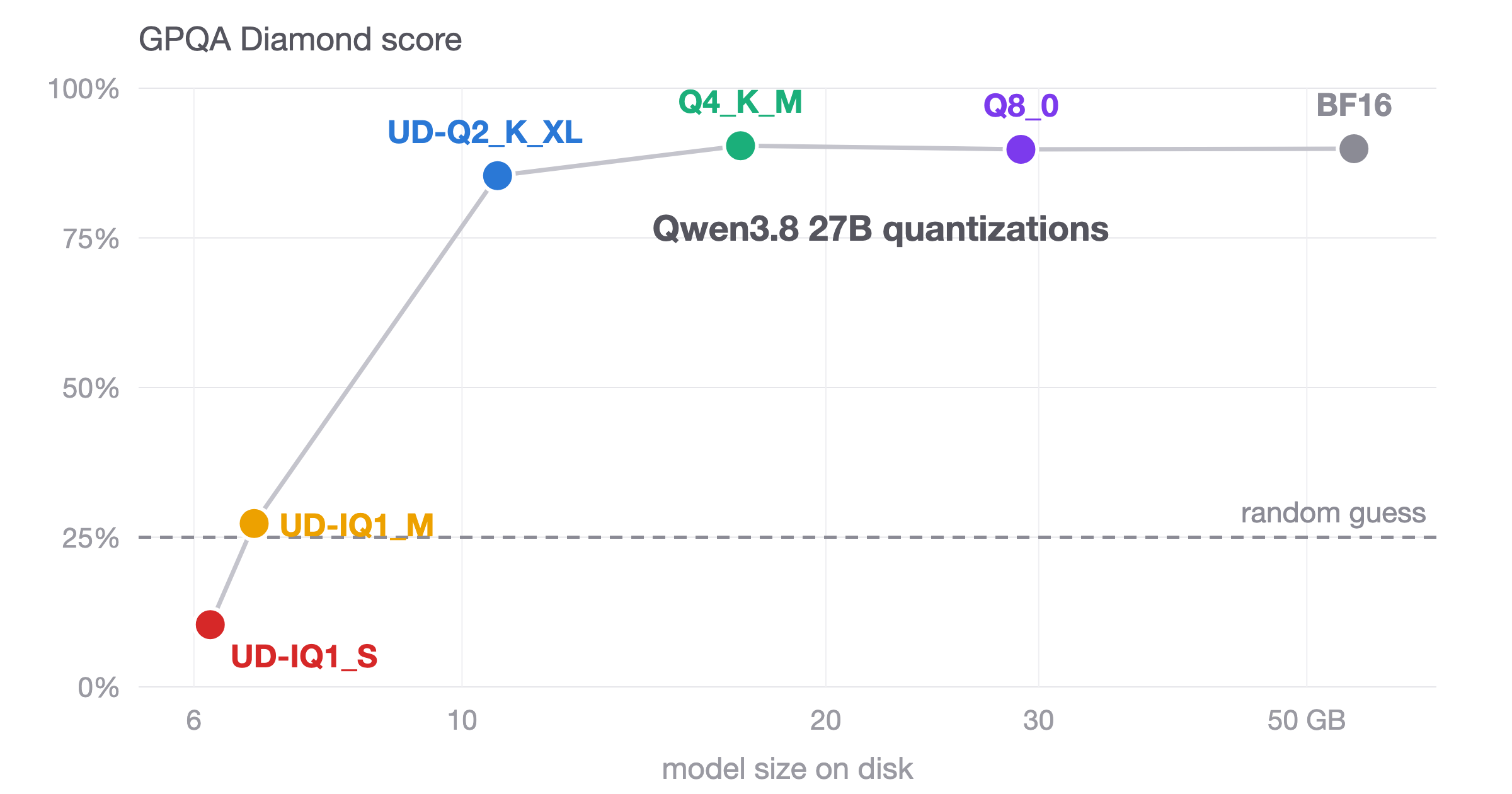
The Qwen3.8 27B model, a powerful 27-billion parameter language model, was subjected to rigorous evaluation at various quantization levels. The findings are clear: while 4-bit quantization offers substantial efficiency gains with minimal performance loss, 1-bit quantization proves too aggressive, leading to a dramatic collapse in model capabilities across key benchmarks.
4-bit Quantization: A Viable Efficiency Boost
Quantizing a model to 4 bits typically involves representing each weight using a 4-bit integer instead of the standard 16-bit or 32-bit floating-point numbers. This reduction in precision dramatically cuts down the model's size and memory bandwidth requirements. For Qwen3.8 27B, the benchmarks indicate that this level of quantization is largely successful.
Performance metrics such as perplexity and accuracy on downstream tasks remain competitive when compared to the full-precision model. This suggests that for many practical applications, 4-bit quantized Qwen3.8 27B can serve as an effective replacement for its larger counterpart, enabling deployment on hardware with more constrained resources. Developers can leverage this for faster inference on edge devices or for serving more users concurrently on existing infrastructure. The stability of 4-bit quantization means that the core reasoning and generation capabilities of the model are largely preserved, making it a reliable option for production environments where efficiency is paramount.

1-bit Quantization: A Collapse in Performance
The situation changes drastically when moving to 1-bit quantization. This extreme form of quantization represents each weight using only a single bit, essentially forcing weights into binary values (e.g., -1 or +1). While this offers the maximum possible reduction in model size and memory usage, it places an immense strain on the model's ability to retain complex patterns and nuances learned during training.
The benchmarks reveal that Qwen3.8 27B at 1-bit quantization exhibits severe degradation. Tasks that require nuanced understanding, complex reasoning, or factual recall become nearly impossible for the model. Performance metrics plummet, rendering the model effectively useless for most practical NLP applications. This collapse isn't a subtle dip; it's a fundamental failure of the model to perform its intended functions. The extreme simplification of weights at the 1-bit level appears to destroy the intricate connections necessary for sophisticated language processing. This finding serves as a critical warning: while pushing the boundaries of efficiency is important, there are limits beyond which model utility is irrevocably compromised.
Implications for LLM Deployment
These findings have direct implications for how LLMs like Qwen3.8 27B are deployed. The success of 4-bit quantization validates its position as a go-to method for balancing performance and efficiency. It allows for wider accessibility of powerful models without requiring top-tier hardware.
Conversely, the failure of 1-bit quantization underscores the need for careful selection of quantization strategies. It suggests that for models of this scale and complexity, 1-bit might be an impractical target for general-purpose use. Future research might explore novel techniques to mitigate the performance loss at such extreme low-bit rates, perhaps through specialized training methods or architectural changes, but for current implementations, 1-bit is a non-starter.
Developers considering quantization should view these results as a practical guide. Prioritize 4-bit for significant efficiency gains with reliable performance. Approach 1-bit quantization with extreme caution, understanding that it is likely to result in a model that is functionally impaired. The benchmark results provide empirical evidence that the sweet spot for aggressive, yet practical, quantization for models like Qwen3.8 27B lies firmly at 4 bits.