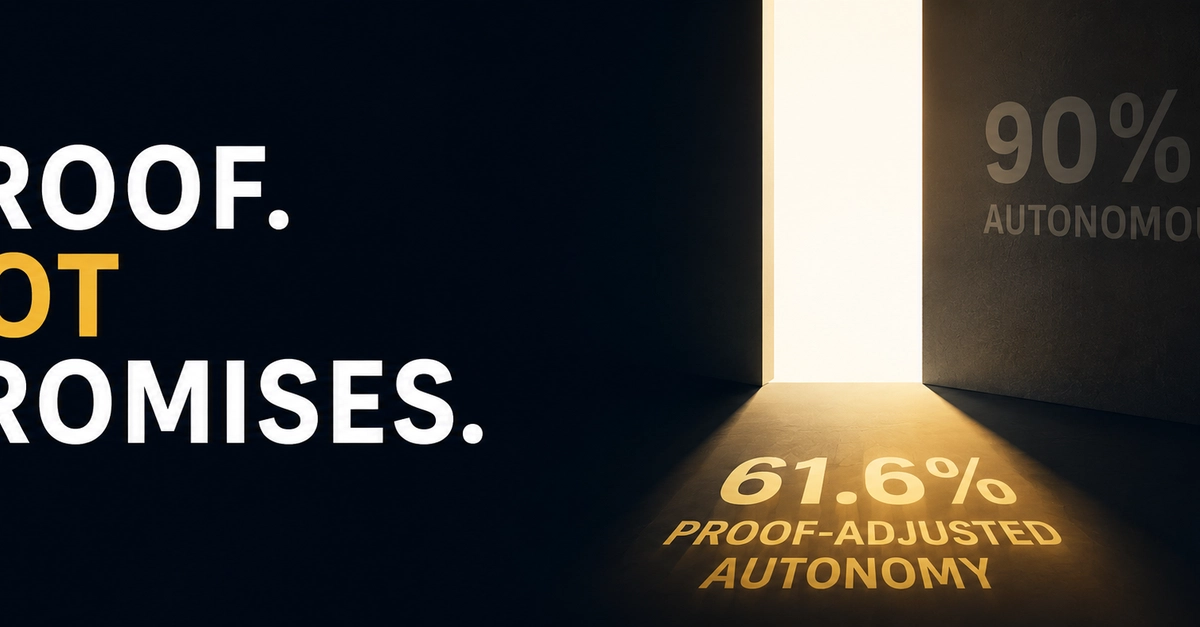
The Illusion of 90% Autonomy
Every demonstration of an AI agent inevitably concludes with a slide proclaiming "90% autonomous." This figure, while seemingly impressive, measures the wrong thing. It quantizes the amount of work the agent completed without direct human intervention. However, companies do not operate on completed work; they operate on accepted work. The crucial distinction lies in whether that completed work is true and reliable enough to be accepted without extensive manual reconstruction or verification.
This disconnect is precisely what Grant Thornton identified as the "AI Proof Gap." Their research highlights that organizations are deploying AI at a pace that outstrips their ability to establish clear accountability for its outputs. The problem is exacerbated by what Jason Wei terms the "Verifier's Rule." This principle suggests that the ease with which an AI can be trained to perform a task is directly proportional to how verifiable that task's outcome is. In simpler terms, AI can easily be trained to produce results that look correct, but verifying their actual truthfulness and reliability can be disproportionately difficult and labor-intensive for humans.
Consider a task like writing code. An AI might generate 90% of a function, leaving a few critical lines or a subtle bug. From the AI's perspective, it completed 90% of the task. From a developer's perspective, that remaining 10%—especially if it involves a complex logic error or a security vulnerability—represents the majority of the effort. They must not only fix the bug but also spend significant time understanding why the AI produced it, re-testing the entire function, and potentially rewriting large sections to ensure correctness. This asymmetry of effort—easy generation for the AI, hard verification for the human—is the core of the problem.
Understanding the 'Proof Gap'
The AI Proof Gap is not merely an academic concern; it has tangible business implications. When an AI agent is tasked with generating a financial report, drafting legal documents, or even diagnosing a medical condition, the cost of human verification can quickly erode any perceived efficiency gains. If a 90% autonomous agent requires 90% of the human effort to verify and correct its output, then its true autonomy, in a practical business sense, plummets. The 90% figure, therefore, becomes a misleading vanity metric.
The crux of the issue is the definition of "autonomous." If autonomy implies generating output that can be directly integrated into business processes with minimal human oversight, then current metrics are failing. The "90% autonomous" agent, in reality, might only be 61.6% useful, assuming that the remaining 10% of work requires nearly as much human effort to verify as the original 90% took the AI to generate. This is an illustrative calculation, but it captures the essence of the problem: the verification burden can be exponentially higher than the generation burden.
The Verifier's Rule in Practice
Jason Wei's Verifier's Rule provides a theoretical framework for this phenomenon. It states that the difficulty of verifying an output is inversely related to the difficulty of generating it. Tasks with objective, easily verifiable outcomes—like simple arithmetic or factual recall—are where AI excels and human oversight is minimal. Conversely, tasks requiring nuanced judgment, creativity, subjective assessment, or complex problem-solving are where AI struggles to produce reliably verifiable results. The AI can generate plausible-sounding text, but a human expert must still validate its accuracy, tone, and appropriateness.
For example, an AI might be able to write marketing copy that sounds persuasive. However, a marketing team must review it to ensure it aligns with brand voice, legal compliance, and strategic objectives. This review process, often involving multiple iterations, is the human verification step. The AI's ability to generate text quickly is offset by the human's critical role in ensuring that text is not just complete, but correct and strategically sound.
Rethinking Autonomy Metrics
The industry needs to move beyond simplistic "completion" metrics. A more meaningful measure of AI autonomy would incorporate the human verification cost. This could manifest as a "proof-adjusted autonomy" score, which factors in the effort required to validate the AI's output. If a 90% autonomous agent requires 50% of the original task's human effort to verify, its proof-adjusted autonomy would be significantly lower than 90%.
Consider this: If a task takes 10 hours of human work, and an AI completes 90% of it (9 hours), but verifying that 9 hours of output requires 8 hours of human work, the total human effort is 8 hours. The AI effectively saved only 2 hours. The AI's contribution is 9 hours of generated work, but its true autonomous value is limited by the 8 hours of human verification. The AI's contribution to the *final accepted work* is 9 hours generated, but the *net human effort reduction* is only 2 hours. This suggests the agent is only truly "autonomous" in a useful sense for a fraction of the task.
This shift in perspective is crucial for several reasons:
- Realistic Expectations: It sets more accurate expectations for what AI agents can deliver.
- Resource Allocation: It helps businesses allocate human resources more effectively for AI oversight and validation.
- Accountability: It encourages the development of AI systems that are not only capable of performing tasks but also of providing verifiable evidence of their correctness.
- Product Development: It guides the development of AI tools that prioritize verifiable outputs and transparency.
The path forward requires a re-evaluation of how we measure AI success. The "90% autonomous" agent is a powerful tool, but its true value is realized only when its outputs can be reliably and efficiently verified. Until then, the "AI Proof Gap" will continue to be a significant hurdle for widespread, accountable AI deployment.