The Elusive Liquidation Cascade
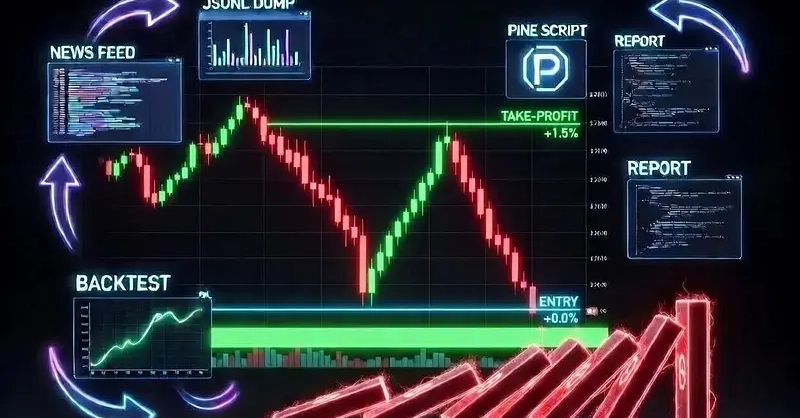
Liquidation cascades, characterized by rapid, deep price drops within one or two trading bars followed by sharp V-shaped bounces, are a recurring phenomenon in financial markets. These events, which occur dozens of times annually, stem from exchanges forcibly closing leveraged positions when prices breach certain thresholds. The ensuing market orders flood the system, driving prices down until no sellers remain, triggering a swift recovery. The challenge for traders is that the precise criteria defining these cascades—what constitutes a 'certain level' or the magnitude of the bounce—are not static. They shift monthly, rendering pre-defined strategies obsolete.
Traditionally, staying ahead of these shifts required manual analysis of news feeds to understand who was liquidated and why. This process is not only time-consuming but also prone to human error and delays, making it difficult to profit from these volatile events. The core problem is that the parameters dictating a liquidation cascade are fluid, adapting to changing market regimes and participant behavior. What might be a support level breakdown with continuation in one month could manifest as a short-lived spike followed by an immediate rebound in another.
The need for an automated, intelligent system to track and adapt to these changing parameters is clear. This is where artificial intelligence offers a promising solution, moving beyond reactive human analysis to a proactive, data-driven approach.
Automating the Identification and Update Process
A novel AI workflow aims to address this by creating an agent capable of continuously identifying and updating the criteria for liquidation cascades. This system integrates two primary data streams: market data and news feeds. The agent monitors price action for the characteristic patterns of a cascade—the rapid decline and subsequent sharp recovery. Simultaneously, it processes news related to liquidations, such as regulatory actions, major fund failures, or significant leverage unwinding events. By correlating market movements with news events, the AI can infer the underlying drivers and adjust the parameters that define a cascade.
The workflow begins with initializing an agent using a command-line interface. For instance, developers can leverage tools like npx @backtest-kit/cli --init --output my-project to set up the foundational code for such an agent. This agent is designed to be more than a passive observer; it actively learns and adapts. It learns to recognize not just the price patterns but also the contextual information from news that precedes or accompanies these patterns. This allows it to distinguish between genuine liquidation cascade triggers and other forms of market volatility.
The sophistication of this approach lies in its ability to dynamically update a model of market conditions. Instead of relying on static, manually set thresholds, the AI builds a model that reflects the current 'regime' of liquidation cascades. This means that if a cascade typically begins with a 5% price drop and a 3% V-bounce in one month, but the next month sees cascades triggered by 3% drops and 2% bounces, the AI will automatically update its internal criteria. This continuous learning loop is crucial for maintaining the efficacy of any trading strategy built around these events.
The Agent's Learning Mechanism
The AI agent's learning mechanism can be conceptualized as follows: it maintains a set of parameters that define a liquidation cascade. When market conditions exhibit behaviors that align with these parameters and are correlated with relevant news events (e.g., news about a large hedge fund facing margin calls), the agent reinforces its current parameters. If, however, the market exhibits cascade-like behavior that does not align with existing parameters, or if news events suggest a new trigger mechanism, the agent flags this discrepancy.
This discrepancy triggers an update process. The AI analyzes the new market behavior and the associated news to infer new parameter ranges. For example, if a cascade was previously defined by a sharp drop below a moving average and a quick recovery, but a new pattern emerges where cascades are preceded by unusual options activity followed by a rapid price squeeze, the AI will learn to incorporate these new signals. This is akin to a seasoned trader constantly refining their understanding of market psychology based on new information, but done at machine speed and scale.
The integration of news feeds is particularly vital here. Without this context, an AI might misinterpret normal volatility or technical breakouts as liquidation cascades. By processing and understanding natural language from news articles, the AI can correlate market events with specific underlying causes. This allows it to build a more robust and accurate model of what truly constitutes a cascade in the current market environment. It moves the system from pattern recognition to causal inference, a significant step in financial AI.
Implications for Automated Trading
The primary implication of this AI workflow is the potential for significantly more robust and adaptive automated trading strategies. Strategies that previously failed because their liquidation cascade criteria became outdated can now be continuously recalibrated. This means that opportunities presented by these predictable yet shifting market events can be captured more reliably.
For developers building trading bots, this workflow provides a framework to incorporate dynamic risk management and opportunity identification. Instead of hardcoding thresholds, they can integrate an AI agent that continuously refines the parameters. This reduces the need for constant manual oversight and strategy re-tuning, freeing up developer time for more complex tasks like optimizing execution or portfolio management.
The surprising detail here is not the AI's ability to detect patterns, but its capacity to integrate unstructured news data to *update* those patterns. Most automated systems struggle with dynamic criteria; they are often brittle. This AI workflow offers a path to building systems that are resilient to changing market regimes, making them more valuable in volatile periods.
Ultimately, this AI workflow represents a significant step towards truly intelligent, self-adapting trading systems. By automating the complex and ever-changing task of identifying liquidation cascade criteria, it promises to unlock new opportunities for profit and risk management in a market that constantly evolves.