
Automated Skill Generation for Claude
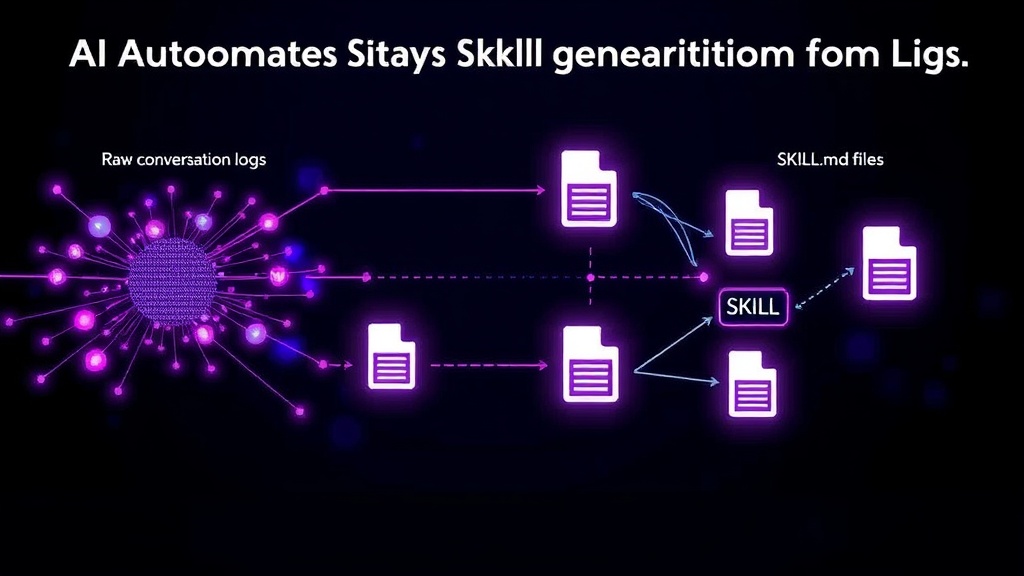
In the quiet hours of the night, a sophisticated batch job actively works to enhance AI capabilities. This process, running nightly at 3:30 AM, reads through the previous day's conversation logs. Its core function is to identify and extract reusable procedures from these interactions. These distilled procedures are then saved as SKILL.md files, effectively automating the creation of new functionalities for Claude. This system has already generated an impressive collection of 104 skills, all operating autonomously within the ~/.claude/skills/auto/ directory.
The preceding post detailed the lifecycle management of these auto-generated skills, focusing on their retirement process from 'stale' to 'archived' states. This article, however, delves into the crucial step that precedes retirement: the nightly 'harvest' batch. This process is designed to be highly efficient, extracting only the essential, reusable procedural elements from extensive logs and formatting them into the standardized SKILL.md format.
The Challenge: Log Volume and Quota Limits
A significant hurdle in automating skill generation is the sheer volume of data. Processing all 3,349 conversation logs every single night presents a substantial challenge, primarily due to potential quota limitations. If the batch job were to read every log file in its entirety, it would quickly consume the allocated resources, rendering the automation unsustainable. This necessitates a more intelligent approach to log processing, one that can efficiently pinpoint relevant procedural information without exceeding operational limits.
The strategy employed here focuses on parsing specific patterns within the logs that indicate a repeatable action or a defined procedure. Instead of a brute-force read of every line, the script intelligently scans for markers that signify the beginning and end of a distinct task or a set of instructions that could be generalized. This targeted extraction is key to managing computational resources and adhering to any API or service quotas.
Distilling Reusable Procedures
The heart of this automation lies in the algorithm's ability to distinguish between casual conversation and actionable procedures. A reusable procedure, in this context, is a sequence of steps or a defined interaction pattern that can be invoked independently and applied to different situations. The system looks for specific linguistic cues, command structures, or consistent input-output pairs that signal a procedural element.
For instance, if a user repeatedly asks Claude to perform a specific formatting task, or to retrieve and summarize information from a particular type of source, the system can identify this as a candidate for a new skill. The extraction process involves not just identifying the steps but also abstracting them. This means replacing specific parameters from the log (like a particular file name or date) with generic placeholders that the skill can later accept as arguments. This abstraction is what makes the extracted procedure truly reusable.
The skill-harvest.sh Script
The automation is orchestrated by a shell script, aptly named skill-harvest.sh. This script acts as the central controller for the nightly batch job. Its responsibilities include:
- Initiating the log reading process at the scheduled time.
- Iterating through relevant conversation log files.
- Applying parsing logic to identify and extract procedural elements.
- Abstracting specific details into generalizable parameters.
- Formatting the extracted procedures into the
SKILL.mdstandard. - Writing the generated
SKILL.mdfiles to the designated auto-skills directory.
The efficiency of this script is paramount. It must be robust enough to handle variations in log formats and intelligent enough to avoid false positives – identifying conversational filler as a procedure. The choice of a shell script suggests a focus on system-level operations, leveraging standard Unix utilities for file manipulation and text processing. This approach often leads to highly optimized and resource-efficient solutions for batch tasks.
The SKILL.md Format
The output format, SKILL.md, is a critical component of this system. Markdown files are human-readable and easily parseable by machines, making them an excellent choice for defining AI skills. This format likely includes sections for the skill's name, a description, its parameters (inputs), and the sequence of actions or instructions it performs. Adhering to a standardized format ensures that Claude can consistently interpret and utilize these auto-generated skills.
This structured approach to skill definition is essential for maintaining a growing library of AI capabilities. It allows for clear documentation, versioning, and integration into the broader Claude ecosystem. The fact that 104 skills have been generated and are managed implies that the SKILL.md format is well-defined and effective for capturing the essence of reusable procedures derived from natural language conversations.
Implications for AI Development and Personalization
This automation represents a significant step towards more personalized and adaptive AI systems. By continuously learning from user interactions, Claude can evolve its capabilities without constant manual intervention. This approach democratizes skill creation, enabling users to implicitly contribute to the AI's functionality simply by interacting with it naturally.
For developers and AI researchers, this method offers a powerful tool for rapidly expanding the functional repertoire of AI models. It reduces the bottleneck of manual skill development, allowing for faster iteration and experimentation. The ability to distill complex interactions into discrete, executable skills opens up new avenues for creating highly specialized AI agents tailored to individual or organizational needs. The continuous, unattended generation of skills means the AI's utility grows organically, directly reflecting the patterns of its use.