%22%20%2F%3E%0A%20%20%3C%2Fsvg%3E)
The Shifting AI Narrative: From Replacement to Augmentation
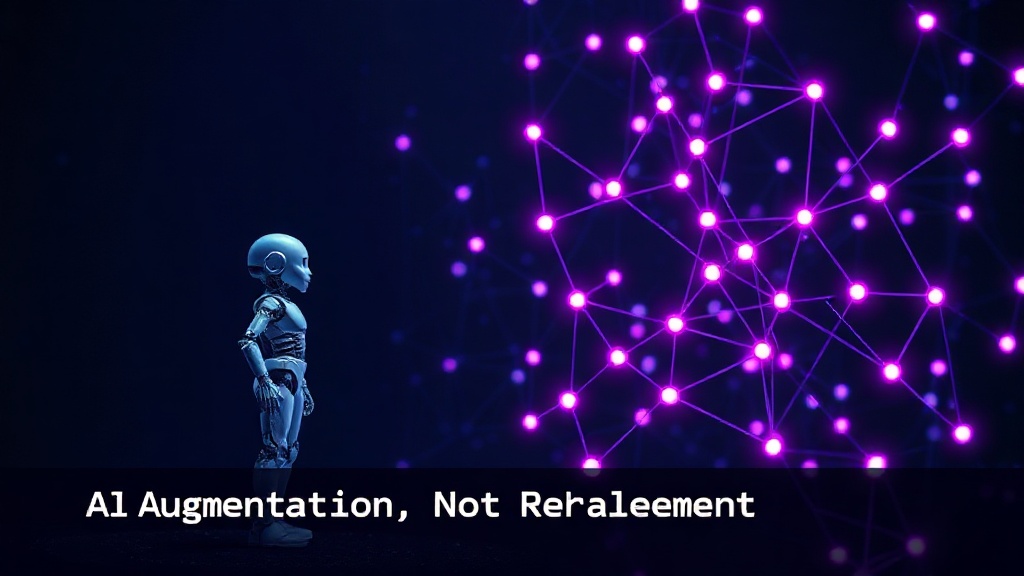
The prevailing narrative around artificial intelligence often centers on its potential to replace human workers. Headlines scream about job losses and AI's inevitable superiority. However, a deeper look, particularly as AI technology matures and becomes more accessible, suggests a different, more nuanced future. The true competitive advantage in the coming decades will likely belong not to those who deploy AI in isolation, but to organizations and individuals who master the art of human-AI collaboration.
The current economic comparison often pits the cost of a human salary against the operational cost of AI tools. This perspective, while relevant today, is shortsighted. As AI technologies mature, driven by economies of scale and the relentless march of innovation, their per-unit cost is expected to decrease significantly. This is analogous to the 'Lindsey Effect,' where the cost of advanced technology historically drops to the point of widespread adoption. When AI becomes as cheap and ubiquitous as electricity, its standalone cost will cease to be the primary differentiator.
The critical question then becomes: what provides the sustainable competitive edge? The answer increasingly points towards the synergy between human intelligence and AI capabilities. A human augmented by AI is not merely a more efficient worker; they are a fundamentally different kind of professional. They can leverage AI for data analysis, pattern recognition, content generation, and complex problem-solving, freeing up their cognitive resources for higher-level strategic thinking, creativity, empathy, and nuanced decision-making—areas where AI currently struggles and may continue to do so.
The Power of the Hybrid Workforce
Consider a marketing team. An AI can generate dozens of ad copy variations, analyze market trends with unprecedented speed, and even personalize campaign elements at scale. However, it's the human marketer who understands the subtle cultural nuances, the emotional resonance required for a specific demographic, and the ethical implications of a particular message. This human marketer, armed with AI-generated insights and content drafts, can then refine, strategize, and execute campaigns with a depth and strategic foresight that a purely AI-driven approach would miss.
Similarly, in software development, AI tools can write boilerplate code, identify bugs, and suggest optimizations. But it is the human developer who architects complex systems, understands user needs intuitively, and makes critical trade-offs based on long-term maintainability and business goals. The developers who embrace AI as a powerful assistant, rather than viewing it as a threat, will be the ones building more robust, innovative, and user-centric software faster.
This shift implies a redefinition of 'skill.' Technical proficiency will always be important, but it will increasingly be complemented by 'prompt engineering,' AI literacy, critical evaluation of AI outputs, and the ability to integrate AI tools seamlessly into existing workflows. The future professional will be adept at asking the right questions of AI, interpreting its responses critically, and synthesizing AI-generated information with their own domain expertise and judgment.
What About Pure AI Operations?
The argument for a purely AI-driven operation often hinges on efficiency and cost reduction. While this model may prove viable for highly standardized, repetitive tasks with predictable inputs and outputs—think basic data entry or simple customer service queries—it faces significant limitations in dynamic, complex, or creative domains. AI systems, by their nature, are trained on existing data. They excel at interpolation within their training distribution but struggle with true extrapolation, novel problem-solving, or adapting to unforeseen circumstances that fall outside their learned patterns.
A pure AI shop would require immense investment in developing and maintaining highly specialized AI models for every conceivable task, coupled with robust systems for continuous retraining and adaptation. The agility and adaptability of a human-AI hybrid team, capable of leveraging general-purpose AI tools and applying human judgment to novel situations, may prove more cost-effective and resilient in the long run. It's less about replacing humans entirely and more about creating a symbiotic relationship where each party's strengths compensate for the other's weaknesses.
The companies that will thrive are those that foster a culture of continuous learning and adaptation, encouraging their workforce to experiment with and integrate AI tools. This requires investment not just in technology, but in training and upskilling employees. It means building an organizational structure that supports human-AI teaming, where AI is viewed as a collaborator and enhancer, not just an automation tool.
The Unanswered Question of AI Governance
While the focus shifts to human-AI collaboration, a critical unanswered question looms: how will the governance and ethical frameworks evolve to manage these augmented workforces? As AI becomes more deeply embedded in decision-making processes, ensuring fairness, transparency, and accountability becomes paramount. Who is responsible when an AI-assisted human makes a flawed decision? How do we prevent bias amplification when AI tools are used to augment human judgment? These are complex societal and organizational challenges that will require careful consideration and proactive solutions as we move towards this collaborative future.
In essence, the future of work is not a battle between humans and AI, but an evolution towards a more potent, intelligent, and adaptable hybrid workforce. The companies and individuals who recognize and act upon this paradigm shift will be the true champions of the AI era.