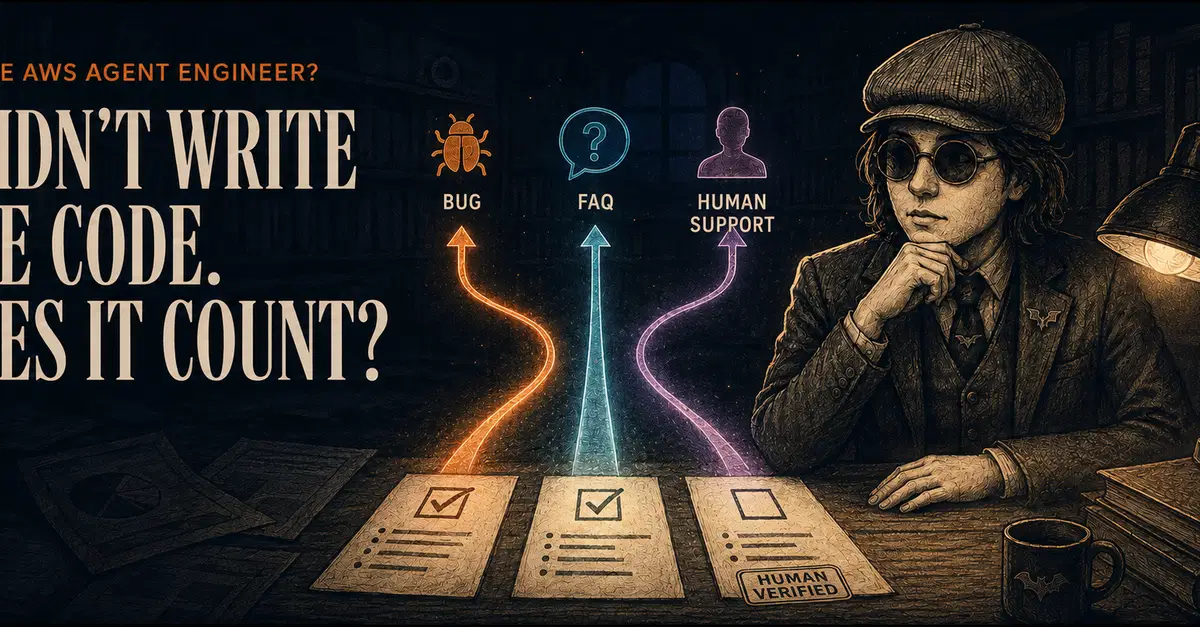
The AI-Generated Chatbot That Passed
The question of whether AI-generated code truly counts towards learning and professional development is no longer theoretical. For students and aspiring engineers, it's a present-day dilemma. This week, a student completed an AWS coursework project, building a functional chatbot that met all the specified requirements and was submitted just before the deadline. The project even involved working with an AWS service that the company had already discontinued, adding a layer of complexity.
The core of the project involved leveraging AI agents to assist in the coding process. The student explicitly sought and received permission to use these tools, and meticulously documented their usage in the project's README file. This documentation detailed precisely which AI tools were employed and the specific role each played in the development, alongside the student's own contributions. Transparency was a priority; no one involved in the assessment was misled about the methodology.
Despite this transparency and successful completion, a significant concern lingered: did the project truly count? This wasn't a question of academic integrity or cheating. The use of AI agents for building the project was explicitly permitted. The worry stemmed from a deeper uncertainty about the value of AI-assisted development in the context of learning and demonstrating foundational engineering skills. If the AI wrote the bulk of the code, what did the student actually learn? What skills were genuinely acquired?
Defining 'Building Ahead of Understanding'
This situation echoes a previous reflection by the same student on "building ahead of understanding." This concept describes the practice of shipping functional products or completing tasks before fully grasping the underlying principles or technologies. It's a pragmatic approach in fast-paced development environments, but it inherently involves a degree of trust in emergent learning – the idea that understanding will follow the act of creation.
When AI agents are involved, this dynamic shifts. Instead of the student wrestling with code and gradually building comprehension, the AI provides a shortcut to functionality. The student's role becomes more about prompt engineering, integration, and validation rather than deep algorithmic thinking or syntax mastery. The question then becomes whether the skills honed – problem definition, tool selection, AI interaction, and output verification – are sufficient substitutes for traditional coding proficiency.
Consider the analogy of learning to cook. If you're given a recipe and a pre-chopped set of ingredients, you can assemble a delicious meal. You learn about flavor combinations and presentation. But if a sophisticated kitchen robot prepares all the ingredients and even executes most of the cooking steps based on your high-level instructions, what have you truly learned about the culinary arts? You might be an excellent kitchen manager, but are you a chef?
The Evolving Role of the Cloud Engineer
The emergence of powerful AI coding assistants like GitHub Copilot, Amazon CodeWhisperer, and specialized agents is fundamentally altering the software development landscape. For cloud engineering roles, which often involve orchestrating complex infrastructure, automating deployments, and managing services, the ability to quickly generate and integrate code snippets is becoming increasingly valuable. AI can accelerate the creation of Infrastructure as Code (IaC) scripts, boilerplate for APIs, and even initial drafts of cloud functions.
The coursework in question was designed to assess the student's ability to deliver a functional product within the AWS ecosystem. The project's success was measured by its adherence to the rubric, which included functionality, deadline adherence, and the use of appropriate services. By these metrics, the AI-assisted chatbot was a success. It performed as required, and the student navigated the process of specifying requirements, selecting tools (including the AI), and integrating the output.
However, the implicit goal of such coursework is often to build foundational competence. If an AI can generate the solution, does the student's contribution represent genuine competence, or merely competence in directing an AI? This distinction is crucial for roles that demand deep problem-solving and debugging skills, especially when systems fail or require novel solutions beyond pre-trained capabilities.
Skills in the Age of AI Agents
The skills involved in an AI-assisted project are undeniably real, but they differ from traditional coding skills. They include:
- Prompt Engineering: Crafting precise instructions for AI models to generate desired code.
- System Design & Integration: Understanding how to break down a problem and assemble AI-generated components into a coherent system.
- API Proficiency: Knowing which APIs to use and how to interact with them, even if the code itself is generated.
- Validation & Debugging: Critically evaluating AI-generated code for correctness, security, and efficiency, and fixing issues.
- Tool Management: Selecting and managing the appropriate AI and cloud services for a given task.
These are valuable skills, particularly for roles focused on leveraging AI tools to enhance productivity. The debate isn't about whether these skills are useful, but whether they fully replace or adequately represent the deep technical understanding traditionally expected of engineers, especially in critical areas like cloud infrastructure where reliability and security are paramount.
The Future of Cloud Engineering Assessment
What nobody has addressed yet is how educational institutions and professional certification bodies will adapt their assessment methods. If AI can generate functional code for AWS projects, how do they ensure that students are developing true engineering acumen rather than just advanced prompt engineering skills? Will future AWS certifications require candidates to demonstrate their ability to build complex systems *without* AI assistance, or will they evolve to include assessments of AI-driven development workflows?
The student's successful, albeit anxiety-inducing, completion of the chatbot project highlights a critical inflection point. For aspiring AWS Agent Engineers, the path forward likely involves mastering the art of collaborating with AI. But the underlying challenge remains: ensuring that this collaboration fosters genuine understanding and capability, not just the ability to delegate complex tasks to a machine. The definition of 'coding' and 'engineering' is expanding, and with it, the methods by which we validate expertise.