The Challenge of Orchestrating AI in Software Development
Individual AI coding agents are increasingly adept at single tasks. Give an agent a clear issue and sufficient context within a repository, and it can often inspect code, modify files, write tests, and deliver a functional implementation. This capability, however, represents only the foundational layer of AI integration in software engineering. The more significant hurdle emerges when we need to implement entire features, comprising multiple interconnected tasks.
These larger initiatives often involve tasks that can run in parallel, others that are strictly sequential, and some that necessitate architectural decisions. Furthermore, certain code areas may require human oversight, disallowing autonomous agent modifications. At this level of complexity, the central question shifts from 'Can an AI agent write code?' to 'How do we structure a software initiative into manageable units that AI agents can execute, validate, review, and integrate safely?'
This article outlines an end-to-end workflow designed to implement an entire Epic (a large body of work) using AI agents, covering the entire lifecycle from its inception to its final integration into the main codebase. The goal is to bridge the gap between individual agent capabilities and holistic feature development.
Defining the Epic and Breaking It Down
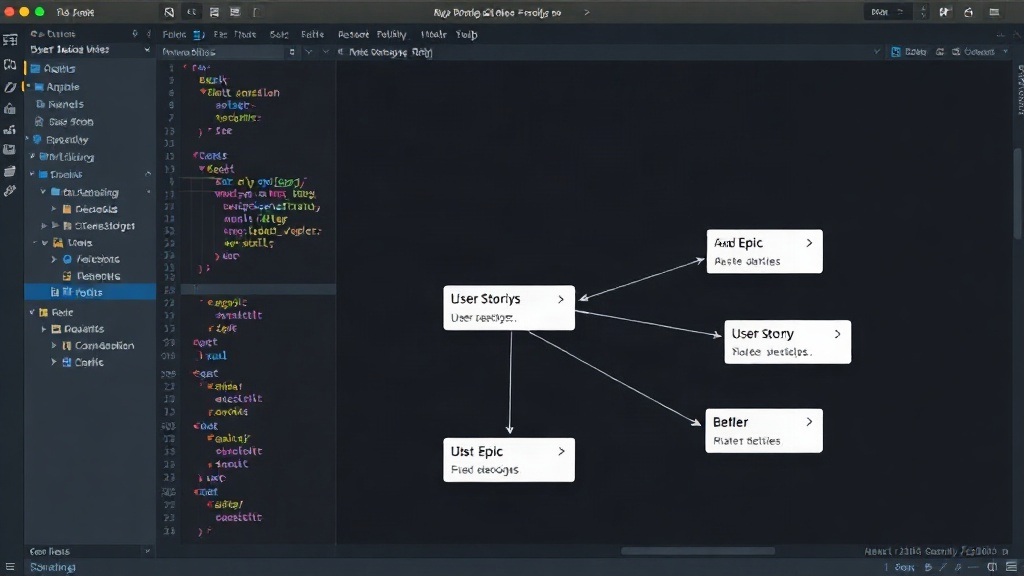
The first step in this AI-driven workflow is the clear definition of an Epic. This involves articulating the high-level business value and desired outcomes. Once defined, the Epic must be broken down into smaller, actionable user stories. Each user story represents a discrete piece of functionality that can be independently specified, developed, and tested. This decomposition is critical because current AI agents operate most effectively on well-defined, granular tasks.
For each user story, detailed requirements must be established. This includes specifying acceptance criteria, outlining necessary code changes, identifying affected modules or components, and defining any new tests required. The level of detail here is paramount; it directly informs the prompts and context provided to the AI agents. Think of it like providing a highly detailed blueprint to a construction crew; the more precise the instructions, the more likely the outcome will match the vision.
The workflow then categorizes these user stories based on their dependencies and potential for parallel execution. Some stories might be prerequisites for others, while some can be developed concurrently. This dependency mapping is essential for orchestrating the agents and ensuring that the integration process proceeds logically.
AI Agent Task Assignment and Execution
With user stories defined and dependencies mapped, the workflow moves to task assignment. Each user story is further broken down into specific tasks that an AI agent can handle. This could include tasks like: writing specific functions, creating or updating unit tests, modifying configuration files, or generating documentation snippets. The system must then select the appropriate AI agent for each task, potentially based on agent specialization or performance metrics.
The context provided to each agent is crucial. This includes the relevant code snippets, architectural guidelines, coding standards, existing test suites, and the specific requirements of the user story. The prompt engineering here is a key factor in success. It needs to be precise enough to guide the agent effectively without being so restrictive that it stifles creativity or misses nuances.
Once assigned, the AI agents execute their tasks. This typically involves checking out a dedicated branch for the task, making code modifications, writing new tests, and running those tests. The agent's output includes the code changes, any new or modified test files, and the results of the test executions. This execution phase is where the agents directly interact with the codebase.
Automated Validation and Testing
After an agent completes a task, the workflow enters an automated validation phase. This is not merely about running the tests written by the agent; it involves a multi-layered approach to verification.
First, the agent's submitted tests are executed. If these tests pass, it signifies that the agent has met its immediate requirements. Second, a broader suite of regression tests is run against the modified code to ensure that the new implementation has not introduced unintended side effects or broken existing functionality. This is critical for maintaining code stability.
Third, static analysis tools are employed to check for code quality, adherence to coding standards, and potential security vulnerabilities. Linters, formatters, and security scanners play a vital role here. The goal is to catch issues that might not be apparent from unit or regression tests alone.
Finally, a preliminary code review is performed by another AI agent. This agent acts as a first-pass reviewer, checking for logical errors, adherence to architectural patterns, and overall code clarity. It flags potential issues that a human reviewer would later need to address. This AI-driven preliminary review significantly reduces the burden on human developers.
Human Review and Integration
While AI agents handle much of the development and validation, human oversight remains indispensable. The workflow designates specific points where human intervention is required. The most critical of these is the final code review. After the automated validation and AI preliminary review, the changes are presented to a human developer. This reviewer focuses on architectural soundness, complex logic, business requirements alignment, and overall code maintainability. They have the final say on whether the code is ready for merging.
If the human reviewer identifies issues, the changes are sent back to the AI agents for further refinement. This iterative process continues until the code meets human-approved standards. Once approved, the changes are merged into a staging branch. Here, integration tests and end-to-end tests are run in a production-like environment. This stage catches issues that only manifest when multiple components interact.
The final step is merging the validated and approved code into the main development branch, completing the 'Epic to Merge' workflow. This structured approach ensures that AI agents contribute effectively while maintaining the quality, stability, and integrity of the codebase.
The Future of AI in Software Development Orchestration
This workflow represents a significant step towards leveraging AI agents for complex software development tasks. By breaking down Epics into manageable, agent-executable units and implementing robust automated validation and human review checkpoints, teams can harness the power of AI to accelerate development cycles. The challenge now lies in refining the prompt engineering, agent selection, and inter-agent communication protocols to handle even more intricate dependencies and edge cases. As AI agents become more sophisticated, the boundary between human and AI contributions in software engineering will continue to blur, pushing towards more efficient and intelligent development pipelines.