AI's Real Impact on DevOps Workflows
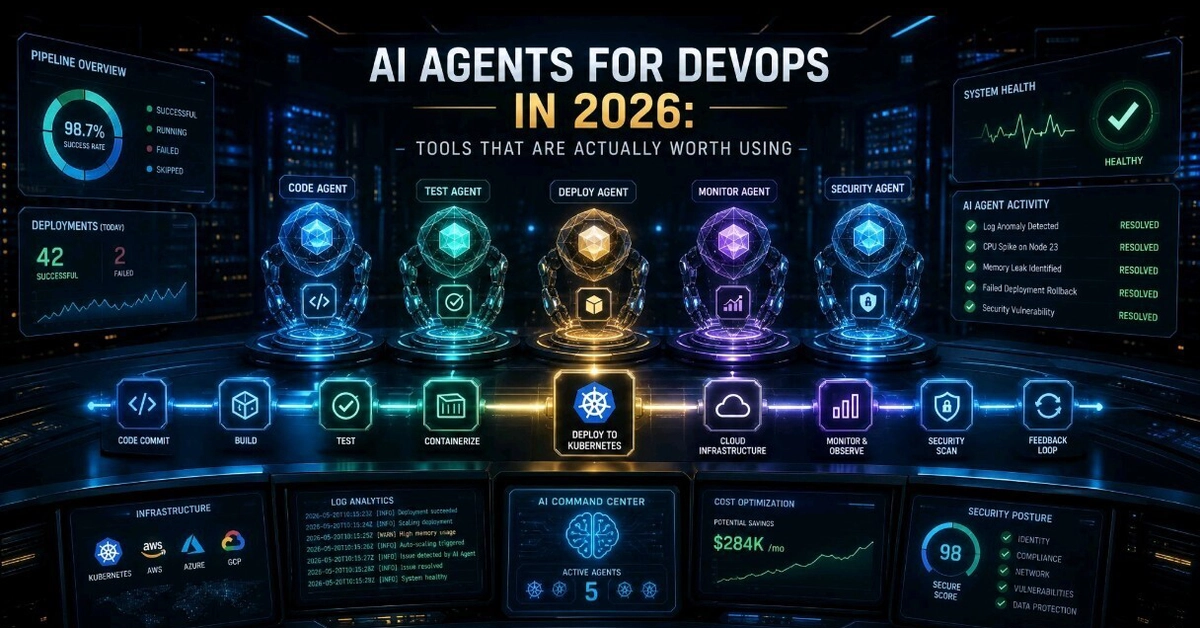
The promise of AI agents revolutionizing DevOps is a constant drumbeat. But beyond the marketing hype, what’s actually delivering tangible value in 2026? After months of rigorous testing across Kubernetes workflows, a clear picture emerges: specific, focused tools are making a difference, while ambitious, fully autonomous systems still face significant hurdles. This isn't about AI writing your entire CI/CD pipeline from scratch; it's about AI augmenting human expertise in critical areas like debugging and incident response.
K8sGPT: The Open-Source Debugging Powerhouse
Among the tools tested, K8sGPT stands out as a genuine productivity booster. This open-source agent actively scans your Kubernetes cluster, identifying potential issues and, crucially, explaining them in plain English. For developers wrestling with pod crashes or misconfigurations, K8sGPT significantly cuts down the time spent on root cause analysis. Instead of sifting through verbose logs or complex metric dashboards, engineers receive concise, actionable insights. Its ability to translate cryptic Kubernetes events into understandable diagnostics is its primary strength, making it an invaluable addition for any team operating in a cloud-native environment.
AI-Assisted Incident Triage: Faster Resolution
The chaos of a production incident is a prime candidate for AI intervention. Tools that correlate logs and metrics are no longer a futuristic concept but a present-day reality that accelerates incident triage. These systems ingest vast amounts of data from various sources – application logs, system metrics, network traffic – and use AI to identify patterns and anomalies that point to the root cause. This moves beyond simple keyword searching in Kibana or Grafana. Instead, AI models can detect subtle correlations, like a spike in latency on service A directly preceding an error surge on service B, even when the direct link isn't obvious to a human operator under pressure. This AI-driven correlation significantly reduces the Mean Time To Resolution (MTTR), a critical metric for any operational team.
Natural Language Infrastructure Provisioning: Early Promise
While still in its nascent stages, the concept of provisioning infrastructure using natural language prompts within CI pipelines shows significant promise. Imagine a developer typing a request like, "Provision a staging environment with 3 replicas of the latest `auth-service` and a PostgreSQL database." This request could then be translated by an AI agent into executable Terraform or Pulumi code. The current reality, however, requires careful prompt engineering and significant human oversight. The AI-generated infrastructure-as-code often needs substantial review and modification to ensure it adheres to best practices, security policies, and organizational standards. It’s not yet a fully automated “set it and forget it” solution, but it represents a step towards more accessible infrastructure management.
What Remains Overhyped: Full Autonomy and Chart Generation
Not every AI application in DevOps is a winner. The idea of fully autonomous remediation without any human approval, especially in production environments, remains a dangerous overreach. While AI can identify issues with high confidence, the potential for unintended consequences from automated fixes is too great. A poorly understood AI decision could lead to outages, data loss, or security breaches. Human oversight remains critical for any action that impacts live systems. Similarly, AI's ability to write complex Helm charts from scratch, while technically possible in some limited cases, still produces output that requires heavy review and expertise to ensure correctness, security, and adherence to best practices. These are areas where AI can assist, but not yet fully replace human judgment and experience.
The Path Forward for AI in DevOps
The trajectory for AI in DevOps is clear: augmentation, not wholesale replacement. The tools that succeed are those that empower engineers by reducing toil, accelerating debugging, and improving incident response times. K8sGPT exemplifies this by providing clear, actionable insights into complex systems. AI-assisted triage offers a data-driven approach to incident management. Natural language provisioning hints at a more accessible future for infrastructure management. The focus for adoption should be on these specific, high-value use cases, rather than chasing the elusive goal of complete AI autonomy. As AI models become more sophisticated and our understanding of their integration deepens, we can expect further advancements, but always with a critical eye on practical application and the indispensable role of human expertise.