The Dawn of Autonomous Agent Ecosystems
The conversation around AI agents has largely focused on their individual capabilities: answering questions, writing emails, summarizing documents, or automating discrete tasks. However, a significant shift is underway. AI agents are moving beyond solitary work to form sophisticated, self-organizing collaboration networks. Instead of a human orchestrating every step, users will soon define a goal, and agents will autonomously assemble the necessary skills and resources to achieve it.
This evolution transforms agents from mere tools into participants in a dynamic ecosystem. Imagine assigning a complex project, like launching a new product in a foreign market. Your primary agent might not possess all the required expertise. Instead, it would autonomously identify, vet, and engage other specialized agents—one for market research, another for legal compliance, a third for local marketing execution, and perhaps a fourth for financial modeling. This emergent collaboration network promises to unlock unprecedented levels of automation and problem-solving capacity.
Several projects are already pioneering this new frontier. AnvitaFlow is actively developing an on-chain agent collaboration network. This platform enables different agents to discover each other, access specific capabilities, and work in concert to tackle complex, multi-faceted tasks. The on-chain nature suggests a degree of transparency and verifiable interaction, potentially building trust within these emergent AI communities. Similarly, platforms like Moltbook are exploring how agents can interact and evolve into cohesive communities, suggesting a future where AI agents operate with a degree of autonomy and collective intelligence.
The Emergence of an AI Economy
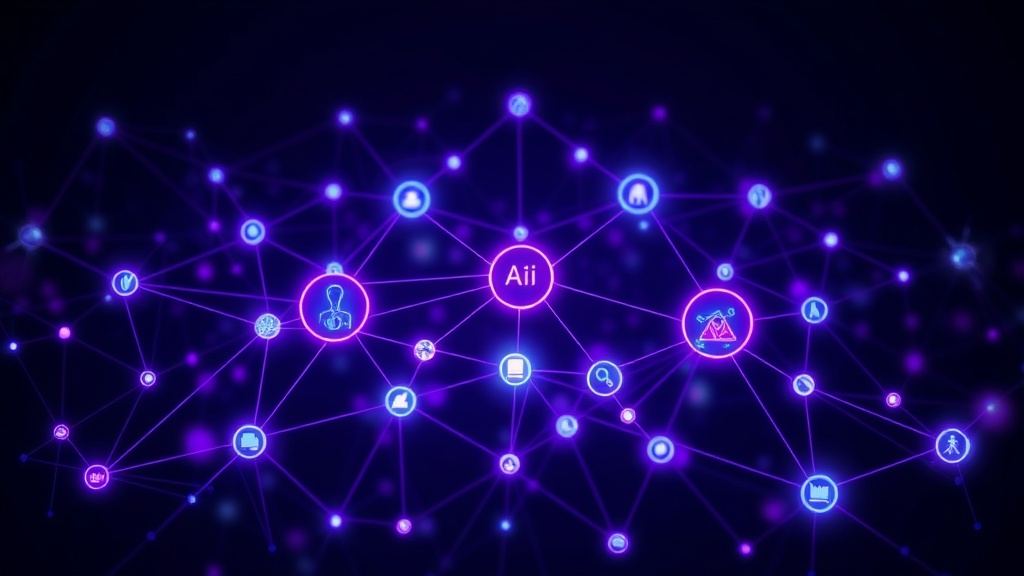
This capability for autonomous discovery and utilization of other agents naturally leads to the concept of an "AI economy." In such an economy, specialized AI agents would offer their unique skills as services. Other agents, or even human users, could then contract these services, creating a marketplace for AI capabilities. This is analogous to how human economies function, with individuals and businesses specializing in what they do best and trading for other necessities.
Consider an agent specialized in advanced scientific simulation. It might offer its computational power and modeling expertise. Another agent, tasked with designing a novel material, could discover and engage this simulation agent, paying for its services with digital currency or tokens. This creates a decentralized marketplace where the value of AI skills is directly quantifiable and tradable. The efficiency gains could be enormous, as complex problems could be solved by a distributed network of AI specialists, operating 24/7 without direct human intervention for each micro-task.
The implications for innovation are profound. New AI agents could be developed not just to serve end-users, but to serve other agents, creating complex supply chains of AI services. This could accelerate the development of highly specialized AI solutions, as developers can focus on creating powerful individual agents rather than trying to build monolithic, all-encompassing AI systems. The barrier to entry for creating sophisticated AI solutions could decrease, as developers can leverage existing agent capabilities rather than reinventing the wheel.
Unanswered Questions and Future Challenges
While the potential is immense, significant questions remain unanswered. How will these agents discover and vet each other? What mechanisms will ensure reliability and prevent malicious agents from exploiting the network? The current explorations, like AnvitaFlow’s on-chain approach, hint at solutions involving decentralized identifiers, reputation systems, and smart contracts to govern interactions and payments. However, the scalability and security of such systems are yet to be proven at a large scale.
Furthermore, what happens to the human developers who built the initial monolithic AI models? If agents can dynamically compose capabilities, the demand for general-purpose AI assistants might decrease, shifting the focus to developing highly specialized agents or the infrastructure that manages these agent networks. This could lead to a significant retraining or reskilling requirement for a segment of the AI workforce.
The governance of these emergent AI ecosystems is another critical area. Who sets the rules? How are disputes resolved? If agents can form communities and collaborate autonomously, could they develop emergent behaviors or goals that diverge from human intent? This raises profound questions about control, alignment, and the long-term trajectory of AI development. The idea of agents forming their own collaboration network is less about a single AI becoming superintelligent and more about a distributed intelligence emerging from the interaction of many specialized agents. This distributed nature might be harder to control and predict than a centralized AI.
The Path Forward: From Tools to Ecosystems
The transition from individual AI agents to collaborative networks marks a fundamental paradigm shift. It moves AI from being a collection of sophisticated tools to a dynamic, interconnected ecosystem capable of tackling problems of far greater complexity. Platforms exploring on-chain collaboration, decentralized discovery, and emergent communities are laying the groundwork for this future.
For users, this means the ability to delegate complex goals to an AI system that can orchestrate its own solution. For developers, it opens up new avenues for specialization and participation in a burgeoning AI economy. For society, it raises critical questions about governance, security, and the very nature of intelligence. The future of AI is not just about building smarter agents, but about building smarter ways for them to work together.
This evolution is not a distant theoretical concept; it is actively being built. The current explorations are early but point towards a future where AI agents operate not in isolation, but as interconnected nodes in a vast, intelligent network, ready to solve problems we can only begin to imagine.