The Intelligence Illusion
When developers first embark on building AI agents, the perceived hurdle is often the AI model's intelligence. The assumption is that making the model smart enough to understand and reason is the core challenge. However, experience quickly reveals a different reality. The true complexity emerges not from the model's comprehension, but from its ability to translate that comprehension into tangible actions in the real world.
Initially, AI projects might present a deceptively simple architecture: a user interacts with a Large Language Model (LLM), which then provides a response. This basic loop functions adequately for many query-and-answer scenarios. The illusion of intelligence is maintained as long as the agent's task remains purely informational.
The paradigm shifts dramatically when the agent is tasked with executing operations. Consider a request like, "Deploy this application." An LLM can readily explain the steps involved, drawing on vast amounts of training data about deployment processes. It can articulate the commands, the configuration files, and the best practices. Yet, it cannot perform the actual deployment itself. This is where the limitations of a standalone LLM become starkly apparent, necessitating the introduction of capabilities beyond simple text generation.
From Tool Calling to Orchestration
The first step in bridging this gap is the integration of tool calling. This allows the LLM to invoke external functions or APIs, transforming it from a passive information provider into an active agent capable of performing specific tasks. Initially, this might involve a single, well-defined tool, such as a calculator for performing arithmetic, a web search API for retrieving current information, or a code interpreter for executing scripts.
However, real-world applications rarely require just one tool. As the agent's responsibilities grow, so does the need for a diverse set of functionalities. What begins with a single tool call quickly escalates. The agent might need to access a database, interact with a cloud service, send an email, schedule a meeting, or manage files. Each new requirement adds another tool to the agent's repertoire.
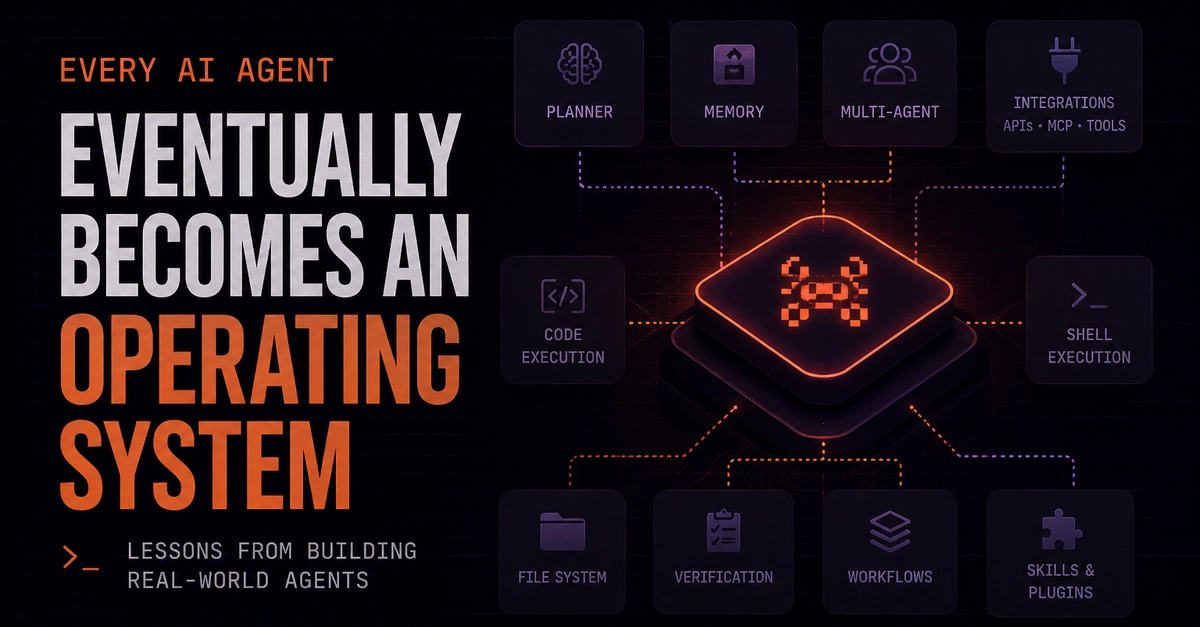
This proliferation of tools leads to a significant architectural challenge. The agent's design evolves from a simple LLM-response loop to a complex system managing numerous interconnected components. The LLM acts as the central orchestrator, interpreting user requests and deciding which tools to call, in what sequence, and with what parameters. The tools themselves become plugins or modules that extend the agent's capabilities.
The Operating System Analogy
This evolutionary path mirrors the development of traditional operating systems. Early computing systems were often monolithic, performing a limited set of functions. As hardware became more sophisticated and user demands increased, these systems evolved to manage diverse resources, run multiple applications concurrently, and provide a standardized interface for both users and developers.
An AI agent, when equipped with a broad array of tools and the logic to manage them, begins to function similarly to an operating system. The LLM acts as the kernel and the user interface, interpreting commands and allocating resources. The tools represent the system's utilities and the applications that can be run on it. Just as an OS provides a framework for applications to interact with hardware and each other, an advanced AI agent provides a framework for its tools to execute tasks and for users to orchestrate complex workflows.
The core problem shifts from 'making the AI smart' to 'making the AI agent reliable and capable of executing complex, multi-step tasks.' This involves sophisticated prompt engineering, robust error handling, state management, and the ability to chain tool calls effectively. Developers are no longer just training models; they are building intricate systems around them. This involves defining the agent's environment, managing its memory, ensuring its actions are safe and predictable, and creating mechanisms for it to learn from its successes and failures.
The Emerging Landscape
This transition has profound implications for the AI development landscape. We are seeing the emergence of frameworks and platforms designed to facilitate the creation of these complex agents. These tools abstract away much of the low-level complexity, allowing developers to focus on defining the agent's behavior and integrating the necessary tools. Concepts like function calling, agent orchestration layers, and memory management are becoming central to AI agent development.
The intelligence of the LLM is the engine, but the surrounding architecture – the tool management, the execution logic, the state tracking – is the chassis and drivetrain that allows the engine to drive. Without this robust infrastructure, the AI remains a powerful but inert component.
The trajectory suggests that AI agents will increasingly resemble operating systems, providing a platform for a vast ecosystem of tools and services. This evolution is driven by the fundamental need to move beyond theoretical intelligence to practical, actionable capability. The challenge is no longer about creating a thinking machine, but about building a reliable, versatile, and executable digital entity.
The Unanswered Question of Interoperability
As these AI agents mature into complex systems akin to operating systems, a critical question arises: how will they interoperate? If each AI agent becomes a unique OS with its own set of tools and APIs, we risk creating isolated digital ecosystems. What mechanisms will emerge to allow agents built on different frameworks, or with different core LLMs, to communicate and leverage each other's capabilities seamlessly? The current trajectory focuses on building powerful individual agents, but the next frontier will undoubtedly involve enabling these agents to work together, much like applications on a modern OS can share data and functionality.