The Project File as the AI Interface
Traditional video editing software, and many AI-driven tools, abstract the editing process behind APIs or complex graphical user interfaces. When AI enters this domain, it's often through specialized APIs that expose functions like addClip() or applyFilter(). This approach means the AI operates on a state managed by the tool itself, often requiring a separate layer for human collaboration or review. This is the path many AI video editing solutions have taken, aiming to simplify tasks for end-users by hiding the underlying complexity.
Ronak Parmar's recently open-sourced FableCut takes a fundamentally different approach. Instead of an API-centric model, FableCut elevates the project file to the primary interface for both human and AI operators. The entire state of a video project—including media assets, individual clips, tracks, keyframes, transitions, and markers—is consolidated into a single JSON document, project.json. This design decision is the core innovation, shifting the paradigm from programmatic control of editing functions to declarative control over the project state.
This means AI agents don't call discrete functions to manipulate the timeline; they directly modify the project.json file. The editor then interprets this JSON to render the final video. This makes the project file itself the universal language, understandable by humans, AI agents, and potentially other tools in the ecosystem. It’s akin to treating a complex software project’s configuration files as the primary means of interaction, rather than a set of SDK calls. This offers a more unified and inspectable workflow, where the state of the edit is always explicitly defined in a human-readable format.
FableCut's Architecture: Browser-Based and AI-Operable
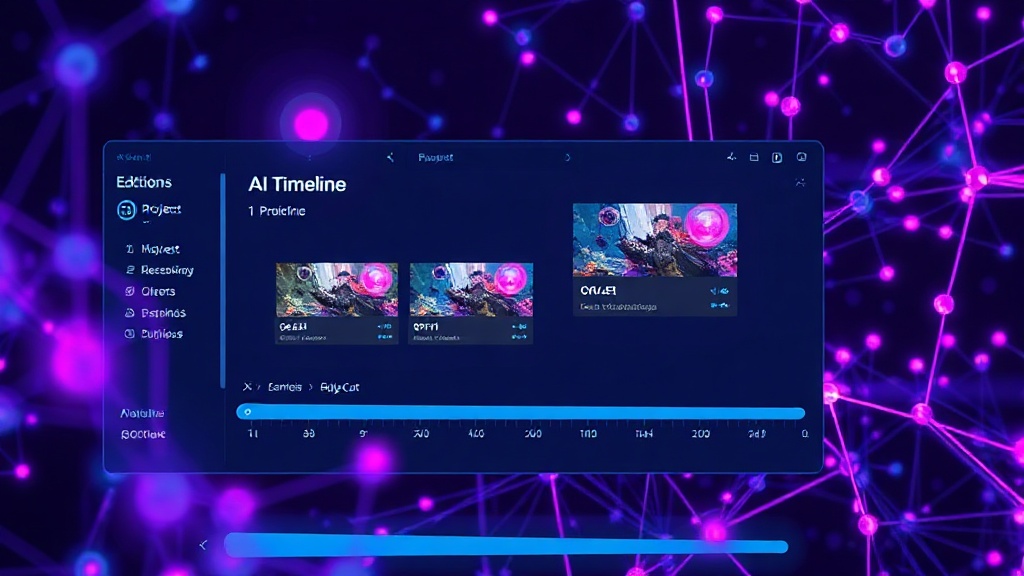
FableCut is built as a Premiere-style video editor that runs entirely within the browser. This choice of platform offers several advantages, chief among them being accessibility and ease of deployment. Users don't need to install heavy desktop software; they can access FableCut from any modern web browser. This also simplifies the integration of AI agents, as they can interact with the editor's state and potentially even its rendering pipeline through web technologies.
The core of FableCut's design philosophy is that the project file is the interface. This means that for an AI agent to operate FableCut, it doesn't need a complex SDK with dozens of methods. Instead, the AI can be trained or programmed to understand and generate valid project.json files. This is a significant departure from typical AI-driven content creation tools, which often rely on proprietary APIs that lock users into specific workflows and ecosystems.
Consider the difference: if an AI is tasked with creating a 30-second social media video, it could achieve this by generating a project.json file that describes the sequence of clips, transitions, and any effects. The FableCut editor then takes this JSON and renders the video. This is far more analogous to how a human editor might work: by arranging elements on a timeline. The AI is essentially learning to 'edit' by learning to 'describe' an edit in a structured format.
The implications for collaboration are also profound. If a human editor and an AI agent need to work on the same project, they can both interact with the same project.json file. The human can make edits directly in the FableCut interface, which updates the JSON. An AI agent can then read the updated JSON, make further modifications, and write it back. This creates a transparent and auditable workflow, where every change is recorded in the project file.
The AI Agent's Perspective: Declarative Control
From an AI agent's perspective, operating FableCut means understanding the structure and semantics of the project.json file. This file acts as a declarative specification of the desired video output. The AI doesn't need to know *how* FableCut renders a transition; it only needs to specify *that* a transition of a certain type should exist between two clips at a specific point in time, with specific parameters.
This declarative approach simplifies the AI's task considerably. Instead of learning a complex API with state management considerations, the AI focuses on generating the desired end state. This is particularly well-suited for large language models (LLMs) or other generative AI systems that excel at producing structured output based on prompts. An LLM could, for instance, be prompted to create a 'fast-paced highlight reel of a soccer match' and, based on that prompt and potentially access to the raw footage metadata, generate a project.json that FableCut can then execute.
The surprise here isn't the capability of AI agents to manipulate video; it's the choice of interface. By making the project file the universal language, FableCut sidesteps the need for bespoke AI APIs for every editing function. This is analogous to how configuration-as-code has become a dominant paradigm in infrastructure management. Instead of imperative commands to set up servers, we define the desired state in configuration files, and tools like Terraform or Ansible reconcile the current state with the desired state. FableCut applies this principle to video editing, with AI agents acting as the 'operators' of this configuration.
Broader Implications for Creative Workflows
The FableCut model has the potential to democratize sophisticated video editing by making it accessible to AI-driven automation. For creators, this could mean generating multiple variations of a video for different platforms quickly, automating the creation of highlight reels from long-form content, or even generating entirely new video sequences based on textual descriptions.
For developers building AI tools, this approach offers a more interoperable path. Instead of building custom integrations for every video editor, developers can focus on mastering the generation of project.json files. This could lead to a richer ecosystem of AI-powered video creation tools, where different AI agents specialize in different aspects of editing—one for pacing, another for color grading, a third for adding effects—all contributing to the same project file.
What remains to be seen is how robust the project.json schema will become and how well it can accommodate the nuances of professional video editing. Complex projects involve intricate layering, precise timing, and subtle adjustments that might be challenging to represent purely declaratively. However, the flexibility of JSON and the iterative nature of open-source development suggest that the schema can evolve to meet these demands. The project file as the interface is a bold step, trading the imperative control of APIs for the declarative power of structured data, and it’s a model that could reshape how AI and humans collaborate in creative production.