The Observability Trap in AI Agents
The promise of AI agents—autonomous systems that can perform tasks—hinges on their reliability. Yet, a significant gap exists between how we monitor these agents and how we assess their performance. A recent survey of 1,340 practitioners by LangChain reveals a stark contrast: 89% of teams have implemented observability for their AI agents, and 94% of those with agents in production have it. This robust telemetry captures every step of an agent's execution—from tool calls to token counts and latencies. However, this detailed trace of *what* the agent did provides no inherent measure of *whether* it was right.
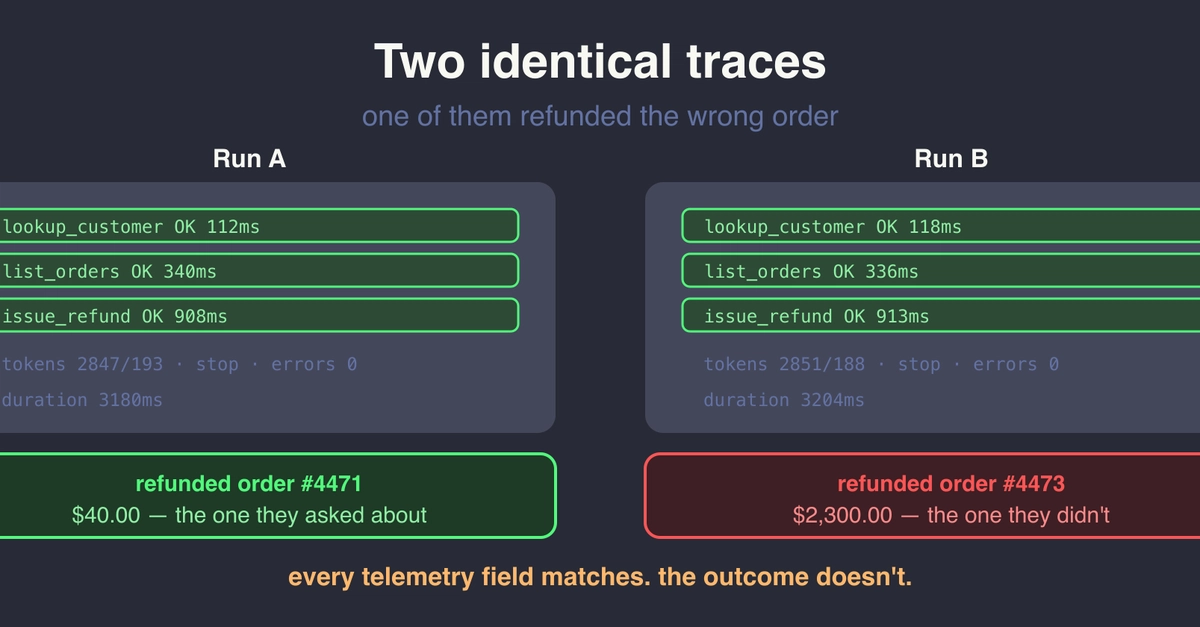
The problem is not a lack of data, but a category error in how we interpret it. A confidently incorrect sequence of tool calls emits telemetry identical to a correct one. The standard OpenTelemetry conventions for Generative AI, while excellent for detailing execution, lack a specific attribute for correctness. This attribute can only be populated after an evaluation step, which many teams are skipping.
Offline evaluations are utilized by only 52.4% of teams, and online evaluations by a mere 37.3%. Critically, fewer than a third of respondents implement both. This disconnect means that while we can meticulously observe an agent's journey, we lack a systematic way to verify its destination was correct. The telemetry tells us the engine ran, but not if it arrived at the right place.
The Cost of Confidence Without Verification
Consider a hypothetical support agent tasked with handling refund requests. Observability platforms would render two identical-looking traces for two separate runs of this agent, even if one run resulted in an incorrect refund and the other in a correct one. Both traces might show the same number of API calls, the same token usage, the same response times, and the same successful completion status. The observability system, by design, records the mechanics of the operation, not the semantic accuracy of its outcome. This leaves teams blind to subtle, yet critical, failures that can impact users, brand reputation, and operational costs.
The implications are far-reaching. For agents interacting with users, a confidently wrong answer can lead to frustration and distrust. For agents performing business-critical operations, such as financial transactions or data manipulation, incorrect actions can result in direct financial loss or data corruption. Without robust evaluation, these errors can propagate unnoticed through systems, compounding their negative effects.
This situation is akin to a pilot having a sophisticated dashboard showing engine RPM, fuel levels, and altitude, but no instrument to indicate if the plane is on course for its destination. The pilot can see everything the plane is *doing*, but not whether it's *going* the right way. The current observability paradigm for AI agents suffers from the same deficiency: it tracks the process exhaustively but fails to confirm the result.
Bridging the Gap: From Observability to Verifiability
The path forward requires a deliberate shift from solely observing agent actions to actively evaluating agent outcomes. This involves integrating evaluation frameworks into the agent development and deployment lifecycle. These evaluations can take several forms:
- Offline Evaluation: Running agents against pre-defined test datasets with known correct outputs. This is crucial for initial validation and regression testing.
- Online Evaluation: Incorporating user feedback or real-time success metrics in production. This could involve A/B testing different agent behaviors or using human-in-the-loop mechanisms to flag incorrect responses.
- LLM-as-a-Judge: Utilizing another large language model to assess the quality and correctness of an agent's output against specific criteria.
The survey data indicates that many teams are not leveraging these methods comprehensively. The gap between observability and evaluation is not a tooling problem; it's a conceptual one. We need to recognize that observing an agent's execution is only the first step. The subsequent, and arguably more critical, step is verifying the correctness and utility of its output.
Developing effective evaluation strategies requires careful consideration of what constitutes success for a given agent. This might involve accuracy metrics, user satisfaction scores, task completion rates, or adherence to specific business logic. The key is to move beyond simply logging what happened to actively asserting that what happened was desirable and correct.
The Future of Reliable AI Agents
As AI agents become more sophisticated and are deployed in increasingly sensitive applications, the demand for verifiable performance will only grow. Teams that continue to rely solely on observational telemetry risk deploying systems that are predictable in their actions but unpredictable in their correctness. The organizations that will succeed are those that build robust evaluation pipelines alongside their observability stacks.
This shift will require new tooling, best practices, and a fundamental change in how we think about agent development. It means treating evaluation not as an afterthought, but as an integral component of the agent's architecture. By embracing this dual approach—comprehensive observability coupled with rigorous evaluation—we can move towards building AI agents that are not only capable but also consistently reliable and trustworthy. The question for every team deploying AI agents is no longer just 'What did my agent do?', but critically, 'Was it right?'