From Doodle to Masterpiece: An AI-Powered Artistic Transformation
For those who possess more enthusiasm than innate artistic talent, the barrier to creating visually appealing art can be frustratingly high. A recent project, shared on Reddit, demonstrates a novel solution: an AI agent designed to take simple doodles from a Remarkable tablet and transform them into sophisticated charcoal sketches. Crucially, this tool doesn't just output static images; it generates real, editable pen-line vectors, opening up new possibilities for digital artists and designers.
The process begins with the user's input on a Remarkable tablet, a device known for its e-ink display and stylus-based note-taking. The user creates a basic sketch – a doodle, a rough character, or an abstract shape. This initial input is then captured by the system. The core of the innovation lies in the subsequent AI processing. The agent first parses screenshots of the device to understand the user's intent and the basic structure of the doodle, effectively creating a creative brief from the visual input. This brief, along with the napkin sketch itself, is then fed into another AI agent.
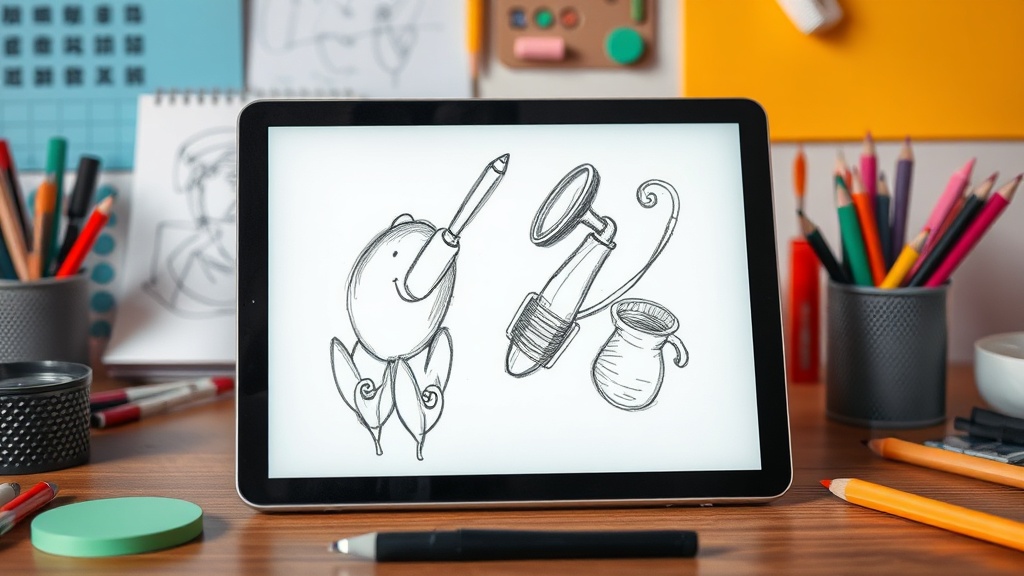
This second agent is responsible for the artistic interpretation. It takes the parsed brief and the rough sketch and generates a detailed charcoal sketch. The output aims for a level of aesthetic quality that far surpasses the original doodle. The choice of charcoal as a medium suggests a desire for a textured, nuanced, and classic artistic feel, moving beyond the clean lines of digital art towards something that mimics traditional artistic techniques.
Beyond Static Images: The Power of Editable Vectors
What elevates this project beyond a simple image-to-image AI filter is the generation of editable pen-line vectors. Many AI art generators produce raster images (like JPEGs or PNGs), which are essentially collections of pixels. While these can be visually impressive, they are difficult to modify without losing quality. Vectors, on the other hand, are based on mathematical equations that define points, lines, and curves. This means they can be scaled infinitely without pixelation and, more importantly, can be easily edited. A designer could, for instance, adjust line weights, alter curves, or change the color of individual strokes within the generated sketch.
This vector output is particularly significant for digital workflows. It means that the AI-generated sketches can be directly imported into vector graphics editors like Adobe Illustrator, Affinity Designer, or Inkscape. Users can then refine the artwork, integrate it into larger designs, or even use it as a base for further digital painting or illustration. The ability to edit the pen lines means that the AI isn't just creating a final product, but a working asset that can be manipulated and improved upon by the user, bridging the gap between AI generation and human creative control.
The developer behind the project highlights that this approach is not merely about creating aesthetically pleasing images, but about providing a tool that empowers users with limited artistic skills to produce professional-looking results. The system acts as an intelligent assistant, translating rudimentary ideas into a polished artistic form. This democratizes a certain level of artistic output, making it accessible to a wider audience.
Implications for Digital Art and Creative Workflows
The implications of such a tool are far-reaching. For aspiring digital artists, it offers a way to explore artistic concepts and generate base artwork without needing years of technical training in drawing or painting. It could serve as a powerful brainstorming tool, allowing for rapid iteration of visual ideas. For graphic designers, it presents an opportunity to quickly generate textured elements or illustrative components that can be seamlessly integrated into branding, web design, or marketing materials. The editable vector output ensures that these elements remain flexible and adaptable to various project requirements.
The underlying technology, involving parsing screenshots to generate creative briefs and then using generative AI to create artistic outputs in a specific style (charcoal sketch) with vector capabilities, is a sophisticated application of current AI advancements. The ability to control the medium and output format (vectors) is a key differentiator from many off-the-shelf AI image generators. It suggests a move towards more specialized AI tools that cater to specific creative needs and professional workflows, rather than a one-size-fits-all approach.
A genuinely surprising aspect of this development is the focus on a traditional artistic medium like charcoal, rendered through digital means. Many AI art tools aim for photorealism or distinct digital styles. By choosing charcoal, the creator taps into a rich artistic heritage while leveraging cutting-edge technology. This blend of old and new could appeal to a broad spectrum of users, from those seeking a unique aesthetic for their personal projects to professionals looking for novel ways to add texture and depth to their digital creations.
The tool's workflow – doodle, select, parse, generate – is remarkably streamlined. While the technical details of the AI models and their training data are not fully disclosed, the practical outcome is clear: a significant reduction in the effort required to translate a simple idea into a complex, editable artistic representation. What remains to be seen is the scalability of this approach to more complex artistic styles or different input devices, and how this might influence the broader landscape of digital art creation tools.