The Problem: Prompt Sprawl in AI Agent Development
The initial AI agent workflow is often a singular, well-defined prompt, coupled with a few specific tools. A single developer understands its behavior. As products mature, this simplicity erodes. New requirements emerge: a refund workflow for support, a CRM updater for sales, report generation for operations. Engineering teams layer in additional tools, browser actions, retry mechanisms, and approval gates.
The result is an "agent" that is no longer a coherent system. It becomes a tangled mess of duplicated prompts, opaque rules, ad-hoc tool descriptions, outdated runbooks, and decisions buried in Slack threads. This phenomenon, known as prompt sprawl, makes the AI product difficult to maintain, hard to test in production, challenging to review for compliance or safety, and risky to roll back when issues arise.
Prompt sprawl is not just an organizational annoyance; it's a direct impediment to scaling and ensuring the robustness of AI-powered products. When the core logic of an agent is scattered and undocumented, diagnosing failures becomes a complex detective task, and introducing new features risks unintended side effects across the entire system.
The Solution: An AI Agent Skill Registry
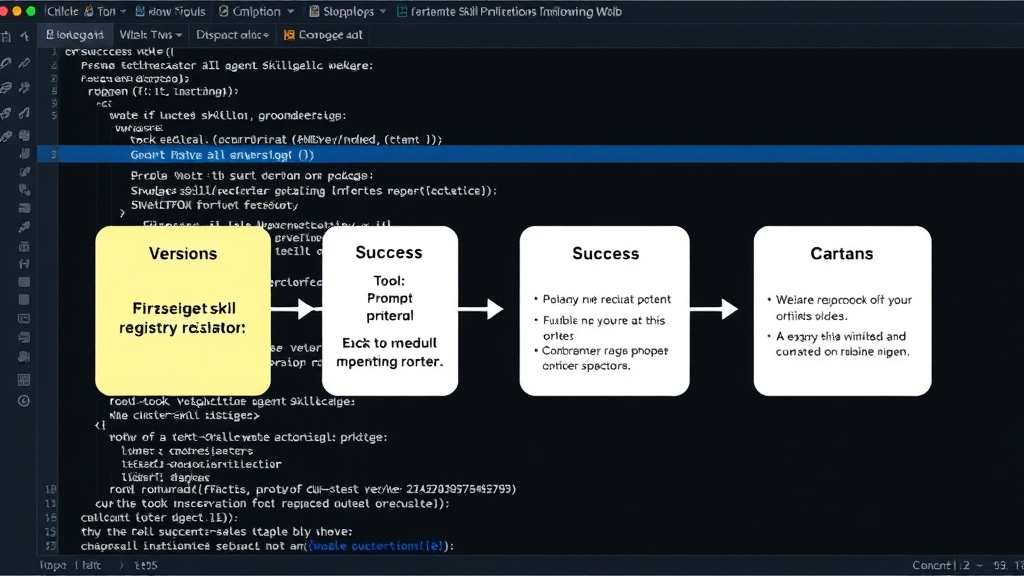
An AI agent skill registry offers a structured approach to managing agent capabilities. It provides a cleaner, more manageable unit of reuse: a versioned, testable package that clearly defines an agent's abilities. Each skill in the registry specifies:
- What the agent can do: A clear description of the task or function.
- Tools it may use: Explicitly lists the approved tools and their versions.
- Input requirements: Defines the necessary data and parameters for the skill to execute.
- Evidence of success: Outlines criteria or metrics that prove the skill executed correctly.
- Constraints/Guardrails: Specifies actions that must never be taken, preventing dangerous or undesirable outcomes.
Implementing a skill registry transforms the development process. Instead of managing monolithic, sprawling prompt files, teams can assemble agent behaviors from discrete, versioned skills. This modularity simplifies debugging, enhances reusability, and provides a clear audit trail for each component of the agent's functionality.
Building a Skill Registry Without Becoming a Platform Team
The challenge for many teams is implementing such a system without incurring the overhead of building and maintaining a full-fledged platform. The goal is to gain the benefits of structure and versioning without the complexity of a dedicated platform engineering effort. This involves selecting tools and methodologies that are lightweight and integrate smoothly into existing workflows.
A key principle is to treat skills as first-class, versioned artifacts. This means that when a skill is updated, it receives a new version number, allowing for explicit control over which version is deployed in production. This is analogous to how software libraries are versioned, providing a familiar paradigm for developers.
Consider the structure of a skill. It should encapsulate not just the prompt but also the associated tool definitions, validation logic, and success criteria. This bundling ensures that a skill is self-contained and its behavior is predictable. For instance, a "Fetch User Data" skill would include the prompt for querying a database, the specific database tool to use, the expected input schema for user IDs, and a success criterion like returning a non-empty JSON object.
Versioning and Testing Strategies
Versioning is paramount. Each skill should have a clear lifecycle, from development to staging and production. When a skill is updated, the previous version remains available, enabling rollbacks or side-by-side testing. This approach is crucial for managing the inherent unpredictability of AI models and ensuring that changes do not introduce regressions.
Testing needs to be integrated at the skill level. This involves unit tests for the prompt logic, integration tests for tool usage, and end-to-end tests that simulate real-world scenarios. For example, a skill designed to book an appointment could be tested with various valid and invalid date/time inputs, different user profiles, and edge cases like calendar conflicts. The success criteria defined within the skill package serve as the basis for these tests.
The surprising detail here is not the complexity of the skills themselves, but how a simple registry structure can tame the chaos of their proliferation. Without this, teams often resort to copy-pasting prompts and configurations, leading to inconsistencies that are nearly impossible to track.
The Impact on Workflow Reliability
By adopting a skill registry, teams can significantly improve the reliability and maintainability of their AI agent workflows. When agent behaviors are decomposed into versioned, testable skills, the overall system becomes more robust. Debugging becomes faster because issues can often be isolated to a specific skill. Deployments are safer because teams can control which versions of skills are active.
Furthermore, a skill registry fosters better collaboration. Developers can share and reuse skills, leading to faster development cycles and consistent implementation of agent capabilities across the product. It provides a common language and structure for defining what an AI agent can do, reducing misunderstandings and technical debt.
Ultimately, this approach moves AI agent development from a craft practiced by a few individuals to an engineering discipline that supports scalable, reliable AI products. It addresses the root cause of prompt sprawl, ensuring that as AI agents become more sophisticated and integrated into business processes, their underlying logic remains manageable and secure.