
The Chasm Between Demo and Deployment
Building an AI agent that performs flawlessly in a controlled demonstration is a common starting point. However, transitioning these agents into a production environment reveals a host of challenges that often go underestimated. The leap from a curated showcase to a real-world, dynamic system exposes the fragility of prototypes and the complexity of robust deployment. This gap highlights that while AI models themselves might be sophisticated, the surrounding infrastructure and operational considerations are equally critical, if not more so, for successful production AI agents.
Tool and API Reliability: The Unseen Foundation
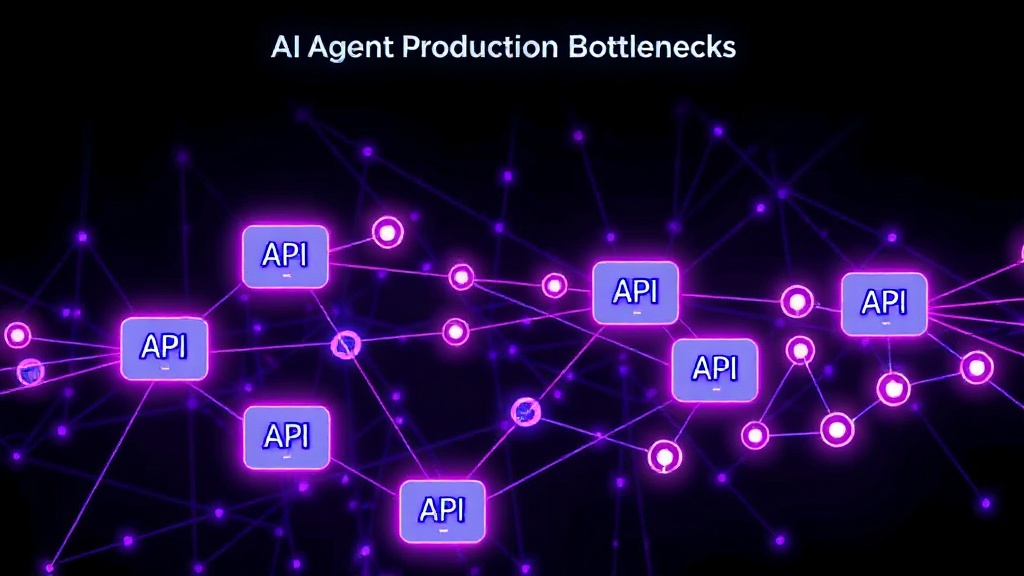
One of the most frequently cited production bottlenecks for AI agents is the reliability of the tools and APIs they depend on. In a demo, these external services might be mocked, simulated, or their availability guaranteed. In production, however, these dependencies become real-world systems subject to downtime, rate limiting, unexpected errors, and changes in their interface or behavior. An AI agent’s ability to function is directly tethered to the stability of its external connections. When an API fails, the agent fails, regardless of the intelligence of its core logic. This necessitates robust error handling, fallback mechanisms, and sophisticated monitoring to detect and react to external service degradation. The problem is exacerbated when agents rely on a complex chain of API calls; a failure in any single link can cascade and bring down the entire operation. Developers often underestimate the sheer volume of edge cases and failure modes inherent in interacting with third-party services, leading to significant production instability.
Context Management and Memory: The Agent's Short-Term and Long-Term Recall
Effectively managing context and memory is another significant hurdle. AI agents need to maintain a coherent understanding of the ongoing conversation or task, recall relevant past interactions, and access necessary information without overwhelming their processing capabilities. In production, the volume and complexity of this context can explode. Unlike a simple demo where the conversation history is short and predictable, production agents might handle lengthy interactions, multiple concurrent users, or complex, evolving datasets. Storing, retrieving, and processing this context efficiently and accurately is a major engineering challenge. Issues arise from:
- Context Window Limitations: Large Language Models (LLMs) have finite context windows. Agents must intelligently summarize, prune, or retrieve relevant parts of the history to stay within these limits.
- Memory Retrieval Accuracy: Vector databases and other memory solutions can struggle with retrieving the *most relevant* information, leading to agents acting on outdated or incorrect data.
- State Management: Keeping track of the agent's internal state, user preferences, and task progress across multiple turns and sessions is complex, especially in distributed systems.
What was manageable in a few-shot demo becomes a significant architectural problem when scaled to thousands of users and interactions. The nuance of what information is crucial versus what can be discarded is difficult to perfect, leading to agents that either forget key details or become bogged down by irrelevant data.
Authentication, Permissions, and Security: The Gatekeepers of Access
When agents move from a sandbox to production, they often need to interact with sensitive data or perform actions on behalf of users. This introduces critical requirements for authentication, authorization, and fine-grained permissions. Ensuring that an AI agent only accesses the data it's permitted to and only performs actions it's authorized to is paramount. This involves complex integration with existing identity and access management (IAM) systems. Developers often underestimate the granular nature of permissions required. For instance, an agent might be allowed to read customer emails but not delete them, or access financial records but only for specific reporting tasks. Implementing these controls securely and efficiently, while also ensuring the agent can dynamically request necessary permissions, is a substantial engineering effort. The risk of an agent misinterpreting its instructions and performing unauthorized actions is a constant threat, demanding rigorous security protocols and auditing capabilities.
Evaluation, Hallucinations, and Ensuring Accuracy
The problem of AI hallucinations – where models generate plausible but factually incorrect information – becomes a critical production issue. While hallucinations might be amusing or easily dismissed in a demo, they can have serious consequences in production, leading to misinformation, poor decision-making, or security vulnerabilities. Establishing robust evaluation metrics and continuous monitoring to detect and mitigate hallucinations is essential. This is more complex than simple accuracy checks; it requires evaluating the factual correctness, relevance, and safety of the agent's outputs in real-time. Developers often underestimate the difficulty of creating comprehensive evaluation frameworks that cover the vast range of potential outputs and failure modes. The iterative process of identifying hallucinations, understanding their root cause, and retraining or fine-tuning models, or implementing guardrails, is a continuous cycle.
Cost, Latency, and Operational Efficiency
For any production system, cost and performance are key metrics. AI agents, particularly those powered by large language models, can incur significant operational costs due to API calls, compute resources, and data storage. Latency is also a major concern; users expect near-instantaneous responses, and slow agents lead to poor user experience and abandonment. Optimizing agents for cost and speed involves a multi-faceted approach: choosing the right models for the task, efficient prompt engineering, caching strategies, and potentially fine-tuning smaller, specialized models. Developers often underestimate the cumulative cost of many small operations or the impact of even slight increases in latency across thousands of daily interactions. Balancing the desire for sophisticated capabilities with the need for economic viability and user responsiveness is a constant trade-off.
Observability and Human-in-the-Loop Workflows
Understanding what an AI agent is doing, why it made a particular decision, and how it's performing requires sophisticated observability tools. In production, simply knowing that an agent failed is not enough; engineers need detailed logs, traces, and metrics to diagnose issues. This includes tracking API calls, model confidence scores, context states, and user interactions. Furthermore, integrating effective human-in-the-loop (HITL) workflows is crucial for tasks requiring human judgment, verification, or correction. Designing these workflows to be efficient and non-disruptive, while still providing valuable oversight, is a complex UX and system design problem. The initial underestimation often lies in the sheer amount of data required for effective monitoring and the design of seamless human intervention points that don't slow down the overall process.
Integration with Legacy Systems
Finally, integrating AI agents with existing, often legacy, enterprise systems presents a unique set of challenges. These systems may have outdated APIs, rigid data formats, or complex business logic that is difficult for an AI to navigate or interact with. The impedance mismatch between modern AI architectures and older enterprise technology stacks can lead to significant development delays and unforeseen integration issues. Bridging this gap often requires custom middleware, extensive data transformation, and a deep understanding of both the AI agent's capabilities and the legacy system's constraints. The surprise here is often the sheer inertia and technical debt embedded within these older systems, which can prove far more formidable than anticipated.