
The Evolution of App Feedback Analysis
Identifying software bugs and crashes is a critical part of the development lifecycle. Many tools exist to surface these issues, but often they stop at the symptom. Ashish Mishra, a developer, faced this limitation with his AppPulse CLI tool. AppPulse aggregates app reviews from platforms like Google Play and the App Store, correlates them with crash data from services like Sentry and Firebase, and uses a Large Language Model (LLM) to classify feedback into categories such as bug reports, crashes, feature requests, performance issues, and praise. While useful for understanding the *what* of user problems, it didn't answer the crucial *where* and *how* within the codebase.
The initial pipeline provided a solid foundation: it could tell a developer, "You have a bug related to user login." However, the next logical step—understanding the specific lines of code responsible and how to fix them—was missing. This gap is common in developer workflows; bug trackers highlight problems, but the journey from reported issue to root cause analysis can be manual and time-consuming, often involving deep dives into logs and codebases. Mishra's goal was to automate this deeper analysis, transforming raw feedback into actionable code-level insights.
Integrating AI for Deeper Code Understanding
To bridge this gap, Mishra extended his pipeline by integrating a PydanticAI agent. This agent was designed not just to identify problems but to explore the codebase, locate the root cause of reported bugs, and suggest specific code modifications. This represents a significant shift from passive reporting to active code-level problem-solving powered by AI.
The core of this enhancement lies in the agent's ability to interact with the codebase. Think of it less like a static code linter and more like a highly skilled junior developer who can be given a bug report and then asked to navigate the project's file structure, read relevant code sections, and deduce the most probable source of the error. This involves techniques for code context retrieval and analysis, enabling the AI to understand the relationships between different code modules and identify logical flaws or unintended side effects that lead to bugs.
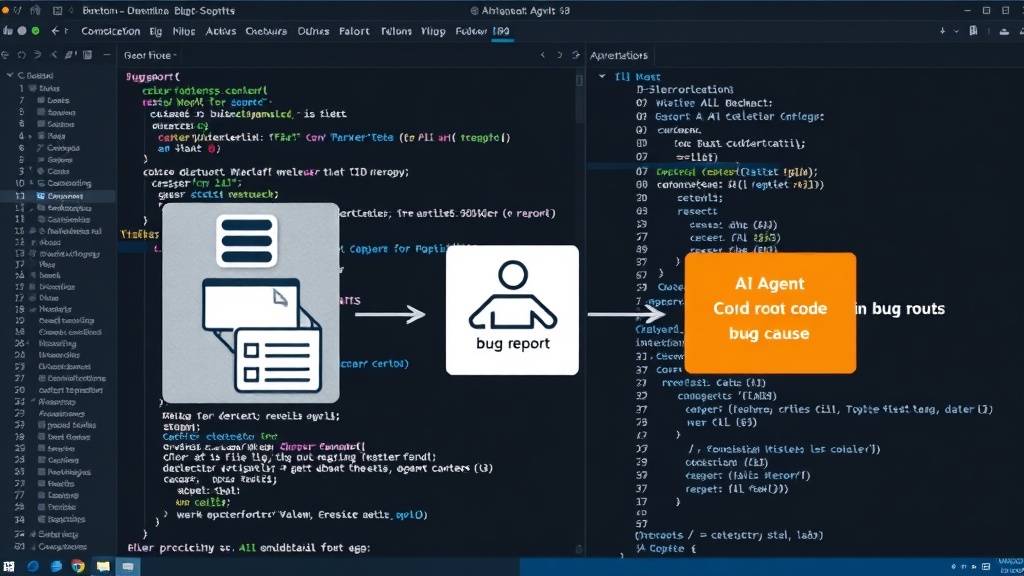
The process begins with the classified bug report from AppPulse. This report is fed to the PydanticAI agent. The agent then uses its integrated tools to perform a simulated code review focused on the reported issue. This could involve searching for keywords related to the bug, analyzing function calls, inspecting variable states, and cross-referencing with known bug patterns. The outcome is a precise identification of the problematic code segment and a proposed solution, moving the developer directly from "There's a bug" to "The bug is in `user_auth.py` at line 157, and it's caused by an uninitialized variable; change `var = None` to `var = ''`."
Pluggable Architecture for Flexible AI Backends
A key architectural decision was making the analysis engine pluggable. This allows the system to leverage different AI models and their specialized capabilities for code analysis. Currently, the pipeline supports backends like Grok Build, Claude Code, and OpenAI Codex. This flexibility is crucial because the landscape of AI code analysis tools is rapidly evolving. By adopting a pluggable architecture, Mishra ensures that the pipeline can adapt to new, more powerful, or more specialized models as they become available, without requiring a complete system overhaul.
Each backend has its strengths. Some might excel at understanding complex algorithms, others at identifying security vulnerabilities, and yet others at generating concise code patches. A pluggable system means that if a new model emerges that offers superior performance for a specific type of bug or a particular programming language, it can be seamlessly integrated. This also allows for experimentation; developers can test different models against their codebase to find the optimal balance of accuracy, speed, and cost.
The process of plugging in a new backend involves defining an interface that the AI agent can use to interact with the model. This interface handles tasks such as sending code snippets and prompts to the AI, receiving and parsing its responses, and integrating the suggested fixes back into the analysis workflow. It's akin to having a universal adapter that can connect to various power sources, ensuring the system remains operational regardless of the specific AI technology powering it.
Challenges and Future Directions
The journey wasn't without its hurdles. Integrating AI for code analysis, especially for root cause identification, is complex. Challenges can include the AI misinterpreting code, hallucinating fixes, or struggling with large, intricate codebases. The accuracy of the AI's suggestions is paramount; a misleading root cause analysis can be more detrimental than no analysis at all. Developers must also critically evaluate the AI's output, using it as a powerful assistant rather than an infallible oracle.
What nobody has addressed yet is the long-term impact of such AI-driven code analysis on developer skill sets. Will reliance on AI for root cause identification lead to a degradation of manual debugging skills? Or will it free up developers to focus on higher-level architectural challenges and innovation? The current approach focuses on augmenting the developer, providing faster insights. The next phase will likely involve more sophisticated AI agents that can not only find bugs but also proactively suggest architectural improvements or refactorings based on usage patterns and performance metrics, moving towards an AI-assisted software design process.
The immediate next steps involve refining the accuracy of the AI agents, expanding the range of supported programming languages and frameworks, and improving the user interface for presenting the AI-generated insights. The ultimate goal is to create a feedback loop so tight that developers receive not just bug reports, but also precise, actionable code-level solutions, dramatically accelerating the development and maintenance cycle.