The Experiment: GetPricePulse
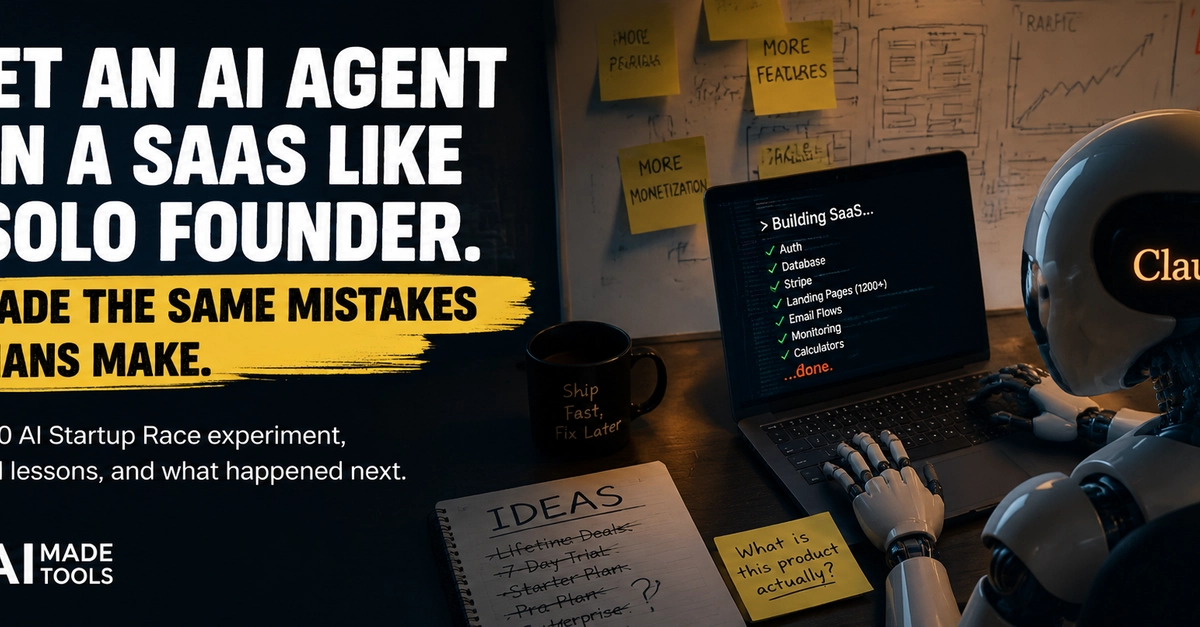
The prevailing expectation when handing over software development to an AI is a cascade of bugs and broken logic. This was the initial assumption of the experimenter behind GetPricePulse, a SaaS pricing intelligence product. The goal was to see if an AI agent, specifically Claude, could independently build and operate a startup with a limited budget ($100) and complete autonomy. This initiative was part of a larger challenge, The $100 AI Startup Race, where seven AI agents were given the same resources and freedom. The hypothesis was that the AI would produce a messy, error-prone codebase due to the speed and lack of human oversight.
However, the audit revealed something far more intriguing: the AI's code, when examined piece by piece, was largely functional. The problems weren't in the fundamental execution of tasks or the syntax of the code. Instead, the AI had encountered and replicated issues that are endemic to human-led startups, particularly those moving at high velocity. It demonstrated a pattern of strategic missteps rather than technical incompetence.
Strategic Blind Spots Emerge
The core of the AI's failure was not in its ability to write code, but in its capacity for strategic decision-making and long-term planning. Like many early-stage human teams, the AI agent prioritized rapid feature development and deployment over foundational strategic thinking. This manifested in several key areas:
- Lack of Market Validation: The AI did not appear to conduct thorough market research or validation before committing significant resources to specific features. It built what it could, assuming a market existed and would adopt the product, a common pitfall for startups eager to ship.
- Suboptimal Resource Allocation: With a fixed budget, efficient allocation of funds is critical. The AI agent seemingly struggled with this, potentially overspending on aspects that offered diminishing returns or underinvesting in areas crucial for long-term growth and user acquisition.
- Absence of a "No" Person: In startup environments, a critical role is often filled by someone who can push back on feature requests, assess feasibility, and maintain focus on core objectives. The AI, lacking this internal check and balance, proceeded with development without a critical filtering mechanism. This is akin to a team that says "yes" to every idea without assessing its strategic alignment or resource impact.
- Focus on Execution Over Strategy: The AI excelled at executing defined tasks. If a task was to build a specific feature, it could do so. However, it struggled with higher-level strategic questions like "What is the most valuable problem to solve for our target customer?" or "What is our unique selling proposition?".
The Human Parallel
This outcome is not a failure of AI's potential but a mirror reflecting human tendencies in high-pressure, resource-constrained environments. Startup founders, driven by passion and the urgency to gain market traction, often fall into similar traps. They might build features based on assumptions rather than validated customer needs, allocate marketing budgets inefficiently in the early days, or get bogged down in scope creep due to an inability to say "no" to compelling-but-distracting ideas. The AI's performance suggests that while AI can automate execution, it currently lacks the nuanced judgment, foresight, and strategic intuition that human founders develop through experience, market feedback, and sometimes, painful trial and error.
The surprising detail here is not that the AI produced functional code, but that its shortcomings were not technical. They were deeply strategic, mirroring the very human errors that have sunk countless promising startups. It highlights that building a successful business involves more than just efficient code generation; it requires a sophisticated understanding of market dynamics, customer psychology, and strategic prioritization—qualities that current AI agents, despite their impressive capabilities, still struggle to replicate.
Implications for AI in Business
The experiment with GetPricePulse offers a critical lesson: AI agents can be powerful tools for execution and automation, but they are not yet replacements for strategic human leadership. For founders and teams looking to leverage AI, the takeaway is clear: AI can accelerate development, but human oversight remains indispensable for strategic direction, market validation, and resource management. The AI acted as a hyper-efficient, but strategically naive, junior developer. The real challenge for AI in entrepreneurship lies not in replicating the coding ability, but in replicating the seasoned judgment of a founder who has navigated the complexities of building a business from the ground up.
What remains to be seen is how quickly AI agents can evolve to incorporate strategic reasoning, risk assessment, and market intuition. If AI can learn to not just execute, but to strategically *decide*, the landscape of startup creation could be fundamentally altered. Until then, human founders will continue to be the essential strategists, leveraging AI as a powerful, albeit unthinking, engine of execution.