The Uncanny Valley of AI Web Design
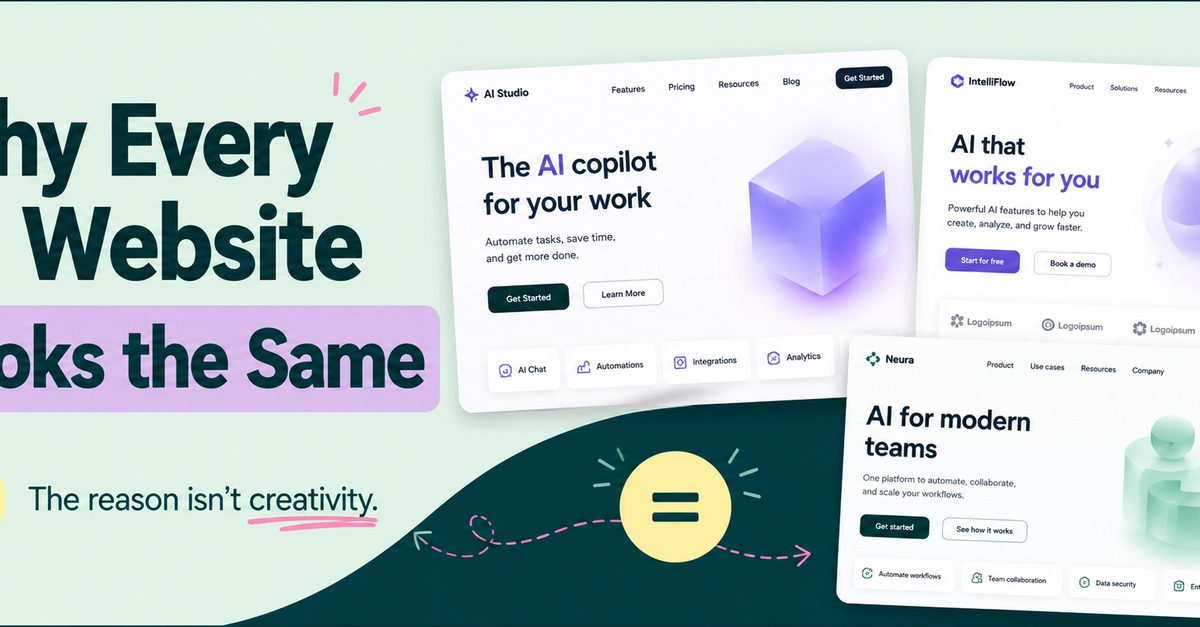
Scroll through any showcase of recently launched websites, especially those leveraging AI for their creation, and a pattern emerges. It’s a familiar landscape: oversized, centered hero headlines bathed in purple-to-blue gradients, rounded cards neatly arranging feature lists, and floating dashboard mockups. Even when using different AI website builders, the output for similar concepts can be strikingly alike. This isn't necessarily a limitation of AI's creative potential; rather, it stems from the foundational elements these tools are trained on, the default components they employ, and the way users interact with them through prompts.
The common thread isn't a lack of imagination from the AI, but a reflection of the data it has learned from. These models are trained on vast datasets of existing websites. When asked to generate a website for, say, a SaaS product, the AI draws from the most prevalent examples it has encountered. This often means defaulting to established, successful design paradigms that have proven effective in the past. Think of it less like a blank canvas and more like an exceptionally talented mimic that excels at replicating popular styles. The very success of these patterns means they are overrepresented in training data, leading the AI to favor them.
Furthermore, AI website builders are often designed with a specific set of components and layouts in mind. These are curated to be generally appealing and functional, but they also contribute to a standardized aesthetic. Developers of these tools select pre-designed blocks – hero sections, testimonial carousels, pricing tables, contact forms – that are known to work well. The AI’s task then becomes assembling these blocks in a coherent manner, guided by user input. This component-driven approach, while efficient, inherently limits the design space and encourages a degree of uniformity.
The prompting process itself also plays a significant role. Users often provide high-level descriptions or keywords. The AI interprets these prompts based on its learned associations. If a prompt mentions "modern," "sleek," or "professional," the AI is likely to select design elements that align with the most common interpretations of these terms in its training data – which, again, often leads back to the gradient-heavy, card-based layouts.
Breaking the Mold: Strategies for Differentiation
To escape this homogenization, creators need to push beyond the defaults. This requires a more intentional approach to prompting and a willingness to deviate from the AI's initial suggestions.
1. Granular and Specific Prompting
Instead of broad terms, provide detailed instructions. Specify color palettes beyond simple gradients, mention typography styles (e.g., "geometric sans-serif," "handwritten script"), describe layout structures (e.g., "asymmetrical grid," "two-column asymmetrical layout"), and even reference specific aesthetic movements (e.g., "brutalist influence," "art deco elements"). The more precise the instructions, the more likely the AI is to generate something unique. For instance, instead of asking for a "tech website," try "a minimalist website for a cloud storage startup, using a muted teal and charcoal color scheme, with generous whitespace and a focus on large, legible typography for feature descriptions, avoiding typical SaaS dashboard mockups."
2. Iterative Refinement and Customization
Treat the AI's first output as a starting point, not a final product. Most AI website builders allow for significant customization. This means manually adjusting colors, fonts, spacing, and imagery. Don't be afraid to swap out AI-generated images for custom graphics or photography that better reflects your brand. Rearrange sections, change the order of elements, and modify the content. The AI can provide the structure, but human curation is key to infusing personality and uniqueness.
3. Leveraging Unconventional Components
Explore options that go beyond the standard hero-banner-features-testimonials structure. If the AI builder offers more experimental layouts or interactive elements, experiment with them. Consider incorporating unique navigation patterns, custom illustrations, or even unexpected media types like embedded audio or video backgrounds (used judiciously). If the AI is limited, be prepared to hand-code or integrate custom elements to break the visual monotony.
Consider the AI less as a fully autonomous designer and more as an advanced assistant. Its strength lies in rapid iteration and pattern recognition. Your role is to provide the vision, the specific constraints, and the final polish. If you prompt for "websites that look like they were designed in the early 2000s with modern web standards" or "a website that prioritizes negative space and uses only monochrome photography," the AI will have to work harder to synthesize something novel, potentially leading to a more distinctive outcome.
4. Understanding the Underlying Data
The core issue is that AI models are trained on the web as it is. If the web is increasingly filled with similar-looking AI-generated sites, the AI will learn and perpetuate those trends. To truly innovate, one might need to fine-tune models on more niche or historically significant design archives, or explicitly prompt the AI to avoid common contemporary patterns. This requires a deeper understanding of both design history and the limitations of current AI training data.
What nobody has addressed yet is the long-term impact of this design homogeneity on user trust and brand perception. If every AI-powered startup looks like a slightly different version of the last, how do users begin to differentiate between genuine innovation and marketing gloss?
The Future of Distinctive AI Web Design
Building a website that stands out in the age of AI requires a conscious effort to inject human creativity and intentionality into the process. It means viewing AI tools not as magic buttons that produce finished products, but as powerful collaborators that can accelerate the creation of unique digital experiences. By mastering prompt engineering, embracing customization, and understanding the limitations of AI's learned patterns, developers and designers can move beyond the ubiquitous AI aesthetic and craft websites that are both functional and distinct.